Saturn frequency in Hz: where 147.85 Hz comes from
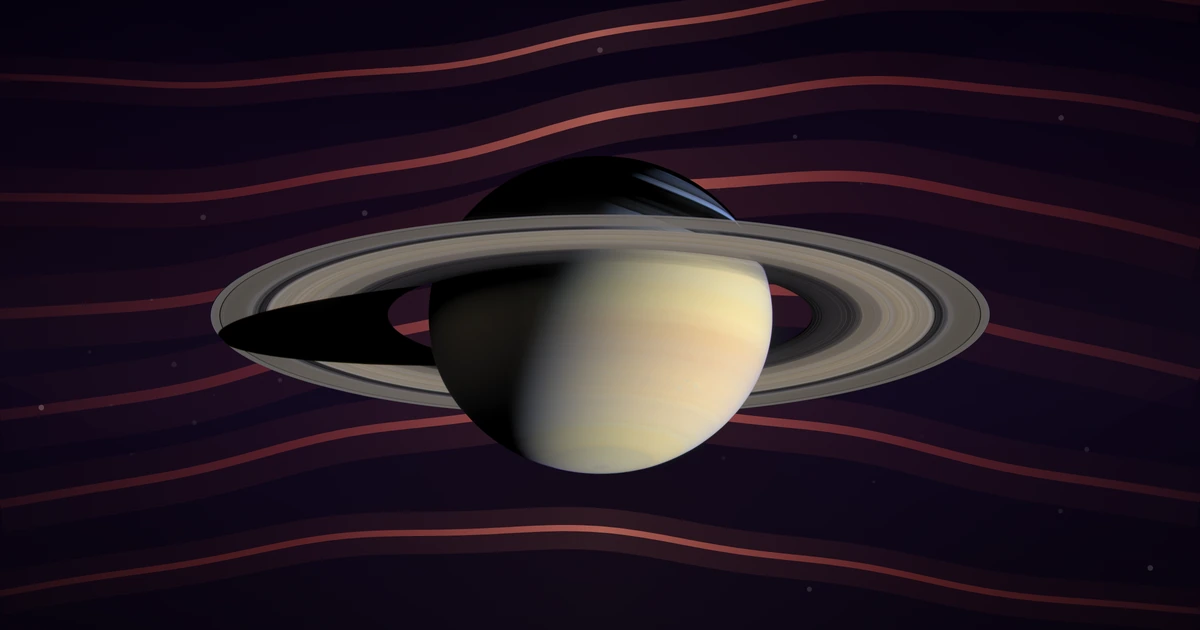
Saturn's frequency is 147.85 Hz, the tone Hans Cousto's cosmic octave gives the planet. Take its orbit of the Sun, 10,759.21 days or about 29.46 years, as one very slow vibration and double it 37 times: it becomes 147.85 Hz, close to a D. It is arithmetic, not a sound from Saturn, and no published study has tested listening to it.
Ready to play Saturn 147.85 Hz
Give yourself time to plan at your own pace.
What is the Saturn frequency in Hz?
The Saturn frequency is 147.85 Hz, a low tone close to the D below middle C. The number comes from the tables of planetary tones that the Swiss mathematician and music researcher Hans Cousto began in Munich in 1978 and called the cosmic octave. Most Saturn tones you can play online, Harmonance's included, use it.
Harmonance's own page links the tone with structure, patience and steady attention, and offers it for planning or quiet reflection. Those associations come from astrology, not from a measurement. The number itself is plain arithmetic, and anyone can redo it.
How does Saturn's orbit become 147.85 Hz?
Saturn's orbit becomes 147.85 Hz by doubling, 37 times over. Cousto starts from the time Saturn takes to circle the Sun once, measured against the stars, which his tuning tables give as 10,759.21 days, about 29.46 years. Read as a vibration, that is one cycle every 929,595,744 seconds, the days multiplied by the 86,400 seconds in each: a frequency of 0.0000000010757 Hz, about a billionth of a hertz.
Doubling a frequency raises it by one octave, the same note higher up. Doubling this one 37 times multiplies it by 137,438,953,472 and gives 147.848 Hz, which rounds to 147.85 Hz. On a piano tuned to A at 440 Hz the nearest note is the D at 146.83 Hz, and 147.85 Hz sits 11.93 cents above it, where a cent is a hundredth of a semitone. Cousto's tables also give the tuning that makes the two meet: set an instrument's A to 443.04 Hz instead of 440 Hz, and its D lands on 147.85 Hz.

The ladder runs on past hearing in both directions. Thirty doublings give 69.30 beats a minute, which Cousto lists as Saturn's tempo; 79 give about 650 trillion hertz, a frequency of visible light, the blue at 461 nanometres. Only octaves 35 to 44, from 36.96 to 18,924.56 Hz, fall inside the range of human hearing, and 147.85 Hz is the third of them. The guide to planetary frequencies works the same method through every planet, the Earth and the Moon.
Which Saturn cycle gives which tone?
Each of Saturn's rhythms gives its own tone, and the orbit is only the best known. The same doubling works on any cycle, so the table below takes Saturn's orbit, its synodic period and its day from NASA's Saturn fact sheet, sets them beside Cousto's orbit, and doubles each one until it can be heard.
| Cycle | Tone |
|---|---|
| Orbit, Cousto: 10,759.21 days | 147.85 Hz, D (37 doublings) |
| Orbit, NASA today: 10,755.699 days | 147.90 Hz, D (37 doublings) |
| Tropical orbit, NASA: 10,746.940 days | 148.02 Hz, D (37 doublings) |
| Synodic period, NASA: 378.09 days | 131.48 Hz, C (32 doublings) |
| Day, NASA's radio period: 10.656 hours | 218.67 Hz, A (23 doublings) |
| Day, from Cassini's rings: 10 h 33 min 38 s | 220.65 Hz, A (23 doublings) |
The orbit rows show how little the tone depends on which figure is chosen. NASA's fact sheet gave Saturn's orbit as 10,759.22 days in 2010, Cousto's figure to within a hundredth of a day, and gives 10,755.699 days today. The newer figure lands at 147.90 Hz, about half a cent higher, far too small a step for anyone to hear. Cousto's tables expect exactly this: "If science obtains more detailed data about a distant space object, it may lead to a more accurate determination of the orbital period, resulting in slightly different octave frequencies."
The tropical orbit is Saturn's return to the same place measured from the spring equinox, the point the zodiac of Western astrology counts from. It is a little shorter, 10,746.940 days or about 29.42 years, and it gives 148.02 Hz, two cents above Cousto's tone. The synodic period is the time from one opposition to the next, when Earth passes between the Sun and Saturn and Saturn is up all night; 32 doublings make its 378.09 days 131.48 Hz, close to a C.
Saturn's day was the hardest of its cycles to pin down, because the planet has no solid surface to watch turn. NASA's fact sheet still lists 10.656 hours, its System III period, close to the 10:39:23 that Voyager's data gave in 1981, and that day gives 218.67 Hz, 10.5 cents below the A at 220 Hz; Cousto's table of planetary days gives the same 218.67 Hz. In 2019 NASA's Jet Propulsion Laboratory reported an answer read from waves in Saturn's rings, measured by the Cassini spacecraft: "It's 10 hours, 33 minutes and 38 seconds." Doubled 23 times, that day is 220.65 Hz, within 5.1 cents of the A. Earlier estimates, the laboratory notes, ranged from 10:36 to 10:48.
Is NASA's sound of Saturn the same as 147.85 Hz?
No. NASA's sounds of Saturn are radio waves made audible, and they sit far higher than 147.85 Hz. Sound cannot cross the near emptiness of space, but radio waves can, and Saturn sends out strong radio emissions tied to its auroras. Cassini recorded them, and the team behind its radio and plasma wave instrument at the University of Iowa turned them into audio. As they explain, the emissions lie well above the range of hearing, so "we have shifted them downward by a factor of 44", and the recording plays 22 times faster than real time.
Those emissions, called Saturn kilometric radiation, cover "a typical frequency range from about 3 kHz to 1.2 MHz, peaking between 100 and 400 kHz", in the words of a study of Cassini's first years at Saturn (Lamy and others, 2008). Divided by 44, that peak lands between about 2,270 and 9,090 Hz, four to six octaves above 147.85 Hz. So the two have nothing in common but the planet: one is a real signal from Saturn, moved into hearing; the other is arithmetic on its orbit.
The recording NASA publishes as the "Sound of Saturn" is a third thing again: a recording of plasma waves moving from Saturn to its moon Enceladus, made by the same instrument two weeks before Cassini's mission ended in 2017. NASA's page says researchers "converted the recording of plasma waves into a 'whooshing' audio file that we can hear". None of these recordings is 147.85 Hz, and none of them is a pure tone.
What does 147.85 Hz sound like?
147.85 Hz is a low, smooth tone at about the pitch of the D below middle C. Halve it and you get its lower octaves, 73.93 and 36.96 Hz; double it and you get 295.70, 591.39 and 1,182.78 Hz, the same note higher up. The 147.85 Hz page plays it in two ways, and we measured both from the page's own audio files.

| Octave band | Tone alone | Strings |
|---|---|---|
| 1,182.8 Hz, three octaves up | 0% | 2.5% |
| 591.4 Hz, two octaves up | 0% | 16.5% |
| 295.7 Hz, one octave up | 0.5% | 45.6% |
| 147.85 Hz, the tone itself | 99.5% | 29.5% |
| 73.93 Hz, one octave down | 0% | 5.7% |
| 36.96 Hz, two octaves down | 0% | 0% |
Download the measurements (CSV)
With Strings off, the page plays the tone on its own, as a loop of 20 seconds. It is close to a pure sine: two faint overtones sit above it, at 295.7 Hz, 23.1 dB quieter, and at 443.55 Hz, 34 dB quieter.
With Strings on, most of the sound moves above the tone. The strings play notes of the D major scale, the scale of the tone's own D, and their eight strongest lines are G at 98.8 Hz, A at 111.1 Hz, D at 147.9 Hz, G at 197.7 Hz, the strongest of all, A at 222.3 Hz, E at 332.2 Hz, F sharp at 370.5 Hz and A at 444.1 Hz. The exact 147.85 Hz tone still plays underneath, 35.4 dB below the music. A high tone works the other way round: the guide to 963 Hz measured nearly all of its strings below the tone, while Saturn's tone is low enough that the music rises above it.
Why is Saturn linked with Capricorn and Aquarius?
Saturn is linked with Capricorn and Aquarius because Ptolemy's Tetrabiblos, an astrology handbook written in Greek in the second century, gave it those two signs as its houses. Ptolemy describes Saturn's nature as "chiefly to cool and, moderately, to dry", because it is the planet farthest from the Sun's heat. In his scheme the two signs of high summer went to the Sun and the Moon, and Saturn, the coldest planet and the farthest from both, took the two opposite them in midwinter, Capricorn and Aquarius, "with the additional reason that these signs are cold and wintry".
Cousto kept the old picture. His German page on Saturn, from his book Die Töne der Kosmischen Oktave, calls the planet "kosmischer Kontrolleur", the cosmic ticket inspector, and says its transits are like an inspector coming down the train: "Pech für Schwarzfahrer!", bad luck for fare dodgers. He gives it Capricorn "seit alters her", since ancient times, and credits the tone with furthering concentration and the process of becoming aware. That is his reading, offered without a study, and no study has tested it since.
Modern astrology adds the Saturn return. In Wikipedia's summary, "a Saturn return is an astrological transit that occurs when the planet Saturn returns to the same position that it occupied at the moment of a person's birth", which comes round at roughly 29.5-year intervals, near the ages of 29, 59 and 88. Since the zodiac is counted from the equinox, the return follows the tropical orbit, the one that gives 148.02 Hz. Harmonance's Capricorn and Aquarius pages both play the Saturn tone, as symbolism to listen with, not a rule for anyone's life, and the guide to astrology and frequencies explains how signs, planets and tones connect.
What have listeners written about the Saturn tone?
Listeners under Harmonance's Saturn videos on YouTube have written very different things. Under the pure tone video, one wrote:
It is too heavy. I feel sick
Another wrote an affirmation in Arabic, shown here with our translation:
اسمح لزحل ان يكون معلمي الحكيم وليس عبئي الثقيل ❤❤❤
In English: "I allow Saturn to be my wise teacher, and not my heavy burden."
A third found it more of a ride than a weight, with an emoji of a roller coaster:
It feels like a 🎢
And under the channel's other Saturn video, someone wrote simply:
Channelling Saturn on this one
Four comments are four people's experiences, not a finding, and the first is a fair warning. If 147.85 Hz feels heavy, turn it down, stop, or try it with Strings on, where most of the sound sits above the tone. Everyone hears it in their own way.
Is there research on listening to 147.85 Hz?
No published study has tested listening to 147.85 Hz. PubMed, the main index of medical research, holds no record for "147.85 Hz"; its four records for "cosmic octave" are about other things, such as aircrew hearing and astronomy instruments. Europe PMC, a wider index, returns nothing for either phrase, or for the Saturn frequency and music together. So what people describe for the Saturn tone, from steadiness to Cousto's concentration, comes from tradition and personal experience, not from research.
Research on music in general is further along, but it is still early. The US National Center for Complementary and Integrative Health sums it up:
However, because much of the research on music-based interventions is preliminary, few definite conclusions about their effects have been reached.
None of that research used planetary tones. If you listen to 147.85 Hz, what you notice is yours to weigh: it is not an effect anyone has measured.
How do you listen to 147.85 Hz on Harmonance?
Press play on the 147.85 Hz Saturn page. With Strings off it plays the tone alone; switch Strings on beside the player, or open the page with Strings already on, and evolving strings play around a quiet 147.85 Hz tone. Nothing plays until you press play, and no account is needed.
No study sets a length for 147.85 Hz. The Saturn page suggests fifteen to twenty minutes at a modest volume, under a serious piece of thinking, and switching to another tone if the steadiness starts to feel heavy. Keep the volume comfortable whatever you choose: loud sound is the one listening risk that is well established. The same page from the National Center for Complementary and Integrative Health warns that "listening to music at too high a volume can contribute to noise-induced hearing loss", and the World Health Organization's safe listening advice is that "you can safely listen to a sound level of 80dB for up to 40 hours a week", with your device at no more than 60% of its maximum volume.
In Harmonance Studio you can set Saturn beside other tones and shape your own mix. The planetary collection plays every planet's tone, and the astrological collection pairs the tones with the signs. Saturn also sits on two feelings pages, Want to feel grounded and Overthinking, for its quiet, even character. For the Earth's own year as a tone, 136.10 Hz, which Cousto named Om, read the guide to the Om frequency, and for what research on sound has and has not shown, the science of sound healing.
Sources and limits
The number rests on Cousto's tables and NASA's fact sheet, read in their original form, and the arithmetic is worked again here from both. The astrology is quoted from Ptolemy in the Loeb translation and from Cousto's own page, as tradition, not evidence. The day of 10 hours, 33 minutes and 38 seconds is one team's result, read from models of Saturn's interior that match the waves in its rings, and NASA's sheet still lists the older radio period. No study of listening to 147.85 Hz turned up in PubMed or Europe PMC, so none is reported. The listeners' words come from public comments under Harmonance's own videos, quoted whole and without names, and the measurements of the 147.85 Hz page are Harmonance's own, made from the page's audio files.
- Hans Cousto, tuning data of the planets (Planetware, English edition): Saturn's orbit, its octaves, its note and its tuning.
- Hans Cousto, Saturn, from Die Töne der Kosmischen Oktave (Planetware, in German): the cosmic inspector, Capricorn and the tone's effect in his words.
- NASA Space Science Data Coordinated Archive, Saturn fact sheet: the orbit, the synodic period and the day today.
- The same NASA fact sheet as the Internet Archive saved it in 2010: the orbit as 10,759.22 days.
- NASA Jet Propulsion Laboratory (2019), Scientists Finally Know What Time It Is on Saturn: the day from the rings.
- University of Iowa, The Eerie Sounds of Saturn's Radio Emissions: how Cassini's radio recording was made audible.
- Lamy, Zarka, Cecconi, Prangé, Kurth and Gurnett (2008), Saturn kilometric radiation: average and statistical properties, in the Journal of Geophysical Research: the emission's frequency range.
- NASA Science, Sound of Saturn: Radio Emissions of the Planet and Enceladus: plasma waves converted into audio.
- Ptolemy, Tetrabiblos, Book 1, translated by F. E. Robbins (Loeb Classical Library, 1940), on LacusCurtius: Saturn's nature and its houses.
- Wikipedia, Saturn return: the astrological transit and its interval.
- Comments under Harmonance's 147.85 Hz Saturn video, quoted without names.
- A comment under Harmonance's other Saturn video, quoted without the name.
- National Center for Complementary and Integrative Health, Music and Health: the state of music research, and loud listening.
- World Health Organization, safe listening: weekly limits and device volume.
Tones to play while you read
Related guides
111 Hz benefits and the ancient chamber story
111 Hz benefits, checked: the angel number behind the tone, the stone chambers that ring near 110 Hz, and what a pilot found when 30 adults listened.
174 Hz benefits: the claims and what is known
174 Hz benefits, checked: the comfort and natural anaesthetic claims, where the number came from, and how 37 listeners rated the lowest Solfeggio tone.
174 Hz, 417 Hz and 741 Hz played together
174 Hz 417 Hz 741 Hz played together: why the three Solfeggio tones sit smoothly in the ear, where the numbers come from and what has been studied.
Just be curious. This is not a medical device or medical advice. For any health concern, please speak to your doctor.