Guide
Plain-language context
This is a plain guide to what science can reasonably say about sound, music and listening, and what it cannot say about any single exact frequency. The aim is to give you a steady reading frame so you can enjoy a listening practice without being misled by overconfident claims.
What acoustics actually describes
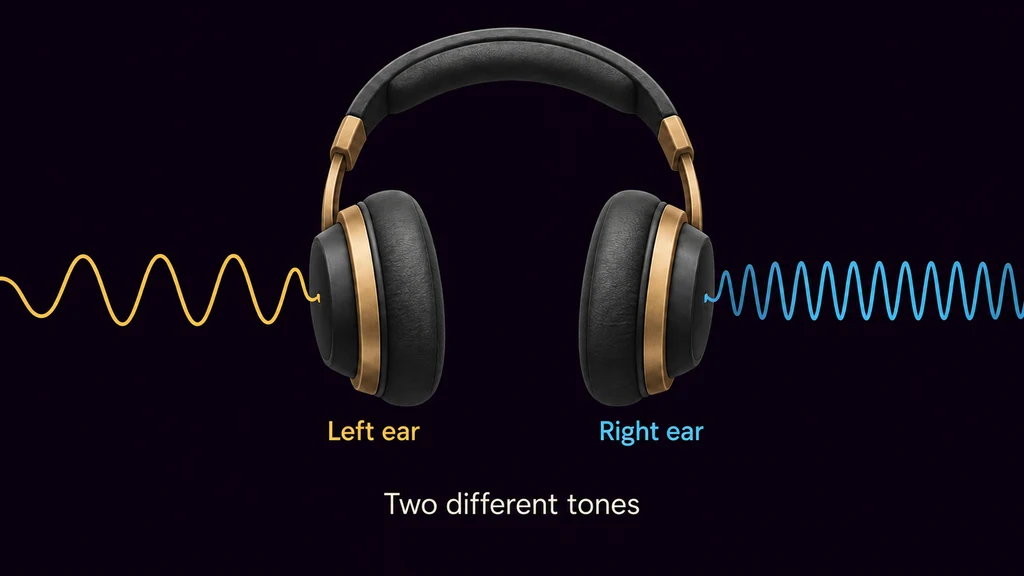
Acoustics is the study of how vibrations travel and how the ear and brain process them. Much of it is straightforward and useful: sustained low frequencies feel rounder and steadier, higher frequencies feel brighter and more alert, and the same recording feels different in a hard room than a soft one. Acoustics also describes beating, where two close frequencies create a slow pulse, which is the basis of binaural beats. For more on that technique, see binaural beats versus isochronic tones.
What research can and cannot say
Some general findings are reasonably well supported. Slow, predictable music tends to lower heart rate and breathing rate. Chosen music can lower self-reported stress. Group singing has measurable links with mood and a sense of connection. Music therapy, delivered by trained professionals, is a recognised supportive practice in some care settings. Other claims are much weaker than the marketing suggests: specific Hertz values are often promoted with very confident effects attached, but the published work on any one pitch tends to be small, inconsistent and easy to overstate. The narrower the claim about a single frequency, the more cautious you should be.
How to listen with a steady frame
- Hold dramatic single-frequency promises with healthy scepticism.
- Notice that the room, the volume, your mood and the rest of your week all shape how a track lands.
- Judge a tone over many sessions rather than one, and let your own response guide you.
What the evidence says
The honest summary is that sound clearly shapes how a space feels and how settled a body is, while the question of whether any specific frequency produces a specific predictable outcome remains open and under-studied. Curious, unhurried listening sits comfortably with that uncertainty.
Listen with this
If this piece speaks to you, you might explore these tones gently as part of a wind-down or focus routine: 432 Hz 7.83 Hz Schumann binaural 528 Hz.
Sources
NCCIH’s overview concerns music-based interventions. Our inference is that this evidence does not establish a clinical benefit from one isolated listening tone. Personal enjoyment is a listening response, not a clinical measurement. Read the music research and its limits.
- NCCIH: Music and Health, What You Need To Know
- Binaural beats reviews (PubMed)
- Sound and music intervention reviews (Cochrane Library)
Safety note: Harmonance is for relaxation, reflection, and educational exploration. It is not health advice or a replacement for professional care.
Listen without turning context into a promise
The related tone buttons below are audible listening examples. Press Play deliberately, begin quietly and pause when you want. A traditional name, simulation or whole-music study is not proof of a clinical effect from the displayed pitch.