Frequency guide
Listening context
147.85 Hz is the tone that Hans Cousto's cosmic-octave system assigns to Saturn, the great ringed planet roughly twice as far from the Sun as Jupiter. The pitch sits close to a D in standard tuning, with a steady, composed character that listeners often describe as serious rather than warm.
Origin: the astronomy and the octave maths
Cousto's method takes a real orbital period and doubles its frequency through octaves until it becomes audible. Each doubling is exactly one octave, so even a decades-long cycle can be raised into the hearing range without losing its proportions.
Saturn completes one orbit of the Sun every 29.46 Earth years, the longest journey of the planets visible to the naked eye and the slowest cycle most ancient astronomers could track across a human lifetime. Cousto read that long period as a very low frequency and doubled it through thirty-seven octaves, arriving at about 147.85 Hz. The slow orbit gives a quiet, even tone rather than a busy one. As always, the figure is a mathematical translation of orbital motion, not a sound the planet emits across the vacuum of space.
Tradition and mythology
Saturn is named for the Roman god of agriculture and time, whose festival Saturnalia was a great midwinter celebration; the Greeks knew him as Kronos. As the most distant planet the ancients could see, Saturn became the marker of limits, endings, and the long view. In Vedic astrology Shani is associated with discipline, patience, and careful self-examination. Western astrology ties Saturn to structure, responsibility, and the steady building of something over time. Cousto's tone carries that sense of seriousness and patience.
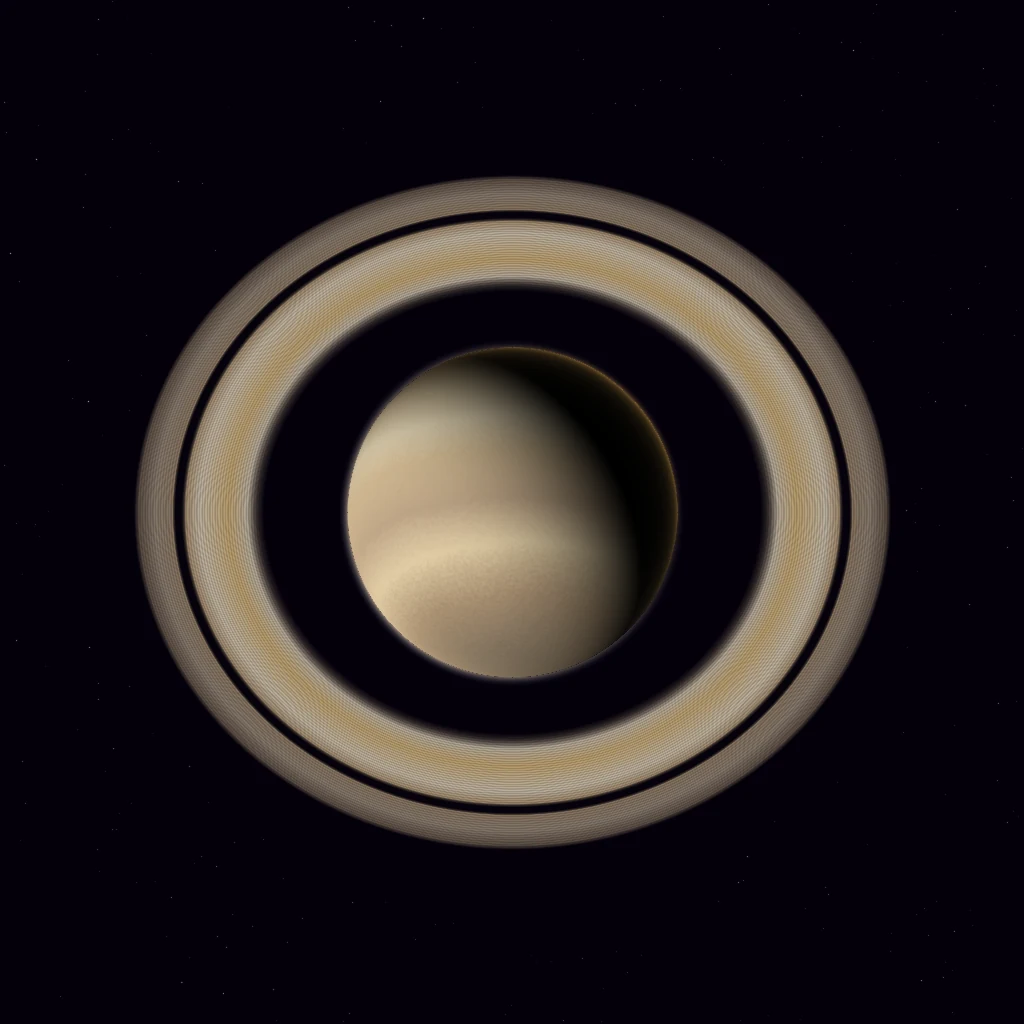
Saturn is, for many, the most beautiful sight in the solar system: a pale golden gas giant encircled by a vast, bright ring system made of countless pieces of ice and rock, spanning hundreds of thousands of kilometres yet, in places, only metres thick. Galileo first glimpsed the rings in 1610 but his telescope was too crude to resolve them, so he described Saturn as having mysterious handles or companions on either side. It took decades, and Christiaan Huygens, to recognise them as a ring. As the most distant planet visible without a telescope, Saturn marked the very edge of the known cosmos for the ancients, which is part of why it came to stand for limits, endings, and the long view.
How listeners use it
- A steady, composed quality with little of the brightness of the Mars or Sun tones.
- A backdrop for planning sessions where you want fewer distractions.
- A reminder to be patient with what is taking longer than you hoped.
- A pairing with a single sheet of paper and the work you would like to keep tending.
What the evidence says
NCCIH’s overview concerns music-based interventions. Our inference is that this evidence does not establish a clinical benefit from this isolated 147.85 Hz tone. Personal enjoyment is a listening response, not a clinical measurement. Read the music research and its limits.
How to listen
- Try a session of fifteen to twenty minutes when you have a serious piece of thinking to do.
- Pair the tone with a single, specific writing prompt rather than free association.
- Keep the volume modest; the tone benefits from sitting under the work.
- Match it to a clear ending: a closing breath, putting the pen down, closing the laptop.
- Switch references if the steadiness starts to feel heavy rather than steadying.
147.85 Hz Saturn: Discipline And Listening Context
For direct playback, use the related frequency page: 147.85 Hz: Saturn.
147.85 Hz Saturn: structure, patience, and listening context
The Saturn tone comes from Hans Cousto's cosmic-octave method, which doubles the frequency calculated from a real orbital period through octaves until it reaches the range of hearing. Saturn completes one orbit every 29.46 Earth years, the longest journey of the planets visible to the naked eye, and that slow cycle gives a steady, composed reference that listeners often describe as serious rather than warm.
Where the symbolism comes from
Saturn is named for the Roman god of agriculture and time, known to the Greeks as Kronos; in Vedic astrology Shani is associated with discipline and patience. As the most distant planet the ancients could see, Saturn became the marker of limits, endings, and the long view. Galileo first glimpsed its rings in 1610 but could not resolve them, describing mysterious handles on either side until Christiaan Huygens recognised them as a ring.
The figure is a mathematical translation of orbital motion, not a sound the planet emits across the vacuum of space. Follow-through in life comes from many small choices over time, not from a single tone, so hold the discipline symbolism as a steadying story rather than a claim.
How listeners use it
- A steady, composed quality with little of the brightness of the Mars or Sun tones.
- A backdrop for planning sessions where you want fewer distractions.
- A reminder to be patient with work that is taking longer than you hoped.
Many people pair it with a single sheet of paper and a specific writing prompt. Used this way it sits quietly under the slower work of building a habit. Our piece on sound and relaxation offers more on building a calm routine.
How to listen
- Try a session of fifteen to twenty minutes when you have a serious piece of thinking to do.
- Keep the volume modest so the tone sits under the work.
- Match it to a clear ending: a closing breath, putting the pen down, closing the laptop.
- Switch references if the steadiness starts to feel heavy rather than steadying.
Listen with this
If this tone suits you, these neighbouring references give you something to compare it with.
Sources
NCCIH’s overview concerns music-based interventions. Our inference is that this evidence does not establish a clinical benefit from one isolated listening tone. Personal enjoyment is a listening response, not a clinical measurement. Read the music research and its limits.
Harmonance is for relaxation, reflection, and educational exploration. It is not medical advice and should not replace professional care.
What benefits are claimed for 147.85 Hz?
The traditional associations described above are listening themes, not measured outcomes. NCCIH’s overview concerns music-based interventions. Our inference is that this evidence does not establish a clinical benefit from this isolated 147.85 Hz tone. Personal enjoyment is a listening response, not a clinical measurement. Read the music research and its limits.
What is 147.85 Hz?
147.85 Hz means 147.85 cycles per second. Cousto doubles Saturn's 29.46-year orbit through octaves into this tone; Saturn is the Roman god of time and harvest, Kronos to the Greeks, and the Vedic Shani of discipline and patience.
Try the pitch, then notice
Press Play above when you are ready. Start quietly, listen briefly, and use the player’s volume control. Compare the neighbouring tones without judging one as medically superior. Stop if the sound is uncomfortable. Signed-in Studio lets you choose layers and timers; public listening needs no account.