183.58 Hz benefits: Jupiter's tone and where its meanings come from
183.58 Hz is the Jupiter tone of Hans Cousto's cosmic octave: Jupiter's orbit of the Sun, 4,332.59 days or about 11.86 years, raised 36 octaves until it can be heard, as an F sharp. The benefits linked to it, such as growth, good fortune and wisdom, come from astrology's Jupiter and from Cousto's notes. No study has tested 183.58 Hz itself.
Ready to play Jupiter 183.58 Hz
Think of something you would like to offer someone.
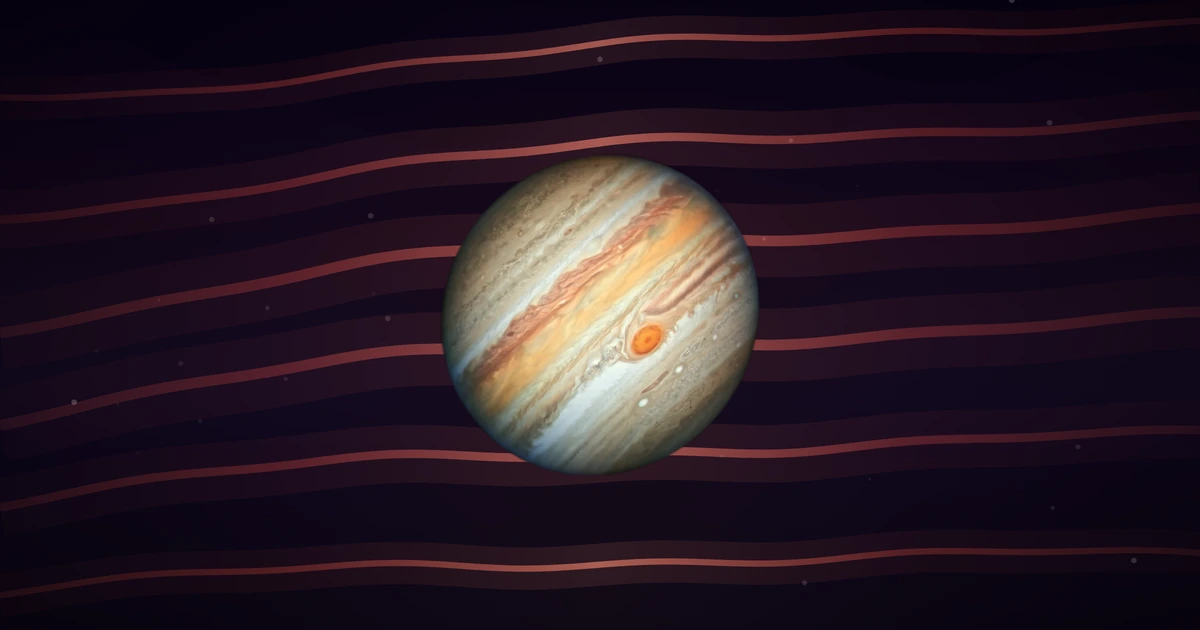
Where does 183.58 Hz come from?
It comes from Jupiter's orbit of the Sun. NASA's Jupiter fact sheet times one orbit against the stars at 4,332.589 days, or 11.86 Earth years. Read as a vibration, that orbit is one cycle every 374,335,690 seconds, a frequency of 2.67 billionths of a hertz, far below anything a person can hear.
Doubling a rate raises it by one octave. Double Jupiter's rate 36 times, which multiplies it by 68,719,476,736, and it reaches 183.58 Hz, close to the F sharp below middle C. The whole sum fits on one line: 68,719,476,736 divided by 374,335,690 seconds is 183.58 cycles a second.
Every octave on the way is the same orbit in another register. Hans Cousto's tuning tables list them. The 33rd octave, 22.95 Hz, is the first that can be heard at all, as a deep hum near the floor of hearing. The 29th, 1.43 Hz, is too slow to hear as a pitch, so the tables give it as a tempo instead: 86.05 beats a minute.
Who first worked it out?
Hans Cousto, a Swiss mathematician and music researcher. His tables date the idea to the autumn of 1978, in a shared flat in Munich: to carry the musical law of the octave beyond the range of hearing, starting with the rhythms of the Earth, the Moon, the planets and the Sun. He set out the method in his book The Cosmic Octave in 1984. The same tables time Jupiter's orbit at 4,332.588 days and name its 36th octave as 183.58 Hz, an F sharp.
They also give the A that belongs to this F sharp: 436.62 Hz, which is 13.34 cents below the 440 Hz A of standard concert pitch. A cent is a hundredth of a semitone, so the Jupiter tone sits about an eighth of a semitone below the piano's F sharp, 185.00 Hz. On a tuner it reads as a slightly flat F sharp.
Every tone in Harmonance's planetary family comes from the same method. Saturn's orbit raised 37 octaves is 147.85 Hz, the Saturn tone; the lunar month raised 29 octaves is 210.42 Hz, the Moon tone; and the Earth's year raised 32 octaves is 136.10 Hz, known as the Om frequency. The guide to planetary frequencies sets out the whole cosmic octave, and the planetary collection plays each tone.
What are the benefits of 183.58 Hz?
The benefits named for 183.58 Hz are symbolic. They come from Cousto's own notes and from astrology's Jupiter, and no study has tested any of them.
Start with Cousto. His page on the Jupiter tone, in German, gives its effect in one line: "Fördert die Gestaltungskraft und das stetig Aufbauende", that is, it encourages the power to shape things and to build steadily. He calls Jupiter the planet of the clergy, credits it with steadiness, splendour and joviality, and pairs it by tradition with the sign of the Archer.
Astrology carries most of the other claims. Western astrology has called Jupiter the greater benefic since the Roman poet Manilius, who described it in the first century as temperate and benign. In the scheme of rulerships set out in Ptolemy's Tetrabiblos, it rules two signs, Sagittarius and Pisces, and Harmonance's zodiac pages for Sagittarius and Pisces both play this tone. The guide to astrology frequencies pairs every sign with its ruling planet the same way.
Indian astrology adds a teacher. Hindu astrologers named the planet after Brihaspati, the religious teacher of the gods, and call it Guru. English keeps a trace of the European tradition in one word: jovial, which astrologers of the Middle Ages used for Jupiter, came to mean happy or merry, the moods they ascribed to the planet.
So when a video or a website lists growth, good fortune, wisdom or expansion as benefits of 183.58 Hz, those words come from these traditions. They describe meanings people have given the largest planet, not something measured in listeners. Read them as interpretation.
Why is Jupiter linked with twelve years?
Because it crosses about one sign of the zodiac a year, and takes close to twelve years to cross all twelve. Ancient Chinese astronomers knew Jupiter as the year star and based their cycle of twelve earthly branches on the number of years it takes to go round the Sun, as the history of Jupiter's observation records.
To see that cycle as it looks from Earth, Harmonance asked NASA JPL's Horizons system for Jupiter's place among the stars on every day from 2026 to 2038, 4,749 readings, and drew the path.

| Sign | Jupiter arrives | Days there |
|---|---|---|
| Leo | July 2026 | 391 |
| Virgo | July 2027 | 395 |
| Libra | August 2028 | 396 |
| Scorpio | September 2029 | 393 |
| Sagittarius | October 2030 | 389 |
| Capricorn | November 2031 | 306 |
| Aquarius | April 2032 | 290 |
| Pisces | April 2033 | 292 |
| Aries | April 2034 | 373 |
| Taurus | April 2035 | 376 |
| Gemini | May 2036 | 380 |
| The Crab | May 2037 | 384 |
Leo to Leo took 11.95 years, a little longer than one orbit of the Sun, 11.86 years, because the Earth is in a different part of its own orbit when Jupiter comes round. In between, Jupiter spends from 290 to 396 days in each sign, never less than about nine and a half months. Days there counts every day spent in a sign, including the weeks when a backward loop carries it back across a border it has just crossed.
The loops are the Earth overtaking Jupiter on the inside track. Every 395 to 403 days, Jupiter seems to stop among the stars, move backward for about four months and then go on, the motion astrologers call retrograde. Across the twelve loops the average gap is 398.8 days, which matches the time NASA gives from one opposition to the next, 398.88 days: the Earth's lap of the Sun, plus the stretch Jupiter has moved on in the meantime.
Which of Jupiter's cycles gives 183.58 Hz?
Only its orbit, timed against the stars. Jupiter keeps other rhythms too, and each one, raised by whole octaves, lands on its own pitch.

A round twelve years, 4,383 days, would give 181.47 Hz, 20 cents below the Jupiter tone: a fifth of a semitone, close to the ear and plain to a tuner. Timing the orbit against the equinox instead of the stars, 4,330.595 days on NASA's sheet, gives 183.66 Hz, less than a cent away.
Jupiter's day, one turn on its axis, lasts 9.925 hours, and doubled 23 times it becomes 234.78 Hz, an A sharp, the rotation tone Cousto's tables give for Jupiter. The 398.88 days between oppositions, doubled 33 times, give 249.25 Hz, a B; that last figure is Harmonance's arithmetic on the same method. When people say the Jupiter frequency, they mean the orbit: 183.58 Hz.
Is 183.58 Hz the sound of Jupiter?
No. Space is too empty to carry sound. In the words of the University of Iowa's space audio team, pressure waves of the kind we hear as sound "do not propagate at audible frequencies in the extremely low density gases that fill space". Spacecraft use antennas to record electric and magnetic waves instead, and some of those can be played straight through a speaker.
Voyager 2 did exactly that on its way to Jupiter in July 1979. Its plasma wave instrument recorded waves near the bow shock, where the solar wind meets the edge of Jupiter's magnetic field, and the Iowa team call them the authentic "sounds of Jupiter", "unmodified and presented at their original frequency". They come from the magnetic bubble around the planet, not from Jupiter itself, and the one constant tone in the recording, at 2.4 kHz, is the spacecraft's own power supply.
183.58 Hz is a different kind of thing altogether: not a signal from Jupiter, but the rhythm of its orbit made audible by arithmetic.
Has any study tested 183.58 Hz?
No. No published study has tested 183.58 Hz, or any tone of Cousto's cosmic octave, on people listening. PubMed, the main index of medical research, holds no record for "183.58 Hz", and its few records for "cosmic octave" are about other things, such as astronomy instruments and aircrew hearing.
The nearest evidence concerns music. A 2020 review of 104 randomised trials, with 9,617 people between them, found that music interventions lowered stress. The effect was small to medium on measures of the body, such as heart rate, and medium on how stressed people said they felt.
Those trials played music, not a single steady tone, and none of them used 183.58 Hz. NCCIH, the US National Center for Complementary and Integrative Health, says much of the research on music for health is preliminary, so "few definite conclusions about their effects have been reached". That is why Harmonance shares 183.58 Hz as a tradition and a pitch to listen with, not settled science. The guide to the science of sound healing sets out what listening research does and does not show.
What does the 183.58 Hz page play?
One steady tone at exactly 183.58 Hz, with two faint overtones above it. Harmonance decoded the 100-second loop that the 183.58 Hz Jupiter page serves and measured it from its samples. The strongest line sits at 183.58 Hz to a hundredth of a hertz. The octave above, 367.16 Hz, is 23 dB quieter, and the line at 550.74 Hz is 34 dB quieter; nothing else comes within 60 dB of the tone.
Its level swells and settles by under 1 dB every 20 seconds, and the loop's end meets its start, so it can repeat for as long as you leave it. The same page has a Strings mode: strings tuned to octaves of 183.58 Hz, with the tone quiet underneath.
How do you listen to 183.58 Hz?
Press play at a low volume and let the tone run. Any speakers or headphones will do, since it is one steady tone, unlike a binaural beat, which needs a different tone in each ear. A speaker carries a tone this low better than small earbuds. The World Health Organization's safe listening advice is to keep a device at no more than 60 per cent of its maximum volume, which matters most if you leave the tone on for hours.
To hum along, find the F sharp below middle C and let it sink a little; a higher voice can hum the octave above, 367.16 Hz. To move at Jupiter's pace, walk or sway at Cousto's tempo, 86.05 beats a minute. Or simply let it sit under reading, planning or any slow piece of thinking, and notice how the room feels when you stop.
The 183.58 Hz Jupiter page plays the tone in full, or opens with Strings already on, and Harmonance Studio lets you layer it with other tones. The Want to reflect page gathers 183.58 Hz with 852 Hz and 777 Hz, and the planetary collection holds the rest of the cosmic octave.
Sources and limits
Jupiter's cycles come from NASA's fact sheet and JPL's ephemeris, the tone and its meaning from Cousto's own tables and page, the astrology from the histories of the tradition, and the music findings from the review itself. The path through the zodiac, the four tones and the measured page audio are Harmonance's own work from those sources. No study has tested 183.58 Hz itself, and the music research concerns music, never a tone.
- NASA, Jupiter fact sheet: the sidereal and tropical orbits, the synodic period and the rotation.
- Hans Cousto, tuning data for the planets: Jupiter's octaves, its tempo, its A at 436.62 Hz and its rotation tone.
- Hans Cousto, the Jupiter tone (in German): its claimed effect, its qualities and its sign.
- NASA JPL, Horizons ephemeris of Jupiter seen from Earth, 2026 to 2038: the data behind the chart.
- Wikipedia, planets in astrology: Jupiter: the greater benefic and its signs.
- Wikipedia, domicile in astrology: the sign rulerships of Ptolemy's Tetrabiblos.
- Wikipedia, Jupiter: the Chinese year star, Brihaspati and the word jovial.
- University of Iowa, space audio: what sound in space does and does not mean.
- University of Iowa, Voyager 2 plasma wave recordings on arrival at Jupiter: the recording and its sources.
- de Witte and others (2020), music interventions and stress, Health Psychology Review: 104 trials and their effects.
- NCCIH, music and health: what you need to know: the state of music research.
- World Health Organization, safe listening: volume and time.
Tones to play while you read
Related guides
211.44 Hz benefits: Neptune's tone and where its meanings come from
211.44 Hz benefits are symbolic: the Neptune tone is its 164.8-year orbit raised 40 octaves, and no study has tested it. Where the meanings come from.
Uranus frequency in Hz: 207.36 and the 84-year orbit behind it
Uranus frequency Hz: 207.36, the planet's 84-year orbit raised 39 octaves to a G sharp. Where its meanings come from, and why no study has tested it.
210.42 Hz benefits: what the Moon tone is, and what is known
210.42 Hz benefits are symbolic: the Moon tone is the 29.53-day lunar month raised 29 octaves, and no study has tested it. Where the claims come from.
Just be curious. This is not a medical device or medical advice. For any health concern, please speak to your doctor.