Mars frequency in Hz: where 144.72 Hz comes from
Mars's frequency is 144.72 Hz, the tone Hans Cousto's cosmic octave gives the planet. Take its orbit of the Sun, 686.98 days or just under two Earth years, as one very slow vibration and double it 33 times: it becomes 144.72 Hz, a little below the D under middle C. It is arithmetic, not a sound from Mars, and no published study has tested listening to it.
Ready to play Mars 144.72 Hz
Choose a small first step towards your next task.
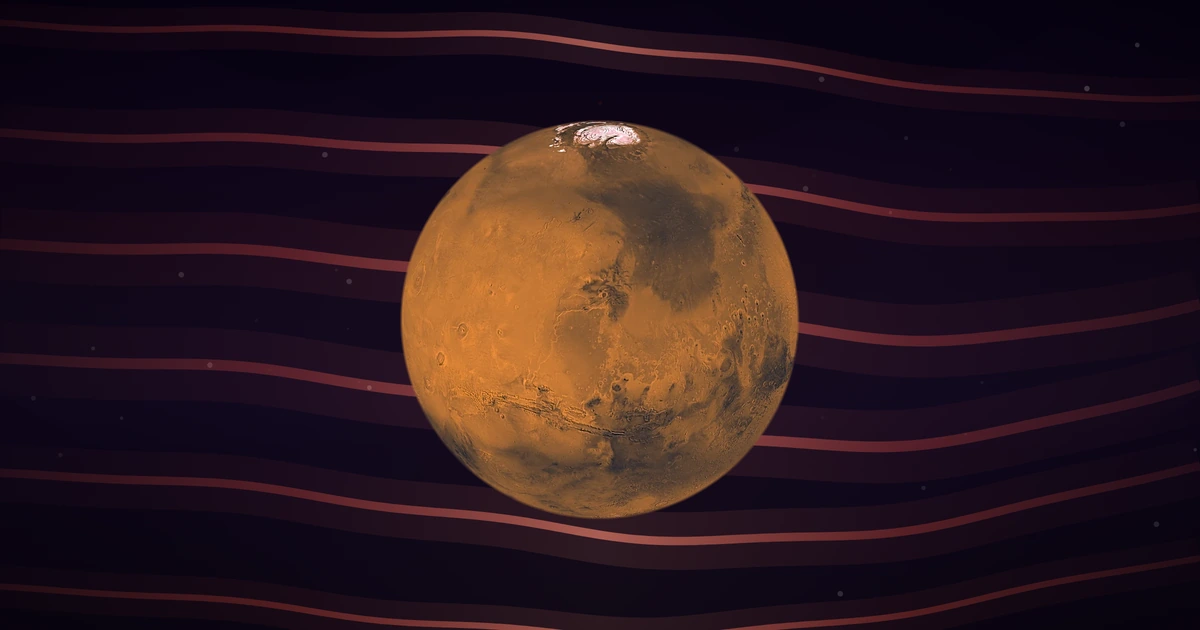
What is the Mars frequency in Hz?
The Mars frequency is 144.72 Hz, a low tone a quarter of a semitone below the D under middle C. The number comes from the tables of planetary tones that the Swiss mathematician and music researcher Hans Cousto began in Munich in 1978 and called the cosmic octave. Most Mars tones you can play online, Harmonance's included, use it.
Harmonance's own page links the tone with momentum, courage and focused action, and offers it for the moment you start a task. Those associations come from astrology, not from a measurement. The number itself is plain arithmetic, and anyone can redo it.
How does Mars's orbit become 144.72 Hz?
Mars's orbit becomes 144.72 Hz by doubling, 33 times over. Cousto starts from the time Mars takes to circle the Sun once, measured against the stars, which his tuning tables give as 686.9798 days, just under two Earth years. Read as a vibration, that is one cycle every 59,355,055 seconds, the days multiplied by the 86,400 seconds in each: a frequency of 0.000000016848 Hz, about 17 billionths of a hertz.
Doubling a frequency raises it by one octave, the same note higher up. Doubling this one 33 times multiplies it by 8,589,934,592 and gives 144.721 Hz, which rounds to 144.72 Hz. On a piano tuned to A at 440 Hz the nearest note is the D at 146.83 Hz, and 144.72 Hz sits 25.07 cents below it, where a cent is a hundredth of a semitone. Cousto's tables also give the tuning that makes the two meet: set an instrument's A to 433.67 Hz instead of 440 Hz, and its D lands on 144.72 Hz.

The ladder runs on past hearing in both directions. Twenty-six doublings give 67.84 beats a minute, which Cousto lists as a tempo for Mars; 75 give about 636 trillion hertz, a frequency of visible light, the blue at 471 nanometres. Only octaves 31 to 40, from 36.18 to 18,524.31 Hz, fall inside the range of human hearing, and 144.72 Hz is the third of them. The guide to planetary frequencies works the same method through every planet, the Earth and the Moon.
Which Mars cycle gives which tone?
Each of Mars's rhythms gives its own tone, and the orbit is only the best known. The same doubling works on any cycle, so the table below takes Mars's orbit, its synodic period, its day and the orbit of its inner moon from NASA's Mars fact sheet, sets them beside Cousto's orbit, and doubles each one until it can be heard.
| Cycle | Tone |
|---|---|
| Orbit, Cousto: 686.9798 days | 144.72 Hz, D (33 doublings) |
| Orbit, NASA: 686.980 days | 144.72 Hz, D (33 doublings) |
| Tropical orbit, NASA: 686.972 days | 144.72 Hz, D (33 doublings) |
| Synodic period, NASA: 779.94 days | 127.47 Hz, C (33 doublings) |
| Solar day, NASA: 24.6597 hours | 188.99 Hz, F sharp (24 doublings) |
| Rotation, NASA: 24.6229 hours | 189.27 Hz, F sharp (24 doublings) |
| Orbit of Phobos, NASA: 0.31891 days | 152.22 Hz, D sharp (22 doublings) |
The orbit rows agree to the hundredth of a hertz. NASA gives Mars's orbit as 686.980 days, Cousto's 686.9798 to three decimal places, so newer figures change nothing here: the tone stays 144.72 Hz. Even the tropical orbit, Mars's return to the same place measured from the spring equinox that the zodiac of Western astrology counts from, is only 0.008 days shorter, and it moves the tone by two hundredths of a cent. Cousto's tables allow that better data may give a more accurate orbit, "resulting in slightly different octave frequencies". For Mars, the data has held.
The synodic period is the time from one opposition to the next, when Earth passes between the Sun and Mars and Mars is up all night. It averages 779.94 days, and 33 doublings make it 127.47 Hz, close to a C. Cousto's own synodic table gives 127.63 Hz for the same period; the doubling on NASA's figure gives 127.47, so the table works every row the same way from NASA's sheet rather than mixing the two. Cousto adds a warning particular to Mars: "For Mars the periods can deviate up to 3% from the mean value", against 1% for the other planets.
Mars's day is the one cycle close to ours. NASA gives a solar day, sunrise to sunrise, of 24.6597 hours, about 24 hours and 40 minutes, and 24 doublings make it 188.99 Hz, an F sharp; Cousto's table of planetary days gives the same figure. Phobos, the larger of Mars's two small moons, circles the planet in 0.31891 days, faster than Mars turns, and 22 doublings bring it to 152.22 Hz. One more coincidence sits in the same tables: Neptune's day of 16.11 hours lands at 144.64 Hz, within one cent of the Mars tone.
Can you hear sound on Mars?
Yes. Mars has an atmosphere, thin and mostly carbon dioxide, so sound travels there, and it has now been recorded. NASA's mission page puts it plainly: "The Perseverance rover carries two microphones, letting us directly record the sounds of Mars for the very first time." That sets Mars apart from Saturn, whose "sounds" online are radio waves moved down into hearing, as the guide to the Saturn frequency explains.
The rover's science team published what the microphones showed in Nature (Maurice and others, 2022). Their paper opens: "Before the Perseverance rover landing, the acoustic environment of Mars was unknown." From the thin air alone, they worked out "approximately 20 dB weaker sounds on Mars than on Earth if produced by the same source". Sound also travels more slowly, at about 240 metres a second against 340 in Earth's air, and the team found "two distinct values for the speed of sound", about 10 metres a second apart, below and above 240 Hz, a quirk of carbon dioxide at low pressure.
The cleanest measurement came from Ingenuity, the small helicopter that flew beside the rover. Its two blades hummed at 84.43 Hz, and from the hum's Doppler shift as the helicopter flew to and fro, the team worked out that it travelled at 237.7 metres a second; above 2,000 Hz, the sound of the rover's laser striking rock moved at 246 to 257 metres a second. In the paper's words, "Ingenuity tones are recorded at 84 Hz and 168 Hz", the hum and its first overtone.
So what would 144.72 Hz do on Mars? It sits between Ingenuity's two lines and below the 240 Hz divide, so it would travel at the slower speed, close to 238 metres a second. One wave of it, crest to crest, would shrink from about 2.35 metres in Earth's air to about 1.64 metres. From the same speaker it would come out about 20 dB quieter, and from 100 metres away it would take 0.42 seconds to reach you, against 0.29 on Earth. A low tone also loses far less on the way than a high one: the paper reports that an 8,000 Hz sound loses as much over 8 metres on Mars as it would over 65 metres on Earth, and NASA notes that sounds "like whistles, bells or bird songs, would almost be inaudible on Mars". These figures are worked here from the paper's speeds for a tone nobody has played on Mars.
None of this is what Cousto's number means. 144.72 Hz is not a sound Mars makes; it is the planet's orbit, turned into a pitch by doubling. But Mars has air that would carry it, and the recordings say how.
What does 144.72 Hz sound like?
144.72 Hz is a low, smooth tone just under the pitch of the D below middle C. Halve it and you get its lower octaves, 72.36 and 36.18 Hz; double it and you get 289.44, 578.88 and 1,157.77 Hz, the same note higher up. The 144.72 Hz page plays it in two ways, and we measured both from the page's own audio files.

| Octave band | Tone alone | Strings |
|---|---|---|
| 1,157.8 Hz, three octaves up | 0% | 2.3% |
| 578.9 Hz, two octaves up | 0% | 12.9% |
| 289.4 Hz, one octave up | 0.5% | 46% |
| 144.72 Hz, the tone itself | 99.5% | 33% |
| 72.36 Hz, one octave down | 0% | 5.6% |
| 36.18 Hz, two octaves down | 0% | 0% |
Download the measurements (CSV)
With Strings off, the page plays the tone on its own, as a loop of 100 seconds. It is close to a pure sine: two faint overtones sit above it, at 289.44 Hz, 23.1 dB quieter, and at 434.16 Hz, 34 dB quieter.
With Strings on, most of the sound moves above the tone. The strings play notes of the D major scale, the scale of the tone's own D, and their eight strongest lines are G at 96.8 Hz, A at 108.6 Hz, B at 121.4 Hz, D at 144.8 Hz, G at 193.5 Hz, the strongest of all, A at 218 Hz, E at 325.5 Hz and F sharp at 362.6 Hz. The exact 144.72 Hz tone still plays underneath, 35.7 dB below the music. The guide to the Saturn frequency measured the same shape for Saturn's 147.85 Hz, only 37 cents higher: a low planetary tone sits under its strings, not over them.
Why is Mars linked with Aries and Scorpio?
Mars is linked with Aries and Scorpio because Ptolemy's Tetrabiblos, an astrology handbook written in Greek in the second century, gave it those two signs as its houses. Ptolemy explains the planet's nature from what he could see: "The nature of Mars is chiefly to dry and to burn, in conformity with his fiery colour and by reason of his nearness to the sun". In his scheme each planet took two neighbouring signs, working outwards from the houses of the Sun and the Moon, and to Mars "there were assigned again the two signs, contiguous to the former, Scorpio and Aries".
Cousto kept the old picture. His German page on Mars, from his book Die Töne der Kosmischen Oktave, notes that "Nach astrologischer Tradition wird der Mars dem Sternzeichen Widder zugeordnet", by astrological tradition Mars belongs to Aries, and that "In der Antike war Mars der Kriegsgott", in antiquity Mars was the god of war. For the tone itself he writes "Fördert die Willenskraft und die zielgerichtete Energie": it furthers willpower and directed energy. That is his reading, offered without a study, and no study has tested it since.
Harmonance's Aries and Scorpio pages both play the Mars tone, and the Scorpio page sets it beside Pluto, the planet modern astrology added to that sign. Both are symbolism to listen with, not a rule for anyone's life, and the guide to astrology and frequencies explains how signs, planets and tones connect.
What have listeners written about the Mars tone?
Listeners under Harmonance's two Mars videos on YouTube have left only a handful of comments, and they are short. Under the pure tone video, one wrote:
Aries Crew
Under the second video, which plays harmonics built on the Mars tone rather than the bare tone, two others wrote:
Gives me shivers up my spine
So smooth
Three comments are three people's reactions, not a finding. They do show what people bring to a planetary tone: the sign they were born under, a reaction in the body, a liking for the sound. Everyone hears it in their own way.
Is there research on listening to 144.72 Hz?
No published study has tested listening to 144.72 Hz. PubMed, the main index of medical research, holds no record for "144.72 Hz"; its four records for "cosmic octave" are about other things, such as aircrew hearing and astronomy instruments, and its three for "Mars frequency" with music are about other subjects too. Europe PMC, a wider index, returns nothing for "144.72 Hz" or for "cosmic octave". So what people describe for the Mars tone, from momentum to Cousto's willpower, comes from tradition and personal experience, not from research.
Research on music in general is further along, but it is still early. The US National Center for Complementary and Integrative Health sums it up:
However, because much of the research on music-based interventions is preliminary, few definite conclusions about their effects have been reached.
None of that research used planetary tones. If you listen to 144.72 Hz, what you notice is yours to weigh: it is not an effect anyone has measured.
How do you listen to 144.72 Hz on Harmonance?
Press play on the 144.72 Hz Mars page. With Strings off it plays the tone alone; switch Strings on beside the player, or open the page with Strings already on, and evolving strings play around a quiet 144.72 Hz tone. Nothing plays until you press play, and no account is needed.
No study sets a length for 144.72 Hz. The Mars page suggests a short session of five to ten minutes, in the morning or early afternoon rather than just before sleep, paired with one small thing you would like to begin. Keep the volume comfortable whatever you choose: loud sound is the one listening risk that is well established. The same page from the National Center for Complementary and Integrative Health warns that "listening to music at too high a volume can contribute to noise-induced hearing loss", and the World Health Organization's safe listening advice is that "you can safely listen to a sound level of 80dB for up to 40 hours a week", with your device at no more than 60% of its maximum volume.
In Harmonance Studio you can set Mars beside other tones and shape your own mix. The planetary collection plays every planet's tone, and the astrological collection pairs the tones with the signs. Mars also sits on two feelings pages, Low on energy and Want a fresh start, beside other daytime tones. For the planetary tone closest to it in pitch, read the guide to the Saturn frequency; for the Sun's tone, the guide to the Sun frequency; and for what research on sound has and has not shown, the science of sound healing.
Sources and limits
The number rests on Cousto's tables and NASA's fact sheet, read in their original form, and the arithmetic is worked again here from both. The astrology is quoted from Ptolemy in the Loeb translation and from Cousto's own page, as tradition, not evidence. What Mars does to sound comes from the Perseverance team's paper, read in its open copy, and from NASA's own page; the wavelength and travel times for 144.72 Hz on Mars are worked here from the paper's measured speeds, for a tone nobody has played there. No study of listening to 144.72 Hz turned up in PubMed or Europe PMC, so none is reported. The listeners' words come from public comments under Harmonance's own videos, quoted whole and without names, and the measurements of the 144.72 Hz page are Harmonance's own, made from the page's audio files.
- Hans Cousto, tuning data of the planets (Planetware, English edition): Mars's orbit, its octaves, its note, its tuning, its synodic period and its day.
- Hans Cousto, Mars, from Die Töne der Kosmischen Oktave (Planetware, in German): Aries, the god of war and the tone's effect in his words.
- NASA Space Science Data Coordinated Archive, Mars fact sheet: the orbit, the tropical orbit, the synodic period, the day and the orbit of Phobos.
- Maurice, Chide, Murdoch, Lorenz and others (2022), In situ recording of Mars soundscape, in Nature: the speeds of sound, the 20 dB, Ingenuity's tones and how high sounds fade.
- NASA Science, Sounds of Mars: Perseverance's two microphones and how Mars changes what you would hear.
- Ptolemy, Tetrabiblos, Book 1, translated by F. E. Robbins (Loeb Classical Library, 1940), on LacusCurtius: Mars's nature and its houses.
- A comment under Harmonance's 144.72 Hz Mars video, quoted without the name.
- Comments under Harmonance's Mars harmonics video, quoted without names.
- National Center for Complementary and Integrative Health, Music and Health: the state of music research, and loud listening.
- World Health Organization, safe listening: weekly limits and device volume.
Tones to play while you read
Related guides
111 Hz benefits and the ancient chamber story
111 Hz benefits, checked: the angel number behind the tone, the stone chambers that ring near 110 Hz, and what a pilot found when 30 adults listened.
141.27 Hz benefits: what the Mercury frequency is and is not
141.27 Hz benefits, checked: the Mercury tone is its 88-day orbit raised 30 octaves, its spin sounds the fifth above, and no study has tested it.
174 Hz benefits: the claims and what is known
174 Hz benefits, checked: the comfort and natural anaesthetic claims, where the number came from, and how 37 listeners rated the lowest Solfeggio tone.
Just be curious. This is not a medical device or medical advice. For any health concern, please speak to your doctor.