141.27 Hz benefits: what the Mercury frequency is and is not
The benefits people link with 141.27 Hz, clearer speech and quicker thinking, come from Hans Cousto's notes on Mercury and from astrology, and no published study has tested them. 141.27 Hz is Mercury's tone in Cousto's cosmic octave: its orbit of 87.969 days raised 30 octaves, close to a C sharp. Mercury's spin, worked the same way, lands a perfect fifth above it.
Ready to play Mercury 141.27 Hz
Consider the words you want to share.
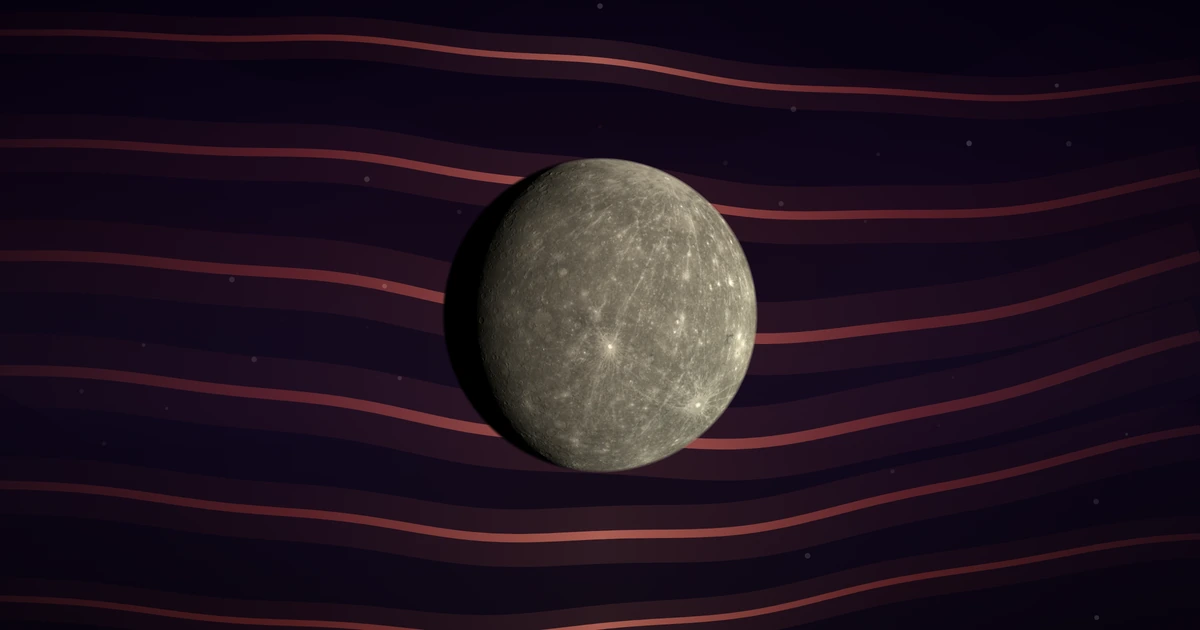
What are the benefits of 141.27 Hz?
The benefits most often linked with 141.27 Hz are about words and wits: clearer speech, quicker thinking, easier conversation. They come from two places. Hans Cousto, the Swiss mathematician and music researcher who first worked out the tone, wrote in his German notes on Mercury that it "fördert das Sprachzentrum und das kommunikativ-intellektuelle Prinzip": it furthers the speech centre and the communicative, intellectual principle. Astrology supplies the rest, with Mercury as the messenger and the planet of language and quick minds.
Neither is a measurement. No published study has tested listening to 141.27 Hz, for speech, for thinking or for anything else, and research on music and thinking in general has found far smaller effects than its reputation suggests, as a section below shows. Harmonance's own page offers the tone as a listening prompt before writing or a conversation. That is the honest way to use it: as a cue you choose, not an effect anyone has measured.
How does Mercury's orbit become 141.27 Hz?
Mercury's orbit becomes 141.27 Hz by doubling, 30 times over. Cousto starts from the time Mercury takes to circle the Sun once, measured against the stars, which his tuning tables give as 87.969 days, and NASA's Mercury fact sheet gives to the same thousandth of a day. Read as a vibration, that is one cycle every 7,600,521.6 seconds, the days multiplied by the 86,400 seconds in each: a frequency of 0.0000001316 Hz, the figure Cousto's tables print as octave 0.
Doubling a frequency raises it by one octave, the same note higher up. Doubling this one 30 times multiplies it by 1,073,741,824 and gives 141.272 Hz, which rounds to 141.27 Hz. On a piano tuned to A at 440 Hz the nearest note is the C sharp at 138.59 Hz, and 141.27 Hz sits 33.17 cents above it, where a cent is a hundredth of a semitone. Cousto's German page calls it "ein hohes Cis oder ein tiefes D", a high C sharp or a low D, since it falls a third of the way from one to the other. His tables also give the tuning that makes it exact: set an instrument's A to 448.51 Hz instead of 440 Hz, and its C sharp lands on 141.27 Hz.
The same ladder runs on past hearing in both directions. Doubled 23 and 24 times, the orbit gives tempos of 66.2 and 132.4 beats a minute, which Cousto lists as Mercury's; octaves 28 to 37, from 35.32 to 18,082.83 Hz, fall inside the range of human hearing, and 141.27 Hz is the third of them; 72 doublings reach blue-green light at 483 nanometres. Cousto's table prints that octave as 74, but the frequency it lists beside it is the one 72 doublings make. The guide to planetary frequencies works the same method through every planet, the Earth and the Moon.
Why do Mercury's day and spin give the same note and its fifth?
Mercury's day and spin give the same note and its fifth because the planet turns on its axis three times for every two orbits of the Sun, and three to two is the ratio of a perfect fifth. NASA's fact sheet gives its turn against the stars as 1,407.6 hours, about 58.65 days, and its day, from one sunrise to the next, as 4,222.6 hours, about 175.94 days. In the words of NASA's Mercury facts, the planet "completes one rotation every 59 Earth days", yet "One Mercury solar day (one full day-night cycle) equals 176 Earth days".

Run the turn through Cousto's method and 30 doublings give 211.89 Hz, a G sharp. Divide 211.89 by 141.27 and the answer is 1.4999: the turn sounds a fifth above the orbit, 701.8 cents against the 702.0 cents of a pure fifth tuned by ear, a gap of about a tenth of a cent that nobody can hear. The day is two orbits long to within about five minutes, so 31 doublings land it on 141.27 Hz, the orbit's own note. Cousto's table of planetary rotations lists both: 211.89 Hz, G sharp, for Mercury's turn, and 141.27 Hz, C sharp, for its day. Mercury's three clocks therefore sound as an open fifth, C sharp with G sharp above it, and the Harmonance page plays the lower of the two.
The lock was found only in 1965. That April the radar at the Arecibo observatory in Puerto Rico bounced signals off Mercury and measured its turn directly (Pettengill and Dyce, 1965): 59 days, give or take 5, far shorter than the 88 days of its orbit. Within months Colombo pointed out in the same journal that "A very nearly uniform rotational motion of 58.65 sidereal-day period, that is 2/3 of the orbital period, may indeed be a stable periodic solution." The same lock gives Mercury its strangest sunrise. From some parts of its surface, NASA notes, "The morning Sun appears to rise briefly, set, and rise again".
Which Mercury cycle gives which tone?
Each of Mercury's rhythms gives its own tone, and the orbit is only the best known. The same doubling works on any cycle, so the table below takes each of them from NASA's fact sheet and doubles it until it can be heard.
| Cycle | Tone |
|---|---|
| Orbit, Cousto and NASA: 87.969 days | 141.27 Hz, C sharp (30 doublings) |
| Tropical orbit, NASA: 87.968 days | 141.27 Hz, C sharp (30 doublings) |
| Turn, NASA: 1,407.6 hours, about 58.65 days | 211.89 Hz, G sharp (30 doublings) |
| Day, NASA: 4,222.6 hours, about 175.94 days | 141.27 Hz, C sharp (31 doublings) |
| Synodic period, NASA: 115.88 days | 214.49 Hz, between G sharp and A (31 doublings) |
Mercury's tone is unusually settled. NASA's fact sheet gives the orbit as 87.969 days today, Cousto's own figure, so newer data has not moved it, while the guide to the Saturn frequency shows how a newer orbit nudges Saturn's tone by half a cent. Cousto's tables still warn that it could happen: "If science obtains more detailed data about a distant space object, it may lead to a more accurate determination of the orbital period, resulting in slightly different octave frequencies." The tropical orbit, counted from the spring equinox as the zodiac of Western astrology is, is one thousandth of a day shorter and gives the same 141.27 Hz.
The synodic period is the time from one inferior conjunction to the next, when Mercury passes between the Earth and the Sun. It is also the rhythm of "Mercury retrograde", the few weeks when Mercury seems to drift backwards across our sky: the retrograde cycles of the inner planets, as Wikipedia's summary puts it, "are tied to their inferior conjunctions with the Sun", and "The period between the center of such retrogradations is the synodic period of the planet." Doubled 31 times, its 115.88 days give 214.49 Hz, 21 cents above the turn's G sharp.
Why is Mercury linked with Gemini, Virgo and communication?
Mercury is linked with communication because of its name and its speed. It is, in NASA's words, "appropriately named for the swiftest of the ancient Roman gods", the messenger, and it circles the Sun faster than any other planet. Ptolemy's Tetrabiblos, an astrology handbook written in Greek in the second century, describes Mercury's nature as changing quickly between drying and moistening, "inspired as it were by the speed of his motion in the neighbourhood of the sun itself".
The same book explains the signs. Mercury "never is farther removed from the sun than one sign in either direction", so Ptolemy gave it the two signs beside the houses of the Sun and the Moon: "the remaining signs, Gemini and Virgo, which are next to the houses of the luminaries". Cousto kept both, with a twist of his own. As morning star Mercury belongs to Gemini, as evening star to Virgo, and it stands, he writes, "für Kommunikation und Schlauheit", for communication and cleverness. That is why he gave it the throat chakra, "denn dort entspringen all unsere schlauen Sprüche": that is where all our clever remarks come from.
Cousto was candid about the limits of his own idea. The planets' tones, he writes on the same page, are heliocentric, worked from orbits round the Sun, and so have "eine weitaus geringere Bedeutung", a far smaller significance, for life on Earth than the vibrations of our own planet and the Moon. Harmonance's Gemini and Virgo pages both play the Mercury tone, as symbolism to listen with, not a forecast, and the guide to astrology and frequencies explains how signs, planets and tones connect.
What does 141.27 Hz sound like?
141.27 Hz is a low, clear tone at about the pitch of the C sharp below middle C. Halve it and you get its lower octaves, 70.64 and 35.32 Hz; double it and you get 282.54, 565.08 and 1,130.16 Hz, the same note higher up. The 141.27 Hz page plays it in two ways, and we measured both from the page's own audio files.

| Octave band | Tone alone | Strings |
|---|---|---|
| 1,130.16 Hz, three octaves up | 0% | 1.8% |
| 565.08 Hz, two octaves up | 0% | 11.7% |
| 282.54 Hz, one octave up | 0.5% | 50.8% |
| 141.27 Hz, the tone itself | 99.5% | 31.3% |
| 70.64 Hz, one octave down | 0% | 4.3% |
| 35.32 Hz, two octaves down | 0% | 0% |
Download the measurements (CSV)
With Strings off, the page plays the tone on its own, from a file of 100 seconds that loops. It is close to a pure sine: two faint overtones sit above it, at 282.54 Hz, 23.1 dB quieter, and at 423.81 Hz, 34 dB quieter.
With Strings on, most of the sound moves above the tone. The strings play notes of the C sharp major scale, the scale of the tone's own C sharp, and their eight strongest lines are F sharp at 94.4 Hz, G sharp at 106.2 Hz, A sharp at 118.6 Hz, C sharp at 141.3 Hz, D sharp at 158.5 Hz, F sharp at 188.8 Hz, the strongest of all, G sharp at 212.5 Hz and E sharp at 354.1 Hz. The exact 141.27 Hz tone still plays underneath, 36.4 dB below the music. The G sharp at 212.5 Hz is the fifth of the strings' scale, and it sits within 5 cents of 211.89 Hz, the tone of Mercury's turn: switch Strings on and Mercury's fifth is in the music.
What have listeners written about the Mercury tone?
One listener has left a comment under Harmonance's 141.27 Hz video on YouTube so far:
Thank you for sharing this magnificent sine tone , ☿💪♍️
The symbols are Mercury's own sign, a flexed arm and the sign of Virgo, the evening-star sign Cousto gives the planet. One comment is one person's experience, not a finding, and it praises the sound rather than any effect. If 141.27 Hz feels too insistent, turn it down, stop, or try it with Strings on, where most of the sound sits above the tone. Everyone hears it in their own way.
Is there research on 141.27 Hz, or on music for thinking?
No published study has tested listening to 141.27 Hz. PubMed, the main index of medical research, holds no record for "141.27 Hz", and its four records for "cosmic octave" are about other things, such as aircrew hearing and astronomy instruments. Europe PMC, a wider index, returns nothing for either phrase. So the benefits people describe for the Mercury tone, from clearer speech to sharper thinking, come from tradition and personal experience, not from research.
The nearest research is on music and thinking in general, and it is a lesson in how a benefit can grow in the telling. Rauscher and colleagues reported that ten minutes of Mozart raised college students' scores on reasoning tasks by 8 or 9 IQ points, and "the Mozart effect" became famous. When Chabris pooled the studies that followed, in Nature in 1999, he found that "any cognitive enhancement is small and does not reflect any change in IQ or reasoning ability in general", and that it came from one kind of task alone. That research used Mozart, not a planetary tone.
Research on music and health is further along, but still early. The US National Center for Complementary and Integrative Health sums it up:
However, because much of the research on music-based interventions is preliminary, few definite conclusions about their effects have been reached.
None of that research used planetary tones. If you listen to 141.27 Hz, what you notice is yours to weigh: it is not an effect anyone has measured.
How do you listen to 141.27 Hz on Harmonance?
Press play on the 141.27 Hz Mercury page. With Strings off it plays the tone alone; switch Strings on beside the player, or open the page with Strings already on, and evolving strings play around a quiet 141.27 Hz tone. Nothing plays until you press play, and no account is needed.
No study sets a length for 141.27 Hz. The Mercury page suggests five to fifteen minutes before writing or speaking work, low enough to talk over, with one idea in mind that you want to put clearly. Keep the volume comfortable whatever you choose: loud sound is the one listening risk that is well established. The same page from the National Center for Complementary and Integrative Health warns that "listening to music at too high a volume can contribute to noise-induced hearing loss", and the World Health Organization's safe listening advice is that "you can safely listen to a sound level of 80dB for up to 40 hours a week", with your device at no more than 60% of its maximum volume.
In Harmonance Studio you can set Mercury beside other tones and shape your own mix. The feelings page Need to focus? pairs it with 741 Hz for one work session. The planetary collection plays every planet's tone, and the astrological collection pairs the tones with the signs. For the other planetary guides, read the guide to 210.42 Hz, the Moon tone, and the guide to the Om frequency, the Earth's year as a tone; for what research on sound has and has not shown, the science of sound healing.
Sources and limits
The number rests on Cousto's tables and NASA's fact sheet, read in their original form, and the arithmetic is worked again here from both. The fifth between Mercury's turn and its orbit is our own arithmetic on NASA's figures; Cousto's rotation table gives the same two tones. The astrology is quoted from Ptolemy in the Loeb translation and from Cousto's own page, as tradition, not evidence. The Mozart research concerns music in general, not this tone. No study of listening to 141.27 Hz turned up in PubMed or Europe PMC, so none is reported. The listener's words come from a public comment under Harmonance's own video, quoted whole and without a name, and the measurements of the 141.27 Hz page are Harmonance's own, made from the page's audio files.
- Hans Cousto, tuning data of the planets (Planetware, English edition): Mercury's orbit, its octaves, its note and its tuning, and the rotations of the planets.
- Hans Cousto, Merkur, from Die Töne der Kosmischen Oktave (Planetware, in German): the tone's effect, the signs and the throat chakra in his words.
- NASA Space Science Data Coordinated Archive, Mercury fact sheet: the orbit, the turn, the day and the synodic period.
- NASA Science, Mercury facts: the day of 176 Earth days, the double sunrise and the planet's name.
- Pettengill and Dyce (1965), A radar determination of the rotation of the planet Mercury, in Nature: the Arecibo radar measurement.
- Colombo (1965), Rotational period of the planet Mercury, in Nature: the turn as two thirds of the orbit.
- Wikipedia, Apparent retrograde motion: why Mercury seems to go backwards, and how often.
- Ptolemy, Tetrabiblos, Book 1, translated by F. E. Robbins (Loeb Classical Library, 1940), on LacusCurtius: Mercury's nature and its houses.
- A comment under Harmonance's 141.27 Hz Mercury video, quoted without the name.
- Chabris (1999), Prelude or requiem for the 'Mozart effect'?, in Nature: what the Mozart research found when pooled.
- National Center for Complementary and Integrative Health, Music and Health: the state of music research, and loud listening.
- World Health Organization, safe listening: weekly limits and device volume.
Tones to play while you read
Related guides
111 Hz benefits and the ancient chamber story
111 Hz benefits, checked: the angel number behind the tone, the stone chambers that ring near 110 Hz, and what a pilot found when 30 adults listened.
174 Hz benefits: the claims and what is known
174 Hz benefits, checked: the comfort and natural anaesthetic claims, where the number came from, and how 37 listeners rated the lowest Solfeggio tone.

174 Hz, 417 Hz and 741 Hz played together
174 Hz 417 Hz 741 Hz played together: why the three Solfeggio tones sit smoothly in the ear, where the numbers come from and what has been studied.
Just be curious. This is not a medical device or medical advice. For any health concern, please speak to your doctor.