963 Hz benefits: the claims and the evidence
963 Hz is the highest of the nine Solfeggio frequencies, called the God frequency online and linked with the crown chakra. It was not among the six numbers in the 1999 book that began the set, and no study shows a benefit. The two known listening studies point away from calm: 37 adults rated it the least calm of twelve tones, and two adults' brainwave readings suggested alertness.
Ready to play Stillness And Unity 963 Hz
Let this be a quiet moment with nothing to finish.

What are the claimed benefits of 963 Hz?
The benefits claimed for 963 Hz are spiritual, not physical. Online it is called the God frequency and the tone of the crown chakra, and it is said to open a sense of oneness, or of connection with something larger than yourself.
Harmonance's own page puts it more quietly, as stillness and unity, and suggests it as the closing sound of a quiet sitting. None of these descriptions comes from a measurement. The number is modern, the names came later, and the two studies that played 963 Hz to people both found it further from calm than lower tones.
Where does 963 Hz come from?
963 Hz comes from the modern Solfeggio set, and it joined the set after the first six numbers had been published. The set began with a 1999 book, Healing Codes for the Biological Apocalypse, which drew six numbers from verse numbers in the Bible's Book of Numbers. Its publisher's press release announced them:
the codes revealed a series of six electromagnetic sound frequencies that correspond to the six missing tones of the ancient Solfeggio scale
The six run from 396 to 852 Hz, and 963 is not among them.
Within two years others had gone further. A tuning fork maker's page, as the Internet Archive saved it in 2012, asks "Why 6 forks when others have gone to 9?" and dates its own question about going to nine to November 2000. So sets of nine were around by then, but who first added the three new numbers, 174, 285 and 963, is not recorded.
All nine appear together, with a date, in a US trademark application filed by Leonard Horowitz, one of the book's two authors, in February 2007. It names them in an unusual order: "396, 417, 528, 639, 741, 852, 963, 174, and 285". The book's six come first, then 963, then 174 and 285.
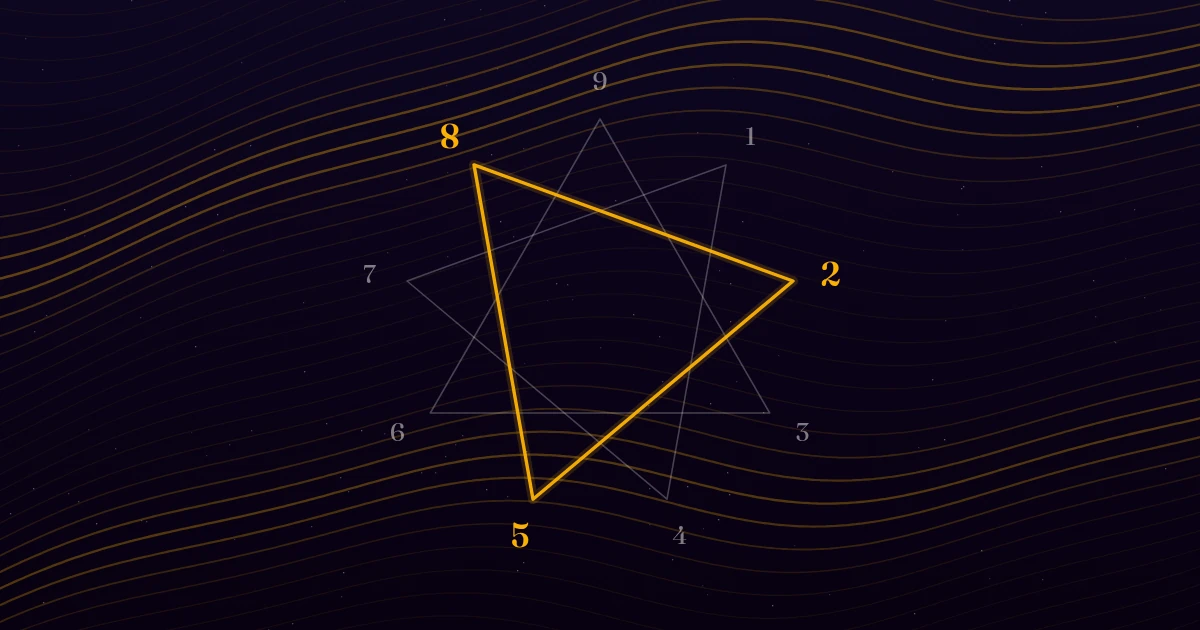
That order is the arithmetic of the set, and it is easiest to see with the nine written out from lowest to highest.

Carry the count one step past 852 and it reaches 963: 8 becomes 9, 5 becomes 6 and 2 becomes 3. One step more turns 9, 6 and 3 into 1, 7 and 4, so the count runs on to 174, then 285, and then 396, where the book's six begin. The three later numbers are the same count carried on until it comes back to its start, and the 2007 filing lists them in exactly that order.
The 528 Hz guide works through the verse arithmetic behind the first six, and the guide to the Solfeggio frequencies tells the story of the whole set, tone by tone.
Why is 963 Hz called the God frequency?
No early record explains the name. The 1999 press release leaves 963 out altogether, and neither the tuning fork maker's page nor the 2007 filing uses it.
Our reading is that the name follows the number's place: the highest tone of the set, matched with the crown, the highest of the chakras. Harmonance calls the tone stillness and unity instead, an intention to listen with rather than a promise about what it does.
Is 963 Hz the crown chakra frequency?
Only in modern charts. In yoga traditions the crown chakra, Sahasrara, is the seventh of the primary chakras, pictured at the top of the head as a lotus of a thousand petals in many colours. Those descriptions give it petals and colours, not a pitch.
Frequencies were matched to the chakras much later. As the guide to chakras and frequencies puts it, the frequencies paired with each centre in modern guides are a recent addition. The match for 963 Hz is easy to see: the highest of the nine tones sits with the highest of the seven centres.
What happened when researchers played 963 Hz to people?
Two studies that played 963 Hz to people could be read in full, and both point away from calm. PubMed, the main index of medical research, lists no study of listening to 963 Hz; these two appeared in other journals.
37 adults rating twelve pure tones, Canberra
Researchers at the Australian National University ran an online test in which 37 adults, aged 20 to 55, heard twelve pure tones for 20 seconds each: the nine Solfeggio tones plus 110, 220 and 440 Hz (Kumar, Abhayapala and Samarasinghe, 2022). For each tone they rated, from 1 to 10, how happy, sad, calm and angry it sounded, comparing it with the tone before and the tone after.
Above 440 Hz the ratings for calm, happy and sad fell as the pitch rose, and the rating for anger climbed. 963 Hz, the highest tone, came last for calm, at about 2 out of 10, and first for anger, at about 9, as read from the paper's graph of the average ratings.
The test asked how each tone sounded, not how the listeners felt. The tones always came in rising order and were judged against their neighbours, so the highest tone was bound to sit at the end of every trend. The volunteers used their own headphones at home, and the authors note that most were young and had experience of listening to audio critically. What the test does suggest is that many people hear a high pure tone as less calm than a low one, which is worth knowing before choosing one to wind down with.
Two adults and five minutes of sound, Japan
A small pilot in Japan gave each of five Solfeggio tones, 174, 396, 528, 639 and 963 Hz, to two healthy adults (Wago, Bando and others, 2026). Each heard five minutes of the sound alone and then the sound with a colour video, ten minutes in all, while the researchers recorded brainwaves and heart rhythm, took saliva samples and asked for a relaxation score out of 10. Everyone knew what they were hearing, and there was no comparison group.
| Measure | First listener | Second listener |
|---|---|---|
| Alpha, sound alone | 49.1 to 18.4 | 89.2 to 70.8 |
| Alpha, sound and video | 36.9 to 53.6 | 100.3 to 85.3 |
| Relaxation, sound alone | 6 | 5 |
| Relaxation, sound and video | 8 | 4 |
With the sound alone, alpha power fell in both listeners. The authors read higher alpha with the eyes closed as a sign of relaxation, so they take the fall as a turn towards alertness:
963 Hz does not uniformly induce a sedative effect but may instead trigger a more activated or stimulating state in certain individuals
Their relaxation scores after the sound alone, 6 and 5 out of 10, were lower than most: six of the seven other listeners who gave a score gave 8 or 9, and one gave 0. The heart rhythm results were mixed. A ratio the authors read as the balance between arousal and rest, LF/HF, moved towards rest in the first listener, from 4.64 to 1.58, and towards arousal in the second, from 0.85 to 1.66.
A later paper from the same group sums up its reading of 963 Hz as "rather attentional modulation": a tone that may steer attention more than it settles. The group is plain about its limits: the number of people is "small and insufficient for statistical verification", the influence of expectation "cannot be completely excluded", and the first paper says that comparing the tones with each other was not its purpose. The authors call for randomised trials or many more cases.
What the two add up to
Neither study shows a benefit of 963 Hz, or any harm. They used different sounds, different measures and very different numbers of people, and both found 963 Hz further from calm than the lower tones. Both are small, and the wider field is not much further along. The US National Center for Complementary and Integrative Health sums up music research in general:
However, because much of the research on music-based interventions is preliminary, few definite conclusions about their effects have been reached.
For listening, the useful part is the direction. If you reach for 963 Hz to wind down, notice whether it leaves you settled or more awake. If it is the second, try a lower tone such as 174 Hz, which the Canberra volunteers rated among the calmest-sounding of the twelve.
What does 963 Hz sound like?
963 Hz is a high, bright tone. On a piano tuned to A at 440 Hz it falls between B flat and B, nearly two octaves above middle C: 56 cents above the B flat at 932.33 Hz and 44 cents below the B at 987.77 Hz, where a cent is a hundredth of a semitone. Halve it again and again and you get its lower octaves, the same note further down: 481.5, 240.75, 120.38 and 60.19 Hz.
The 963 Hz page plays it in two ways, and we measured both from the page's own audio files.

| Octave band | Tone alone | Strings |
|---|---|---|
| 1,926 Hz, one octave up | 0.5% | 0.1% |
| 963 Hz, the tone itself | 99.5% | 4.0% |
| 481.5 Hz, one octave down | 0% | 24.9% |
| 240.75 Hz, two octaves down | 0% | 48.7% |
| 120.38 Hz, three octaves down | 0% | 21.3% |
| 60.19 Hz, four octaves down | 0% | 1.0% |
Download the measurements (CSV)
With Strings off, the page plays the tone on its own. It is not a perfectly pure sine: two faint overtones sit above it, at 1,926 Hz, 23.1 dB quieter, and at 2,889 Hz, 34 dB quieter.
With Strings on, the picture turns over, and almost all the sound lies between 85 and 681 Hz. The strings play a chord built on the tone's own lower octaves: their eight strongest lines are octaves of 963 Hz, at 120.5 and 241.3 Hz, and the third, fifth and sixth above them, and the strongest of all is the fifth, at 181.2 Hz. The exact 963 Hz tone still plays underneath, far below the music.
Played at the same level, 963 Hz also sounds louder than the low Solfeggio tones, because the ear grows more sensitive as pitch rises towards the range where it is most sensitive, between 2 and 5 kHz. In the equal-loudness model Harmonance uses for its own sound, the international standard ISO 226, 963 Hz at the site's level reads about 60 phon, a measure of how loud a tone seems, against about 47 for 174 Hz: roughly two and a half times as loud. It is a model of an average ear, not a listener, and it is why the page suggests a low volume.
How long should you listen to 963 Hz, and how loud?
No study sets a length for 963 Hz: the pilot played it for five minutes and the rating test for 20 seconds. Harmonance's page suggests ten to twenty minutes at a low volume, often as the closing sound of a quiet sitting, and you can stop whenever it no longer feels comfortable.
Keep the volume low, since a high tone sounds louder than a low one at the same setting. Loud listening is the one risk that is well established. The US National Center for Complementary and Integrative Health notes that "listening to music at too high a volume can contribute to noise-induced hearing loss", and the World Health Organization's safe listening advice is that "you can safely listen to a sound level of 80dB for up to 40 hours a week", with your device's volume at no more than 60% of maximum.
How do you listen to 963 Hz on Harmonance?
Press play on the 963 Hz page. With Strings off it plays the tone alone; switch Strings on beside the player and the strings carry the same note in lower octaves. Nothing plays until you press play, and no account is needed.
In Harmonance Studio you can set 963 Hz beside other tones and shape your own mix. Its nearest neighbour in the set is 852 Hz, and the Solfeggio collection plays all nine.
The Can't sleep page lists 963 Hz too, because some listeners save it for the end of the day. Both studies point the other way, so if you try it at night, notice whether it settles you or wakes you up.
For the wider field, what the science of sound healing shows sets out what research on sound and music has and has not found, and the guide to 174, 417 and 741 Hz follows three of 963 Hz's companions in the set.
Sources and limits
The history of the number rests on the 1999 press release, a tuning fork maker's page and a US trademark record, each read in its original or archived form. The research is two small studies: an online rating test of pure tones, and a pilot with two listeners for this tone. Neither can say what 963 Hz does for anyone. A third, a study of six pure tones in the Journal of Scientific Exploration, could not be opened, so whether it included 963 Hz is not known. The measurements of the 963 Hz page are Harmonance's own, made from the page's audio files, and the loudness comparison comes from a model of an average ear, not from listeners.
- Tetrahedron Publishing (1999), press release for Healing Codes for the Biological Apocalypse, Internet Archive copy: the six numbers the book announced.
- SomaEnergetics, tuning fork product page, Internet Archive copy from 2012: sets of nine by November 2000.
- US Patent and Trademark Office, application 77099679: all nine numbers, filed in February 2007.
- Kumar, Abhayapala and Samarasinghe (2022), frequency cues for human emotions, in Acoustics: 37 adults rating twelve pure tones.
- Wago, Bando and others (2026), Frequency-related Exploratory Research No. 1: the pilot's design and first reading.
- Wago, Bando and others (2026), Frequency-related Exploratory Research No. 2: the two listeners who heard 963 Hz.
- Bando, Wago and others (2026), multisensory relaxation with Solfeggio frequencies: the pilot's limits in the authors' words.
- Tanaka, Bando and others (2026), audio and visual stimuli with Solfeggio frequencies: the group's later reading of 963 Hz.
- Wikipedia, Sahasrara: the crown chakra in yoga traditions.
- Wikipedia, equal-loudness contour: where hearing is most sensitive, and the phon.
- National Center for Complementary and Integrative Health, music and health: the state of music research, and loud listening.
- World Health Organization, safe listening: weekly limits and device volume.
Tones to play while you read
Related guides
174 Hz, 417 Hz and 741 Hz played together
174 Hz 417 Hz 741 Hz played together: why the three Solfeggio tones sit smoothly in the ear, where the numbers come from and what has been studied.
528 Hz benefits: what the studies show
528 Hz benefits, checked against the research: what five small studies in people measured, where the claims began, and what no study has shown.
Alpha Waves: What They Are and How to Listen
Alpha waves, the rhythm of calm, eyes-closed rest: what the term means, how binaural beats relate to it, and what the studies actually show.
Just be curious. This is not a medical device or medical advice. For any health concern, please speak to your doctor.