The Om frequency: why 136.1 Hz is called Om
The Om frequency is 136.1 Hz, a planetary tone: the Earth's year treated as one very slow vibration and doubled 32 times, a calculation Hans Cousto published in 1984. He named it the Om tone and wrote that Indian drones and chanted Om are tuned to it. The old texts give Om no pitch, and 547 hand-annotated concert recordings show singers choosing their own home note, called Sa.
Ready to play Earth Year 136.1 Hz
Notice the season you are living through.
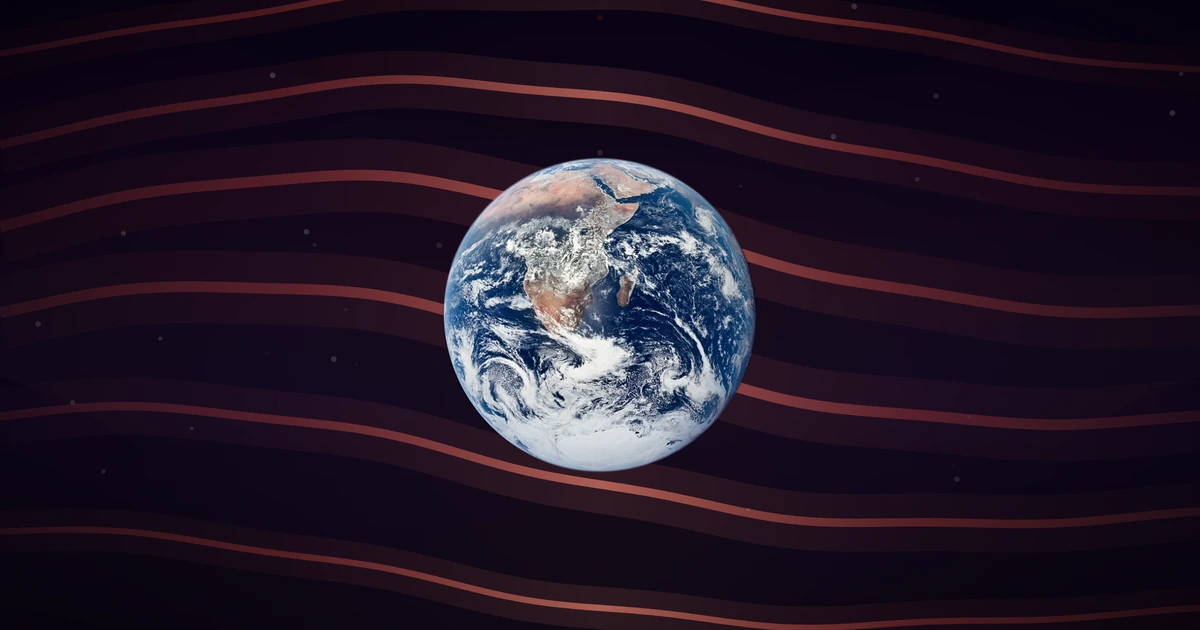
Where does 136.10 Hz come from?
It comes from the length of the year. NASA's Earth fact sheet gives the tropical year, the year of the seasons, as 365.242 days. Hans Cousto's page on the year tone gives the same year in seconds: 31,556,925.97. Read as a vibration, that is one cycle a year, about three hundred-millionths of a cycle a second.
Doubling a rate raises it by one octave. Double the year's rate 32 times, which multiplies it by 4,294,967,296, and it reaches 136.10 Hz, a low C sharp. The whole sum fits on one line: 4,294,967,296 divided by 31,556,925.97 seconds is 136.10 cycles a second.

Which year you start from barely matters. The sidereal year, one orbit timed against the stars, is 365.256 days on the same NASA sheet and gives 136.097 Hz. That is less than a tenth of a cent from 136.102 Hz, where a cent is a hundredth of a semitone. Even a plain calendar year of 365 days gives 136.19 Hz, about one cent higher.
Who first worked it out?
Hans Cousto, a Swiss mathematician and music researcher. The introduction to his planetary tuning tables dates the idea to 1978, in a shared flat in Munich: to carry the musical law of the octave beyond hearing, to every regular cycle in nature. He set out the method in his book The Cosmic Octave in 1984, and tuning forks in these tones have been in use ever since.
The same tables give the Earth year's tone as a C sharp at 136.10 Hz, and the A of that tuning as 432.10 Hz, 31 cents below the 440 Hz A of standard concert pitch. Every tone in Harmonance's planetary family comes from the same method. The Earth day doubled 24 times is 194.18 Hz, and the slow turn of the Earth's axis, the Platonic year, becomes 172.06 Hz. The guide to planetary frequencies sets out the whole family.
Why is 136.1 Hz called Om?
Because Cousto named it so. His page on the year tone, written in German, is headed "Der Jahreston (OM)": the year tone, Om. It says that in India this tone is the keynote of sitar and tanpura music, called Sadja, "father of the others", and that the holy syllable Om is tuned to it, as is most temple music.
The page adds that in the bells and instruments he checked, the difference from 136.10 Hz was very often well under one hertz. It names no instrument and gives no measurements, so the claim cannot be checked from the page. Indian concert tuning can be checked another way, because researchers have measured it recording by recording.
Do Indian musicians really tune to 136.1 Hz?
Some men do, but the tradition fixes no pitch: each artist chooses a tonic, Sa, to suit their own voice. CompMusic, from the Music Technology Group at Universitat Pompeu Fabra, describes the tonic as the base pitch an artist chooses for a performance, with every accompanying instrument tuned to it.
To see how close real concerts come, Harmonance counted the Indian Art Music Tonic Datasets, in which researchers marked by hand the tonic of the lead artist in each recording. Its second collection holds 547 vocal recordings by 79 Carnatic and Hindustani singers, 52 of them men and 27 women. The count covers those vocal recordings only, and what it publishes is counts per quarter-tone, never a single recording's details.

| Measure | Men | Women |
|---|---|---|
| Recordings | 364 | 183 |
| Singers | 52 | 27 |
| Lowest and highest Sa | 100.9 to 192.6 Hz | 138.7 to 245.5 Hz |
| Middle half of recordings | 131.6 to 147.7 Hz | 187.1 to 215.0 Hz |
| Middle value | 141.0 Hz | 197.2 Hz |
| Recordings within a quarter-tone of 136.10 Hz | 69 | 1 |
| Singers whose usual Sa is within a quarter-tone of 136.10 Hz | 10 | 0 |
The men's Sa runs from 100.9 Hz to 192.6 Hz, with half of all their recordings between 131.6 Hz and 147.7 Hz. Their middle value is 141.0 Hz, a little over half a semitone above the Om tone. Of the 364 men's recordings, 69, about one in five, sit within a quarter-tone of 136.10 Hz, and for 10 of the 52 men that is where Sa usually sits.
Carnatic singers sit closest. The middle value for Carnatic men is 134.2 Hz, only 24 cents below the Om tone, while Hindustani men centre higher, on 148.9 Hz. The women sing higher again: their Sa runs from 138.7 Hz to 245.5 Hz around a middle value of 197.2 Hz, and just one of their 183 recordings falls within a quarter-tone of 136.10 Hz. None of the 547 comes within a quarter-tone of its octave, 272.20 Hz.
So 136.10 Hz is a common Sa for a man, above all in Carnatic music, and a rare one for a woman. That is the pattern of a pitch chosen to suit each voice, with no shared keynote at 136.10 Hz. The recordings are a sample of commercial concerts, so they show how singers tune on record, not in every hall or temple.
What is Om in its own traditions?
A syllable to chant and meditate on, with no pitch attached. The Chandogya Upanishad opens with it. In Max Müller's translation: "Om, called the udgîtha; for the udgîtha (a portion of the Sâma-veda) is sung, beginning with Om." A few lines on, speech and breath form a couple, "joined together in the syllable Om."
The Mandukya Upanishad hears Om as the sounds a, u and m and a fourth part beyond them: "The fourth is without an element," it says, and closes, "Thus Om is the Self (Atman) indeed," in Robert Ernest Hume's translation. In the first book of Patanjali's Yoga Sutras, translated by Charles Johnston, the line "His word is OM." is followed by "Let there be soundless repetition of OM and meditation thereon."
None of these texts gives Om a frequency, and the Yoga Sutras ask for it in silence. Pitching Om to a number is a modern step, and 136.10 Hz is one answer among several.
Is Om 432 Hz or 528 Hz?
Neither, by tradition, though each number has its own link to Om. The 432 link runs through Cousto's tuning: with C sharp at 136.10 Hz, the A above it falls at 432.10 Hz. Count 20 equal semitones up the keyboard, each a step of the twelfth root of two and 3.1748 in all, and the Om tone, 136.102 Hz to three decimals, becomes 432.10 Hz. Standard tuning, with A at 440 Hz, puts the same C sharp at 138.59 Hz.

So music tuned to 432 Hz in equal steps holds a C sharp at 136.07 Hz, a fraction of a hertz from the Om tone. The guide to 432 Hz and Pythagorean tuning follows that tuning further.
The 528 link comes from research. A randomised trial in 2025 used an Om chant "specially composed and recorded at the frequency of 528 Hz by one of the authors of the study". One group listened for 15 minutes a day for a month on top of standard care, and the other had standard care alone. With no Om at another pitch to compare, the trial cannot say whether 528 Hz itself played any part.
What happens when people chant Om?
They breathe slowly, and most of what has been measured follows from that. A 2025 review of Om meditation gathered 20 studies: 17 had no randomisation and 3 were randomised trials. Most lasted three days or less, and most were rated of fair quality.
In a small brain imaging study, 12 volunteers chanted Om aloud inside a scanner. Activity in limbic regions, areas tied to emotion, fell compared with rest, while a long "ssss" sound made no such change. A 2022 study of nine trained speech practitioners timed each Om at about 20 seconds, close to three breaths a minute, and found heartbeat and breathing rhythms moving more in step than at rest. A 2001 study in the BMJ found something similar with a yoga mantra and with the rosary in 23 adults: recited about six times a minute, both strengthened the body's own slow heart rhythms and brought them into step.
None of these studies used 136.10 Hz, or any fixed pitch: every voice chanted at its own. The groups were small, the sessions short, and the clearest changes travel with slow breathing, which a long Om demands. The chanting studies say nothing about listening to a recorded tone.
For listening, the lesson is the breath more than the number. A steady tone gives you something to breathe with and to hum against, at a pitch you can match. One listener wrote under Harmonance's 136.10 Hz Earth year video on YouTube:
Okay so the feeling I get is intense from this like you are actually using the right frequencies and maybe others were not even though it said they were
One comment is one person's experience, not a finding. Everyone hears it in their own way.
How do you listen to 136.10 Hz?
Press play at a low volume and let the tone run for a few minutes. Any speakers or headphones will do: it is one steady tone, unlike binaural beats, which need a different tone in each ear. To hum along, find the C sharp low in your voice; a higher voice can hum the octave above, 272.20 Hz, and stay in tune with it. Let each out-breath run long, as the chanting studies did, and stop whenever you like. Then notice the quiet afterwards.
The 136.10 Hz Earth year page plays the tone in full, and Harmonance Studio lets you layer it with other tones. If a busy mind brought you here, the overthinking page gathers 136.10 Hz with two other tones people reach for. The guides to using the human voice and to sound and spirituality go further into chanting, and the planetary collection holds every tone in the family.
Sources and limits
The year and the arithmetic come from NASA and Cousto's own tables, and the Om tradition from translations of the Upanishads and the Yoga Sutras. The tuning count is Harmonance's own, made from the Indian Art Music Tonic Datasets and published as counts only. The chanting studies are small, and none used a fixed pitch.
- NASA, Earth fact sheet: the tropical and sidereal years.
- Hans Cousto, tuning data for the planets: the 32nd octave of the Earth year, its A at 432.10 Hz, and where the method began.
- Hans Cousto, the year tone (in German): the year in seconds, the name Om and the claim about Indian tuning.
- Gulati and others (2014), Indian Art Music Tonic Datasets: the hand-marked tonic of every recording counted here.
- CompMusic, tonic identification in Indian art music: how an artist chooses the tonic.
- Chandogya Upanishad, translated by Max Müller: Om at the opening of the chant.
- Mandukya Upanishad, translated by Robert Ernest Hume (1921): Om and its fourth part.
- Patanjali, Yoga Sutras, translated by Charles Johnston (1912): the soundless repetition of Om.
- Bhoot and others (2025), Om chanting at 528 Hz: how the trial was designed.
- Kumar and others (2025), a review of Om meditation: 20 studies and their quality.
- Kalyani and others (2011), brain imaging of Om chanting: 12 volunteers.
- Hotho and others (2022), slow breathing in Om chanting: nine practitioners.
- Bernardi and others (2001), rosary prayer and yoga mantras: 23 adults.
- A listener's comment under Harmonance's 136.10 Hz Earth year video, quoted without the name.
Tones to play while you read
Related guides

174 Hz, 417 Hz and 741 Hz played together
174 Hz 417 Hz 741 Hz played together: why the three Solfeggio tones sit smoothly in the ear, where the numbers come from and what has been studied.
528 Hz benefits: what the studies show
528 Hz benefits, checked against the research: what five small studies in people measured, where the claims began, and what no study has shown.
Alpha Waves And Binaural Beats: A Listening Guide
Understand alpha-wave language, binaural beat basics, and how to use audio as a gentle focus or meditation support.
Just be curious. This is not a medical device or medical advice. For any health concern, please speak to your doctor.