Pluto frequency in Hz: where 140.25 Hz comes from
Pluto's frequency is 140.25 Hz, the tone Hans Cousto's cosmic octave gives Pluto. Take its orbit of the Sun, which Cousto's 1984 book put at 90,737.2 days or about 248 years, as one very slow vibration and double it 40 times: it becomes 140.25 Hz, a little above C sharp. Newer orbits give 140.52 or 140.64 Hz. No study has tested listening to any of them.
Ready to play Pluto 140.25 Hz
Reflect on what you are ready to leave behind.
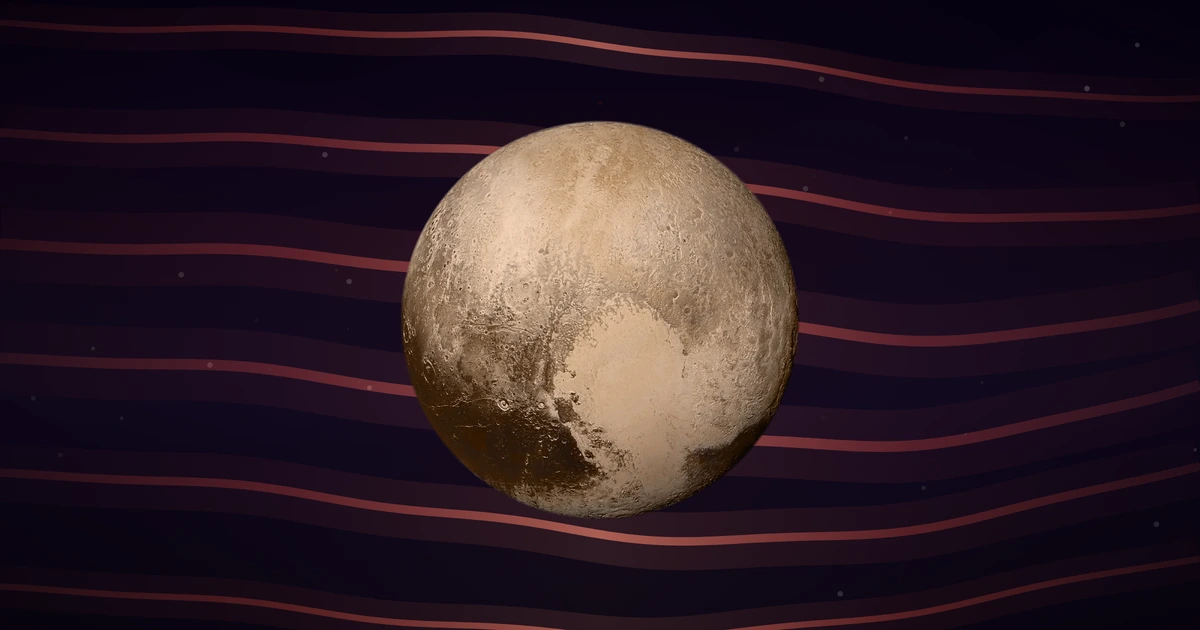
What is the Pluto frequency in Hz?
The Pluto frequency is 140.25 Hz, a low tone a fifth of a semitone above the C sharp below middle C. The number comes from the tables of planetary tones that the Swiss mathematician and music researcher Hans Cousto began in Munich in 1978 and called the cosmic octave. His book of 1984 gave Pluto 140.25 Hz, and Harmonance's Pluto page plays it.
You will also meet 140.64 Hz, and the same arithmetic on NASA's current orbit gives 140.52 Hz. All three come from one method applied to three measurements of one very long orbit, and this guide works through each. Harmonance's page links the tone with change, release and reflective transitions. Those associations come from astrology, which only met Pluto in 1930, not from a measurement.
How does Pluto's orbit become 140.25 Hz?
Pluto's orbit becomes 140.25 Hz by doubling, 40 times over. Cousto starts from the time Pluto takes to circle the Sun once, measured against the stars, which his book took as 90,737.2 days, about 248 Earth years; his tuning tables record that figure beside the newer one. Read as a vibration, that is one cycle every 7,839,694,080 seconds, the days multiplied by the 86,400 seconds in each: a frequency of 0.000000000127556 Hz, about 128 trillionths of a hertz.
Doubling a frequency raises it by one octave, the same note higher up. Doubling this one 40 times multiplies it by 1,099,511,627,776, a little over a trillion, and gives 140.249 Hz, which rounds to 140.25 Hz. Pluto and Neptune, the two slowest orbits in Cousto's planetary tables, both need 40 doublings; Mars needs 33. On a piano tuned to A at 440 Hz the nearest note is the C sharp at 138.59 Hz, and 140.25 Hz sits 20.6 cents above it, where a cent is a hundredth of a semitone. Tune an instrument's A to 445.27 Hz instead of 440 Hz, and its C sharp lands on 140.25 Hz.
The ladder runs on past hearing in both directions. Only octaves 38 to 47, from 35.06 to 17,951.92 Hz, fall inside the range of human hearing, and 140.25 Hz is the third of them. Forty-two doublings further up, at octave 82, the orbit reaches a frequency of visible light, a blue-green near 486 nanometres; Cousto's Pluto page gives the colour as "Blaugrün mit einer Wellenlänge von ca. 485 Nanometer", blue-green at about 485 nanometres. The guide to planetary frequencies works the same method through every planet, the Earth and the Moon.
Why do some sources say 140.64 Hz or 140.52 Hz?
Some sources say 140.64 or 140.52 Hz because Pluto's orbit has been measured more than once, and each figure gives its own tone. Cousto's tuning tables say so in a remark under Pluto: the 1984 book took 90,737.2 days, "which resulted in the frequency 140.25 Hz in the 40th octave", while "NASA determined an orbital period of 90487.277" days from more exact data, which gives 140.64 Hz. Planetware, the site that publishes Cousto's work, now heads its Pluto page with 140.64 Hz. NASA's own Pluto fact sheet gives the orbit as 90,560 days, and the same 40 doublings on that figure give 140.52 Hz.
| Orbit | Tone |
|---|---|
| Cousto's book, 1984: 90,737.2 days | 140.25 Hz, C sharp plus 20.6 cents |
| NASA fact sheet: 90,560 days | 140.52 Hz, C sharp plus 24 cents |
| NASA data in Cousto's later tables: 90,487.277 days | 140.64 Hz, C sharp plus 25.4 cents |
Pluto's orbit is hard to pin down because so little of it has been watched. Clyde Tombaugh found Pluto in February 1930, NASA's fact sheet records, and one orbit takes about 248 years. Planetware's note on its Pluto page says that by 2018 it had covered only about a third of its orbit since it was found ("hat Pluto bis 2018 erst etwa ein Drittel seiner Umlaufbahn um die Sonne zurückgelegt"). Its path is also stretched and tilted, so, the note goes on, the orbital data carry more uncertainty than a planet's. NASA gives the tilt as 17.16 degrees and the eccentricity, how far the orbit is from a true round path, as 0.2444, against 0.0167 for the Earth.
For listening, the gap is small. 140.52 Hz sits 3.3 cents above 140.25 Hz, and 140.64 Hz sits 4.8 cents above it. Harmonance keeps 140.25 Hz, Cousto's original number, on its page and in Studio, and shows the other two here so you can see what the tone rests on.
Which of Pluto's cycles gives which tone?
Each of Pluto's rhythms gives its own tone, and the orbit is only the best known. The same doubling works on any cycle, so the table below takes Pluto's day, the orbit of its largest moon, its synodic period and the orbit of its outermost moon from NASA's fact sheet and doubles each one until it can be heard.
| Cycle | Tone |
|---|---|
| Pluto's day: 153.2820 hours | 243.23 Hz, B (27 doublings) |
| Orbit of Charon: 6.3872 days | 243.21 Hz, B (27 doublings) |
| Synodic period: 366.73 days | 135.55 Hz, C sharp (32 doublings) |
| Orbit of Hydra: 38.20 days | 162.66 Hz, E (29 doublings) |
Pluto's day and Charon's month give the same tone, and that is no coincidence. NASA gives Pluto's day as 153.2820 hours and Charon's orbit as 6.3872 days, which is 153.29 hours, and 27 doublings take both to about 243.2 Hz, close to a B. Charon is about half Pluto's size, and the two turn in step, as NASA's Pluto page describes: "This means Charon neither rises nor sets, but hovers over the same spot on Pluto's surface."
The synodic period, from one opposition to the next as seen from Earth, is only a day and a half longer than our year, 366.73 days, because Pluto moves so slowly that the Earth catches up with it again almost at once. Thirty-two doublings make it 135.55 Hz, close to the 136.10 Hz Cousto gives the Earth year itself, the tone the guide to the Om frequency explores. Cousto's own synodic table gives 135.82 Hz for the same period; the table above works every row the same way from NASA's sheet rather than mixing the two.
Why is the Pluto tone a fifth below Neptune's?
The Pluto tone sits a fifth below Neptune's because Pluto's orbit keeps time with Neptune's. NASA's page on the Kuiper Belt explains: "Pluto is in a 3:2 resonance with Neptune, meaning it circles the Sun twice for every three times Neptune goes around." Doubling keeps the ratio between any two cycles, so a 3:2 ratio of orbits becomes a 3:2 ratio of tones, and in music 3:2 is a perfect fifth, the step from C up to G.
The numbers bear it out. NASA's Neptune fact sheet gives its orbit as 60,189.018 days, and 40 doublings make it 211.43 Hz, the Neptune tone. Against Pluto's 140.52 Hz on NASA's own figure, the ratio is 1.505, a fifth stretched by 5.3 cents. Against Harmonance's 140.25 Hz it is 1.508, 8.7 cents wide. Three of Neptune's orbits take 494.4 years and two of Pluto's take 495.9, which is why the fifth is close but not exact.

The pattern holds even though the two orbits cross. Pluto's stretched path brings it inside Neptune's for part of each orbit, and NASA's Pluto page notes that "From 1979 to 1999, Pluto was near perihelion, when it is closest to the Sun. During this time, Pluto was actually closer to the Sun than Neptune." There are enough small worlds on the same 3:2 orbit that, in NASA's words, "astronomers have given them their own category among the resonant KBOs: the plutinos".
Cousto heard the fifth too. His Pluto page says "Pluto ist sehr harmonisch zum Erdenmond und zum Neptun gestimmt. Er hat zu diesen beiden Himmelskörpern ein genaues Quint-Quart-Verhältnis": Pluto is tuned in harmony with the Moon and with Neptune, an exact fifth or fourth to both. With Neptune the reason is the resonance. With the Moon it is a meeting of numbers: Cousto's tables put the Moon's month at 210.42 Hz, a fifth above 140.25 Hz to within half a cent, yet nothing ties the Moon's orbit to Pluto's. The guide to the Moon frequency tells that tone's own story.
What does 140.25 Hz sound like?
140.25 Hz is a low, smooth tone a little above the C sharp below middle C. Halve it and you get its lower octaves, 70.13 and 35.06 Hz; double it and you get 280.5, 561 and 1,122 Hz, the same note higher up. The 140.25 Hz page plays it in two ways, and we measured both from the page's own audio files.

| Octave band | Tone alone | Strings |
|---|---|---|
| 1,122 Hz, three octaves up | 0% | 2.5% |
| 561 Hz, two octaves up | 0% | 15.5% |
| 280.5 Hz, one octave up | 0.5% | 49% |
| 140.25 Hz, the tone itself | 99.5% | 27.4% |
| 70.13 Hz, one octave down | 0% | 5.4% |
| 35.06 Hz, two octaves down | 0% | 0% |
Download the measurements (CSV)
With Strings off, the page plays the tone on its own, as a loop of 20 seconds. It is close to a pure sine: two faint overtones sit above it, at 280.5 Hz, 23.1 dB quieter, and at 420.75 Hz, 34 dB quieter.
With Strings on, most of the sound moves above the tone: 49% of it lies one octave up, against 27.4% in the tone's own band. The strings play notes of the C sharp major scale, the scale of the tone's own C sharp, and their eight strongest lines are F sharp at 93.7 Hz, G sharp at 105.2 Hz, A sharp at 117.8 Hz, C sharp at 140.4 Hz, D sharp at 157.5 Hz, F sharp at 187.5 Hz, G sharp at 210.5 Hz, the strongest of all, and E sharp at 353.5 Hz. The exact 140.25 Hz tone still plays underneath, 35.4 dB below the music. The strongest line is the fifth above the tone, within a hertz of the Neptune tone, though that comes from the harmony of the arrangement, not from astronomy. The guide to the Mars frequency measured the same shape for 144.72 Hz: a low planetary tone sits under its strings, not over them.
Why is Pluto linked with Scorpio?
Pluto is linked with Scorpio by modern astrology, because the classical scheme was settled long before anyone knew Pluto was there. The ancient houses gave Scorpio to Mars, as the guide to the Mars frequency explains from Ptolemy, and astrologers added Pluto to the sign after its discovery in 1930. Cousto kept the modern picture. His Pluto page notes that "Pluto wird allgemein dem Sternzeichen Skorpion zugeordnet", Pluto is generally assigned to Scorpio, and for the tone he writes "Fördert das magisch-gruppendynamische Prinzip": it furthers the magical, group-dynamic principle. That is his reading, offered without a study, and no study has tested it since.
The name came from a schoolgirl. NASA's Pluto page says plainly that "Pluto was named by an 11-year-old girl": Venetia Burney of Oxford "suggested to her grandfather that the new discovery be named for the Roman god of the underworld", and the observatory chose it. Harmonance's own Pluto page draws the tone's themes of depth and change from that namesake.
Harmonance's Scorpio page plays both rulers: Mars for the older line and Pluto for the modern one, with the suggestion to try Mars first for brightness and Pluto second for depth. Both are symbolism to listen with, not a rule for anyone's life, and the guide to astrology and frequencies explains how signs, planets and tones connect.
Does it matter that Pluto is no longer a planet?
It makes no difference to the tone. "Pluto was reclassified as a dwarf planet in 2006 by the International Astronomical Union because other objects might cross its orbit," NASA explains. The cosmic octave needs only a cycle, and Pluto's orbit is the same whatever it is called; Cousto's tables now give tones for about 160 minor planets as well. NASA's New Horizons spacecraft flew past Pluto in July 2015, and the picture at the top of this guide comes from that flight.
Is there research on listening to 140.25 Hz?
No published study has tested listening to 140.25 Hz, or to 140.52 or 140.64 Hz. PubMed, the main index of medical research, holds two records that mention "140.25 Hz", one on blood flow in the brain and one on heart recordings, and neither is about listening. It holds none for "140.64 Hz", none for Pluto together with music, and four for "cosmic octave", all about other things such as aircrew hearing and astronomy instruments. Europe PMC, a wider index, returns nothing for "cosmic octave" or "140.64 Hz", and its two records for "140.25 Hz" are about other subjects too. So what people describe for the Pluto tone comes from tradition and personal experience, not from research.
Research on music in general is further along, but it is still early. The US National Center for Complementary and Integrative Health sums it up:
However, because much of the research on music-based interventions is preliminary, few definite conclusions about their effects have been reached.
None of that research used planetary tones. If you listen to 140.25 Hz, what you notice is yours to weigh: it is not an effect anyone has measured.
How do you listen to 140.25 Hz on Harmonance?
Press play on the 140.25 Hz Pluto page. With Strings off it plays the tone alone; switch Strings on beside the player, or open the page with Strings already on, and evolving strings play around a quiet 140.25 Hz tone. Nothing plays until you press play, and no account is needed.
No study sets a length for 140.25 Hz. The Pluto page suggests a short session of around ten minutes the first time, at a low volume, perhaps beside some reflective writing, and stepping away or switching to a brighter tone if the mood starts to feel heavier than helpful. Keep the volume comfortable whatever you choose: loud sound is the one listening risk that is well established. The same page from the National Center for Complementary and Integrative Health warns that "listening to music at too high a volume can contribute to noise-induced hearing loss", and the World Health Organization's safe listening advice is that "you can safely listen to a sound level of 80dB for up to 40 hours a week", with your device at no more than 60% of its maximum volume.
In Harmonance Studio you can set Pluto beside other tones and shape your own mix, and Pluto with the 211.44 Hz Neptune tone makes the fifth this guide describes. The planetary collection plays every planet's tone, and the astrological collection pairs the tones with the signs. For another low planetary tone, read the guide to the Mars frequency; for another slow outer planet, the guide to the Saturn frequency; and for what research on sound has and has not shown, the science of sound healing.
Sources and limits
The number rests on Cousto's tables, his Pluto page and NASA's fact sheets, read in their original form, and every tone in this guide is worked again here from them. The resonance with Neptune is NASA's; the fifth it makes between the two tones is worked here from NASA's orbits. The astrology is quoted from Cousto's own page, as tradition, not evidence. No study of listening to 140.25 Hz turned up in PubMed or Europe PMC, so none is reported. Harmonance has no video of the Pluto tone yet, so no listener's words are quoted, and the measurements of the 140.25 Hz page are Harmonance's own, made from the page's audio files.
- Hans Cousto, tuning data of the planets (Planetware, English edition): Pluto's orbit in the 1984 book and in NASA's later data, its octaves and note, Neptune's tone, the synodic table, the Moon and the Earth year.
- Hans Cousto, Pluto, from Die Töne der Kosmischen Oktave, with Planetware's note (in German): the two orbits, the uncertain data, the colour, Scorpio, the fifth and the tone's effect in his words.
- NASA Space Science Data Coordinated Archive, Pluto fact sheet: the orbit, its tilt and stretch, the synodic period, the day, the discovery and the moons.
- NASA Space Science Data Coordinated Archive, Neptune fact sheet: Neptune's orbit.
- NASA Science, Kuiper Belt facts: the 3:2 resonance with Neptune and the plutinos.
- NASA Science, Pluto facts: Charon in step with Pluto's day, the crossing of Neptune's orbit, the name, the reclassification and New Horizons.
- National Center for Complementary and Integrative Health, Music and Health: the state of music research, and loud listening.
- World Health Organization, safe listening: weekly limits and device volume.
Tones to play while you read
Related guides
111 Hz benefits and the ancient chamber story
111 Hz benefits, checked: the angel number behind the tone, the stone chambers that ring near 110 Hz, and what a pilot found when 30 adults listened.
141.27 Hz benefits: what the Mercury frequency is and is not
141.27 Hz benefits, checked: the Mercury tone is its 88-day orbit raised 30 octaves, its spin sounds the fifth above, and no study has tested it.
174 Hz benefits: the claims and what is known
174 Hz benefits, checked: the comfort and natural anaesthetic claims, where the number came from, and how 37 listeners rated the lowest Solfeggio tone.
Just be curious. This is not a medical device or medical advice. For any health concern, please speak to your doctor.