210.42 Hz benefits: what the Moon tone is, and what is known
210.42 Hz is the Moon tone of Hans Cousto's cosmic octave: the average lunar month, 29.53 days from new moon to new moon, raised 29 octaves until it can be heard, as a G sharp. The benefits linked to it, such as emotional balance, creativity and sexual energy, come from Cousto's notes and the chakra tradition. No study has tested 210.42 Hz itself.
Ready to play The Moon 210.42 Hz
Spend a quiet moment reflecting on your evening.
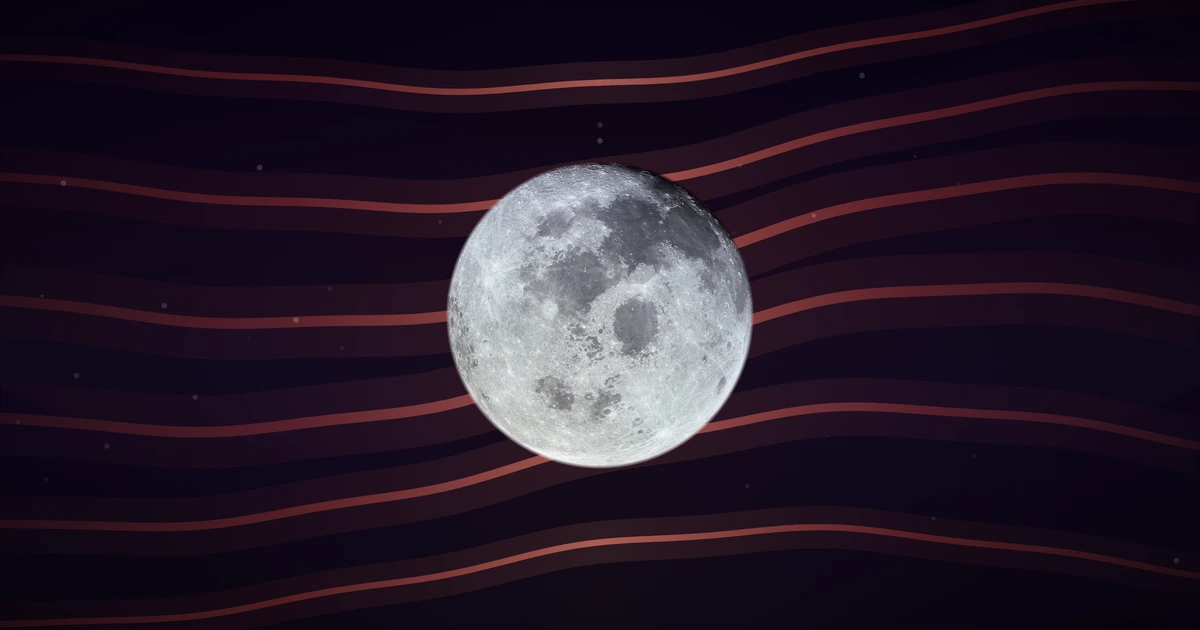
Where does 210.42 Hz come from?
It comes from the Moon's cycle of phases. NASA's Moon fact sheet gives 29.53 days from one new moon to the next, the period astronomers call the synodic month. Fred Espenak's page on the Moon's orbit, written for NASA's Goddard Space Flight Center, gives its mean length closer still: 29.53059 days, or 29 days, 12 hours, 44 minutes and 3 seconds.
Read as a vibration, that month is one cycle every 2,551,442.8 seconds, far too slow to hear. Doubling a rate raises it by one octave. Double the month's rate 29 times, which multiplies it by 536,870,912, and it reaches 210.42 Hz, the G sharp below middle C. The whole sum fits on one line: 536,870,912 divided by 2,551,442.8 seconds is 210.42 cycles a second.

Every octave on the way is the same month in another register. Hans Cousto's tuning tables list them all: the 25th to the 30th octaves are 13.15, 26.30, 52.60, 105.21, 210.42 and 420.84 Hz. The 22nd, 1.64 Hz, is too slow to hear as a pitch, so the tables give it as a tempo instead, 98.63 beats a minute.
Who first worked it out?
Hans Cousto, a Swiss mathematician and music researcher. His tables date the idea to 1978, in a shared flat in Munich: to carry the musical law of the octave beyond the range of hearing to every regular oscillation, starting with the rhythms of the Earth, the Moon, the planets and the Sun. He published the method in his book The Cosmic Octave in 1984. The same tables time the synodic month at 29 days, 12 hours, 44 minutes and 2.8 seconds and name its 29th octave as 210.42 Hz, a G sharp.
They also give the A that belongs to this G sharp: 445.86 Hz, which is 22.91 cents above the 440 Hz A of standard concert pitch. A cent is a hundredth of a semitone, so the Moon tone sits a little under a quarter of a semitone above the piano's G sharp, 207.65 Hz.
Every tone in Harmonance's planetary family comes from the same method. The Earth's year raised 32 octaves is 136.10 Hz, known as the Om frequency, and the Earth's day raised 24 octaves is 194.18 Hz. The guide to planetary frequencies sets out the whole cosmic octave, and the planetary collection plays each tone.
What are the benefits of 210.42 Hz?
The benefits named for 210.42 Hz are symbolic. They come from Cousto's own notes, from the chakra tradition and from astrology's Moon, and no study has tested any of them.
Start with Cousto's own notes. His page on the Moon tone, in German, gives its chakra as Svadisthana and its effect in two phrases: "Stimuliert die sexuelle Energie, fördert die erotische Kommunikation", that is, it stimulates sexual energy and encourages erotic communication. He suggests it as meditation music for full-moon rituals, or simply as music for a full-moon party. The same entry goes on to medical uses, which no study has tested and Harmonance does not claim.
The chakra link carries most of the other claims. Svadisthana, more often spelt Svadhishthana, is the second primary chakra. In its imagery the element of water is shown as a silver crescent, the shape of a young Moon, and the tradition ties it to emotion, to desire and to creativity. The guide to chakra frequencies follows all seven centres.
Astrology adds a sign. In Western astrology the Moon rules the fourth sign of the zodiac, the Crab: the cardinal water sign, with the Moon as its ruling planet, in the scheme of rulerships set out in Ptolemy's Tetrabiblos. Harmonance's zodiac page for the Crab pairs it with this tone, and the guide to astrology frequencies does the same for every sign and its ruling planet.
So when a video or a website lists emotional balance, creativity or sexual energy as benefits of 210.42 Hz, those words come from these traditions. They describe meanings people have given the Moon and its chakra, not something measured in listeners. Read them as interpretation.
Is every lunar month 29.53 days long?
No. 29.53 days is an average, and single months stray from it. Espenak's page says a lunation can differ from the mean by up to seven hours. The shortest come when the new moon falls near perigee, the Moon's closest point to Earth, and the longest near apogee, its farthest point, in a pattern that repeats about every 412 days. Cousto's own page says the same thing: from one lunation to the next the length can differ by several hours, and over the years by more than 13.
To see what that means for the tone, Harmonance took NASA's table of every new moon from 2001 to 2100, timed to the minute in Universal Time, and turned each of the century's 1,236 lunar months into its own tone, exactly as Cousto turns the average month into 210.42 Hz.

| Lunar month | Length | Tone |
|---|---|---|
| The average, Cousto's month | 29.53 days | 210.42 Hz |
| Shortest of 2026 to 2030, from June 2026 | 29.28 days | 212.19 Hz |
| Longest of 2026 to 2030, from December 2026 | 29.81 days | 208.42 Hz |
| Shortest of the century, from June 2053 | 29.27 days | 212.26 Hz |
| Longest of the century, from December 2017 | 29.82 days | 208.35 Hz |
The months of this century run from 29.27 days to 29.82 days, so their tones run from 212.26 Hz down to 208.35 Hz, a spread of 32 cents, about a third of a semitone. A shorter month gives a higher tone. Only 71 of the 1,236 months come within a tenth of a hertz of 210.42 Hz, and 344 within half a hertz.
So 210.42 Hz is the Moon's average, and most real months miss it. They circle it in the slow wave the chart shows, cresting about every 14 lunar months: Espenak's cycle of about 412 days, turned into pitch. The century's mean month, 29.5303 days, still gives 210.42 Hz.
Which lunar month gives 210.42 Hz?
The month of the phases. Astronomers time the Moon's orbit in four ways, and each makes its own tone at the same 29th octave. The synodic month runs from new moon to new moon, and it is the longest of the four, because the Earth carries the Moon around the Sun and the Moon needs about two more days to line up with the Sun again.
| Lunar month | Length in days | Tone in Hz |
|---|---|---|
| Synodic, new moon to new moon | 29.53059 | 210.42 |
| Anomalistic, perigee to perigee | 27.55455 | 225.51 |
| Sidereal, once round against the stars | 27.32166 | 227.43 |
| Draconic, node to node | 27.21222 | 228.35 |
The four lengths are Espenak's. Cousto's tables give the sidereal month its own tone, 227.43 Hz, a B flat, 135 cents above the Moon tone; the anomalistic and draconic tones are Harmonance's arithmetic on the same method. Cousto built the Moon tone from the synodic month because it is the cycle anyone can watch: new moon, full moon and new moon again.
Does the Moon change how people sleep?
Perhaps a little, and the evidence is mixed. In 2013, sleep researchers went back over sleep recordings from their laboratory, made under conditions that kept out light at night, and sorted the nights by lunar phase. Around the full moon, the brain activity of deep sleep was 30 per cent lower, people took 5 minutes longer to fall asleep and slept 20 minutes less, measured by EEG.
Other sleep researchers then checked larger samples of their own, in a letter named after the file drawer problem, the habit of leaving results that find nothing unpublished. Their three samples, sized 366, 29 and 870 against the first study's 33, showed no effect of lunar phase on sleep. The first team replied that the larger analysis had indeed "found no significant effects", and added: "More is not necessarily better."
A field study in 2021 took the question out of the laboratory. Wrist monitors tracked sleep in three Toba/Qom communities in Argentina, one in a city and two in the countryside, one of them without electricity, and among 464 University of Washington students. In each group, sleep started later and was shorter on the nights before the full moon, when moonlight lasts into the evening, most of all 3 to 5 days before it. Each person's nightly sleep changed by 20 to more than 90 minutes across the cycle.
The 2021 authors put the pattern down to light: early-night moonlight once kept people up and about, and artificial light may now play the same part. None of these studies involved a tone. They concern the Moon's light and timing, not listening to 210.42 Hz, and the guide to delta waves explains the slow rhythms of deep sleep they measured.
Has any study tested 210.42 Hz?
No. No published study has tested 210.42 Hz, or any tone of Cousto's cosmic octave, on people listening. The nearest evidence concerns recorded music, and the strongest of it concerns sleep.
A Cochrane review in 2022 gathered 13 randomised trials with 1,007 adults who had trouble sleeping. They listened to recorded music for 25 to 60 minutes a day, for three days to three months. In 10 of the trials, with 708 people, those who listened scored about 2.8 points lower than those who did not on the Pittsburgh Sleep Quality Index, a questionnaire that runs from 0 to 21, where a higher score means poorer sleep. The authors rated this moderate-certainty evidence of improved sleep quality. Sleep timed by instruments, such as how long it took to fall asleep, may not change.
Those trials played music, not a single steady tone, and none of them used 210.42 Hz. NCCIH, the US National Center for Complementary and Integrative Health, says much of the research on music for health is preliminary, so "few definite conclusions about their effects have been reached". That is why Harmonance shares 210.42 Hz as a tradition and a pitch to listen with, not settled science. The guide to the science of sound healing sets out what listening research does and does not show.
What does the 210.42 Hz page play?
A steady tone at exactly 210.42 Hz, with two quiet overtones. Harmonance measured the loop the 210.42 Hz Moon page plays, a file 100 seconds long, from its own samples. The strongest line sits at 210.42 Hz to a hundredth of a hertz. Its octave, 420.84 Hz, is 23 dB quieter, and the next overtone, 631.26 Hz, is 34 dB quieter; nothing else comes within 43 dB of the tone.
The level rises and falls by less than 1 dB over each 20 seconds, and the loop closes on itself, so it can repeat for as long as you leave it. The same page has a Strings mode too: strings tuned to octaves of 210.42 Hz, with the tone quiet underneath.
How do you listen to 210.42 Hz?
Press play at a low volume and let the tone run. Any speakers or headphones will do, since it is one steady tone, unlike a binaural beat, which needs a different tone in each ear. The World Health Organization's safe listening advice is to keep a device at no more than 60 per cent of its maximum volume, which matters most if you leave the tone on for hours.
To hum along, find the G sharp below middle C; a higher voice can hum the octave above, 420.84 Hz, and stay in tune with it. To move or play at the Moon's pace, use Cousto's tempo, 98.63 beats a minute. He suggests the tone for full-moon gatherings, but the page plays the same pitch at every phase, so any night will do. Notice how the room feels when you stop.
The 210.42 Hz Moon page plays the tone in full, and Harmonance Studio lets you layer it with other tones. If the evening finds you awake, the Can't sleep page gathers 210.42 Hz with Neptune's tone, 211.44 Hz, only 8 cents higher, and with 963 Hz. The planetary collection holds the rest of the cosmic octave.
Sources and limits
The month and its variations come from NASA and Fred Espenak's tables, the tone and its traditions from Cousto's own tables and pages, and the sleep findings from the studies themselves. The century of lunar months, the four tones and the measured page audio are Harmonance's own work from those sources. No study has tested 210.42 Hz itself, and the sleep studies concern moonlight and music, never a tone.
- NASA, Moon fact sheet: the synodic and sidereal periods.
- Fred Espenak, eclipses and the Moon's orbit (NASA Goddard): the mean month, how far single lunations stray, and the four ways to time a month.
- Fred Espenak, phases of the Moon, 2001 to 2100 (NASA Goddard): every new moon of the century, the data behind the chart.
- Hans Cousto, tuning data for the planets: the synodic month's octaves, its tempo, its A at 445.86 Hz, and the sidereal month's tone.
- Hans Cousto, the synodic Moon tone (in German): its chakra, its claimed effects and its uses.
- Wikipedia, Svadhishthana: the second chakra and its silver crescent.
- Wikipedia, the Moon's zodiac sign: the fourth sign, the Crab, and its ruling planet.
- Wikipedia, domicile in astrology: the sign rulerships of Ptolemy's Tetrabiblos.
- Cajochen and others (2013), the lunar cycle and human sleep, Current Biology: the laboratory recordings sorted by phase.
- Wikipedia, lunar effect: the sample sizes of the 2013 and 2014 analyses.
- Cordi and others (2014), lunar cycle effects on sleep and the file drawer problem, Current Biology: the unpublished data checked.
- Cajochen and others (2014), the reply to Cordi and others, Current Biology: the first team's answer.
- Casiraghi and others (2021), moonstruck sleep, Science Advances: sleep tracked by wrist monitors across the lunar cycle.
- Jespersen and others (2022), listening to music for sleep problems in adults, Cochrane review: 13 trials and their certainty.
- NCCIH, music and health: what you need to know: the state of music research.
- World Health Organization, safe listening: volume and time.
Tones to play while you read
Related guides
432 Hz benefits, chakras and the evidence
432 Hz benefits and chakra claims weighed: the tuning history, the chakra framework, and what studies of 432 Hz music have and have not found.
888 Hz meaning: the angel number, its history and its sound
888 Hz meaning comes from the number: angel books read eight as plenty, Chinese tradition counts it lucky, and in Greek the name Jesus adds up to 888.
Angel Numbers And Frequencies: Numerology As Listening Prompts
A grounded guide to angel-number symbolism, frequency labels, and reflective listening while keeping spiritual meaning in the realm of personal interpretation.
Just be curious. This is not a medical device or medical advice. For any health concern, please speak to your doctor.