Frequency guide
Listening context
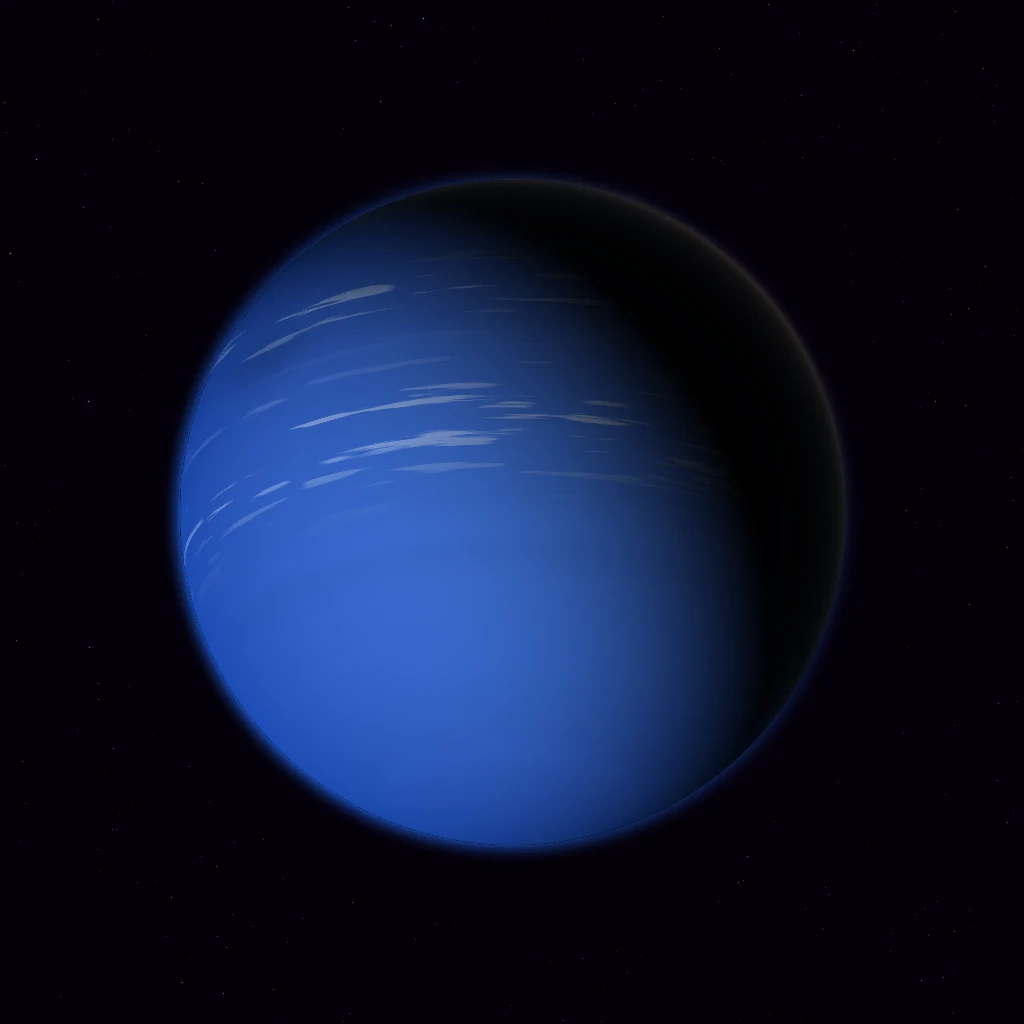
211.44 Hz is the tone that Hans Cousto's cosmic-octave system assigns to Neptune, the eighth and most distant major planet from the Sun. The pitch sits near a G-sharp in standard tuning and is often described as dreamy or oceanic in feel.
Origin: the astronomy and the octave maths
Cousto's method takes a real orbital period and doubles its frequency through octaves until it becomes audible. Doubling a frequency raises it by exactly one octave, so even an immensely slow orbit can be lifted, intact in its proportions, into the range of hearing.
Neptune takes 164.8 Earth years to circle the Sun, so deep an orbit that since its discovery in 1846 it has completed only a little more than one full lap. Cousto read that long period as a very low frequency and doubled it through forty octaves to reach about 211.44 Hz. The deep blue planet was, fittingly, the first to be found by mathematical prediction: astronomers calculated where an unseen world must be from wobbles in the orbit of Uranus, then pointed a telescope and found it. The tone, in the same spirit, is a calculation rather than a recording; sound cannot travel the vast empty distance between us and Neptune.
Tradition and mythology
Neptune is named for the Roman god of the sea, the Greek Poseidon, ruler of the ocean and of storms. Its deep blue colour, from methane in the atmosphere, made the watery name apt. Because Neptune too was discovered only in the modern era, it has no ancient astrological lineage; modern astrologers tied it to the sea-god's domain of depth and mystery, giving it themes of imagination, dreams, music, intuition, and the less defined edges of inner life. Cousto's tone gathers that sense of reverie into a single soft reference.
The story of Neptune's discovery is one of the great triumphs of mathematical astronomy. By the 1840s astronomers had noticed that Uranus was not quite keeping to its predicted path, as though tugged by an unseen body further out. Working independently, Urbain Le Verrier in France and John Couch Adams in England calculated where such a planet must lie. When Le Verrier sent his prediction to the Berlin Observatory in 1846, astronomers found Neptune within a degree of the spot that very night. Here was a world located by pencil and reason before any eye had seen it, fitting for a planet later tied to the imagination. Far out in the cold, it is a deep blue ice giant whipped by some of the fastest winds in the solar system.
How listeners use it
- A hushed, slightly underwater quality that softens the room.
- Easier access to loose, free-associative thinking that helps creative work.
- A backdrop for evening journaling, sketching, or slow stretching.
- A pre-sleep tone for some; others find it best earlier in the day.
What the evidence says
NCCIH’s overview concerns music-based interventions. Our inference is that this evidence does not establish a clinical benefit from this isolated 211.44 Hz tone. Personal enjoyment is a listening response, not a clinical measurement. Read the music research and its limits.
How to listen
- Try it at the end of the day when you want to soften the gap between work and rest.
- Keep the volume low; this tone benefits from sitting underneath the moment.
- Pair it with a five-minute breath practice or a few pages of free writing.
- A single low lamp and a closed laptop suit it well; layer in soft rainfall if you like texture.
- Stop or switch if it ever feels disorienting rather than restful.
211.44 Hz Neptune: Dreams, Intuition, And Listening Context
For direct playback, use the related frequency page: 211.44 Hz: Neptune.
211.44 Hz Neptune: dreams, intuition, and listening context
The Neptune tone is part of Hans Cousto's cosmic-octave system, which doubles the frequency calculated from a real orbital period through octaves until it becomes audible. Neptune takes about 165 Earth years to circle the Sun, the slowest orbit of the major planets, and the resulting reference has a soft, dreamy character that listeners associate with reverie and quiet imagination.
Where the symbolism comes from
In astrology Neptune symbolises dreams, intuition, and the imaginative, mystical side of life; it is tied to artistry and reverie. The planet was the first found by mathematical prediction rather than chance: in 1846 astronomers calculated where an unseen world must be from irregularities in Uranus's orbit, and there it was. Western astrology layered the themes of dreams and the boundless onto that distant blue world.
The figure is a translation of orbital motion, not a sound that crosses the vacuum of space. The dream symbolism is a frame for a softer, more open frame of mind, not a property of the audio.
How listeners use it
- A soft, spacious quality that suits reverie, slow reading, or gentle creative drift.
- A backdrop for meditation where you want fewer hard edges.
- A quiet accompaniment to an evening wind-down or rest.
Many people reach for it when they want a roomy, unhurried atmosphere. For ways to pair it with breath and stillness, see our sound bath listening guide.
How to listen
- Try a session of fifteen to thirty minutes in a calm, dimly lit space.
- Keep the volume low so the tone stays soft and enveloping.
- Pair it with slow breathing or a wandering, unforced meditation.
- Take it off if the softness tips into drowsiness when you need to stay alert.
Listen with this
If this tone suits you, these neighbouring references give you something to compare it with.
- 207.36 Hz: Uranus
- 210.42 Hz: Moon
- 172.06 Hz: Earth Platonic Year
- 7.83 Hz: Schumann Resonance (binaural)
Sources
NCCIH’s overview concerns music-based interventions. Our inference is that this evidence does not establish a clinical benefit from one isolated listening tone. Personal enjoyment is a listening response, not a clinical measurement. Read the music research and its limits.
Harmonance is for relaxation, reflection, and educational exploration. It is not medical advice and should not replace professional care.
What benefits are claimed for 211.44 Hz?
The traditional associations described above are listening themes, not measured outcomes. NCCIH’s overview concerns music-based interventions. Our inference is that this evidence does not establish a clinical benefit from this isolated 211.44 Hz tone. Personal enjoyment is a listening response, not a clinical measurement. Read the music research and its limits.
What is 211.44 Hz?
211.44 Hz means 211.44 cycles per second. Cousto doubles Neptune's 164.8-year orbit through octaves into this tone; the sea-god planet Poseidon or Neptune, found by mathematical prediction in 1846, became the modern symbol of dreams, imagination, and intuition.
Try the pitch, then notice
Press Play above when you are ready. Start quietly, listen briefly, and use the player’s volume control. Compare the neighbouring tones without judging one as medically superior. Stop if the sound is uncomfortable. Signed-in Studio lets you choose layers and timers; public listening needs no account.