Guide
Plain-language context
Carrier pitch is the sound you can hear
A 250 Hz tone repeats 250 times per second. That audible pitch is different from an 8 Hz label used for a binaural difference or an EEG rhythm. A plain 432 Hz or 528 Hz library preview is a pitch comparison, not an EEG demonstration.
A binaural difference is the gap between two ear inputs
For example,250 Hz at one ear and 258 Hz at the other gives an 8 Hz difference. Headphones keep those inputs separate. This example explains subtraction; it is not a claim that an 8 Hz sound is played directly or that the brain is forced into one state. A 2005 laboratory study measured auditory responses with 40 Hz differences and compared binaural and monaural stimulation. Its EEG measurement does not establish a health result from a browser preview.
Schwarz and Taylor’s primary auditory-response experiment
The usual EEG band names
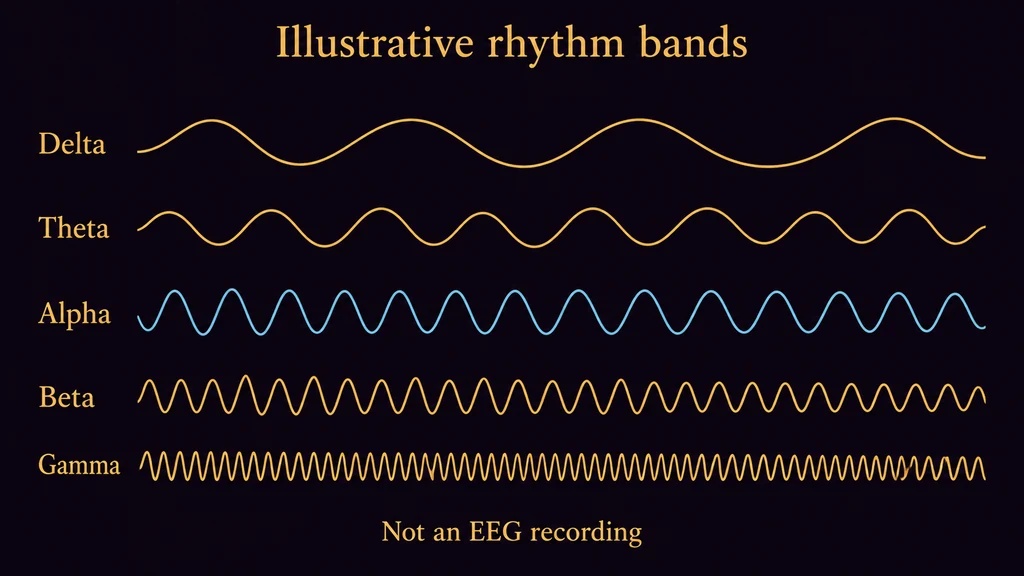
EEG records electrical activity with electrodes; a website waveform does not. Band boundaries vary across studies. The cited 2012 EEG study used delta 1 to 3 Hz, theta 4 to 7 Hz, alpha 8 to 11 Hz, beta 12 to 29 Hz and gamma 30 to 100 Hz. These are example recording categories, not instructions for which audible tone to choose.
- Delta: the slowest listed band.
- Theta: slower rhythmic activity.
- Alpha: a commonly studied waking rhythm.
- Beta: a faster band, covered here rather than on a duplicate beta keyword page.
- Gamma: higher-frequency activity that requires careful measurement and interpretation.
Read the primary 2012 EEG learning study and its band conventions
Compare two audible pitches
Play 432 Hz, pause, then play 528 Hz using the related listening buttons. Keep volume similar and notice the higher pitch. This comparison does not measure EEG, intelligence, attention or a clinical response. For customised carrier pairs, use the signed-in Studio and read its carrier labels.
Binaural and isochronic are different listening arrangements
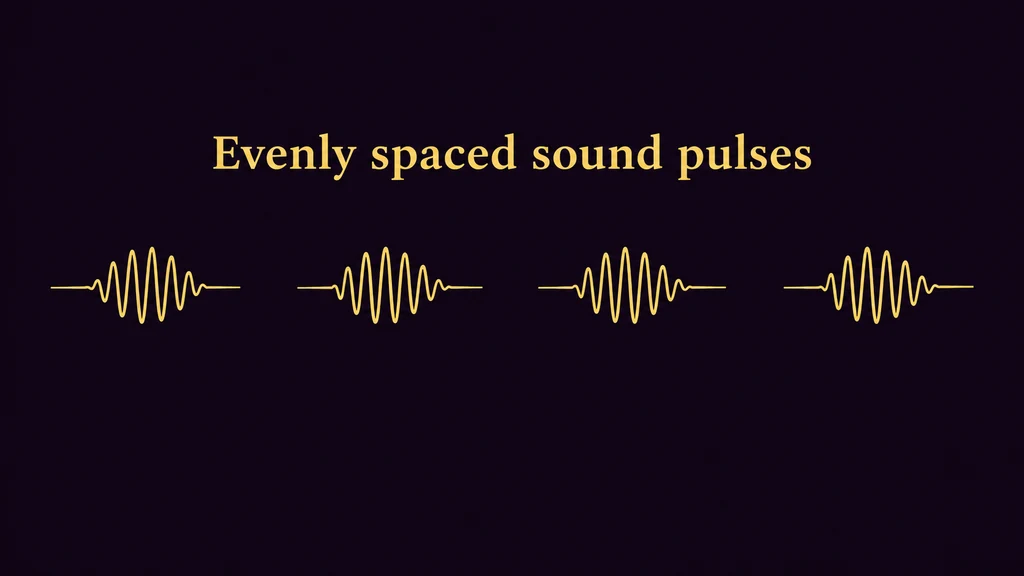
A binaural example separates two tones between the ears. Isochronic sound pulses one audible carrier with gaps. A slow pulse, a perceived beat difference and an EEG band may share a numerical rate without becoming the same physical measurement.
Read the existing band guides
Alpha, theta, delta and gamma retain their different listening and research contexts. Lambda and epsilon are not substitutes for the conventional band table.