Beta waves: what they are and what they do
Beta waves are the brain's electrical rhythm at about 13 to 30 cycles a second, faster and smaller than alpha. Hans Berger saw them replace alpha when eyes opened or the mind got to work. Over the brain's movement areas they dip as you move and rise above rest once you stop. In a review of 14 EEG studies, none using beta binaural beats found the brain following them.
Ready to play Rising Beta Session 16 to 24 Hz

What are beta waves?
Beta waves are rises and falls in the brain's electrical activity at between 13 and 30 cycles a second: faster and smaller than alpha, slower than gamma. The clinical glossary of the International Federation of Clinical Neurophysiology (IFCN), in its corrected form, sets the beta band at above 13 to 30 Hz, which makes a single beta wave 33 to 76 milliseconds long.
They are recorded with EEG, electroencephalography: electrodes on the scalp pick up the summed activity of many neurons beneath. In an awake adult, beta is most typical over the front and centre of the head, above the areas that plan and make movement, and it is small: the IFCN glossary puts it mostly below 30 microvolts. Below beta sit alpha at 8 to 13 Hz, theta at 4 to under 8 Hz and delta below that; gamma runs above 30 Hz. The guide to brainwave frequencies takes each band in turn, and alpha, the band below beta, and gamma, the band above, have guides of their own.
Who named beta waves?
Hans Berger named them. He published the first article on the human EEG in 1929, and a year later he described two kinds of wave. Alpha appeared when people had their eyes closed and were relaxed. When they opened their eyes, had their senses stimulated or did mental work such as counting, alpha gave way to smaller, faster waves, and he called those beta (Babiloni and colleagues' account of Berger's work). In 1938 he linked beta with active mental processes.
The line between the two was loose at first. Berger's division between alpha and beta fell at about 15 to 20 Hz, and Ectors, mapping the cortex of awake rabbits in 1936, called the two ranges waves of rest and waves of activity (Edwards and Chang's history of the band names). Today's glossary draws the line at 13 Hz.
What happens to beta waves when you move?
Beta waves fall while you move and rise above their resting level once you stop. Researchers have described this for decades, so Harmonance measured it in open recordings, to show it in real data with the numbers behind it.
The EEG Motor Movement/Imagery Dataset, shared on PhysioNet by the team behind the BCI2000 recording system, holds 64-electrode recordings of 109 volunteers. In three of each volunteer's runs (runs 3, 7 and 11), a target appeared on the left or right of a screen and the volunteer opened and closed that fist until the target went, about 4.1 seconds later, then rested for about 4 seconds before the next one.
For each movement we took the hand area of the brain on the side opposite the moving hand, kept only the beta band, 13 to 30 Hz, and compared its power with the same volunteer's rest from 1.5 to 0.5 seconds before the cue. Three volunteers were recorded at a different sampling rate and are left out, which leaves 106 volunteers and 4,459 movements.

| Moment | Opposite side | Same side |
|---|---|---|
| 1 s before the cue | -0.9% | +0.4% |
| The cue to move | -7.8% | -8.0% |
| 1 s in | -27.5% | -32.1% |
| 2 s in | -33.6% | -32.3% |
| 3 s in | -30.4% | -31.1% |
| 4.1 s, the target goes | -25.4% | -27.3% |
| 5 s | -0.5% | -21.8% |
| 6 s | +28.8% | -12.0% |
| 6.4 s | +30.2% | -14.6% |
| 7 s | +21.1% | -13.0% |
During the movement, beta over the opposite hand area fell for 96 of the 106 volunteers; for the middle volunteer it sat 28.8 per cent below rest from half a second to three and a half seconds in. Once the target went and the hand stopped, it swung the other way: between about 1 and 3 seconds after the target went, 97 of the 106 were above rest, the middle volunteer by 24.2 per cent. Over the hand area on the same side as the moving hand, beta fell as far during the movement, 30.1 per cent for the middle volunteer, but did not rebound: only 17 volunteers were above rest afterwards.
The dip and the rebound have names: event-related desynchronisation and synchronisation, a fall or a rise in a band's power around an event that differs from band to band (Pfurtscheller and Lopes da Silva). The rebound after a movement, around 20 Hz and strongest on the side of the head opposite the moving hand, was described in detail in 1996 and read as the sign of a movement area going idle (Pfurtscheller, Stancák and Neuper). The open recordings show the same pattern in more than a hundred people, one side rebounding and the other not.
What do beta waves do?
Nobody knows for certain. A 2010 review called the role of beta "not yet well understood", then put forward a hypothesis: that beta activity is related to keeping the current state, in movement or in thought, and is stronger when the status quo is meant to continue than when a change is expected (Engel and Fries). The movement data fit that picture. Beta drops as a hand starts to move and comes back, overshooting, once the hand is still.
Beta is also less steady than an average suggests. Look at single trials rather than averages and it comes in brief events: Shin and colleagues found beta events at 15 to 29 Hz lasting about 167 milliseconds on average in human brain recordings. In monkeys holding something in mind, Lundqvist and colleagues saw beta come in brief bursts that marked a default state, interrupted while information was being taken in or used.
Is more beta better for focus?
Not simply. Beta is often called the band of alert, active thinking, and Berger did link it with active mental processes, but more beta is not more focus. In Shin and colleagues' study of 10 people feeling for touches at the edge of what they could detect, a touch was more likely to be missed when a beta event came within about 200 milliseconds before it.
In Parkinson's, beta deep in the brain is linked with slow, stiff movement. In recordings from nine people with electrodes already implanted for deep brain stimulation, the more levodopa lowered activity at 8 to 35 Hz, the more their movement scores improved, for slowness and stiffness but not tremor. In a proof-of-principle study of 8 people, stimulation switched on only when beta rose improved movement scores by 66 per cent unblinded and 50 per cent blinded, with 56 per cent less stimulation time than stimulation left on all the time.
Some drugs bring out extra beta as well: the IFCN glossary lists alcohol, barbiturates, benzodiazepines and anaesthetics. And meditation does not simply lower it: across 56 EEG studies of mindfulness meditation, Lomas and colleagues found alpha and theta most often higher than at rest with eyes closed, and no consistent pattern in beta. Beta is better read as a sign of what the brain is holding steady than as a dial for concentration. Engel and Fries describe the risk of too much plainly: an abnormal persistence of the status quo.
What are high beta waves?
High beta usually means the top of the band, roughly 20 to 30 Hz, and on the scalp it is hard to measure cleanly. The muscles of the scalp, face and jaw make electrical activity at the same rates. In a study of two people recorded with and without full neuromuscular blockade, power above 20 Hz differed 10- to 200-fold between the two states, and the authors concluded that most of the scalp EEG above 20 Hz is muscle activity.
So a reading of high beta from a headband, or from a scalp recording with a tense jaw, may say more about muscle than about thought. The chart above uses the whole band and compares each volunteer with their own rest, and its rebound shows on one side of the head and not the other, the pattern a movement area gives; even so, scalp beta always carries some muscle.
What are beta binaural beats?
A beta binaural beat plays a slightly different steady tone in each ear, between 13 and 30 Hz apart, and your hearing turns the difference into a beat. The effect was first reported by H. W. Dove in 1839. It is made in the brainstem, where neurons that compare the timing of the two ears fire at the rate of the difference, and Oster found it was heard only with tones below about 1,000 Hz (Chaieb and colleagues' review).
What you hear changes with the rate. A 2023 systematic review sums up the classic findings: up to 20 Hz the beat is heard as a tone fluctuating in loudness, above 20 Hz as a rough sound, and beyond a difference of about 30 Hz the two tones are heard apart, with no beat at all. The binaural beat runs out at about the top of the beta band. Through a speaker, both tones reach both ears and mix in the air, so you hear an ordinary physical beat instead, a monaural beat; binaural beats and isochronic tones explains the difference.

Do beta binaural beats change the brain or focus?
Studies that recorded the brain have not found it following a beta beat, and studies of attention are small and mixed. The 2023 review looked at 14 EEG studies: five supported entrainment, the idea that brain rhythms fall into step with the beat, eight did not and one was mixed, and none of the studies using beats in the beta range found it. The question, in the review's words, remains open.
| Study | What people heard | What was found |
|---|---|---|
| Lane and colleagues | 29 people on a 30-minute watch task on three days, with beats at 16 and 24 Hz or slower beats in pink noise, not told the beats were there | More correct detections, fewer false alarms and a less negative mood with the beta beats |
| Goodin and colleagues | 31 people, beats at 7 or 16 Hz for two minutes during a vigilance task | No change in vigilance or in EEG power, compared with white noise |
| Vernon and colleagues | 22 people, a 20 Hz beat for ten one-minute blocks | The EEG did not follow the beat |
| Beauchene and colleagues | 28 adults, a 15 Hz beat on tones of 240 and 255 Hz during a memory task | Accuracy rose 3 per cent over five minutes while every other sound lowered it; reaction times did not change; links between brain regions in the EEG changed |
A 2019 meta-analysis of 22 studies found a medium average effect of binaural beats across memory, attention and other measures, varying with the beat used, how long people listened and when. It pooled many beat rates, so it cannot say what a beta beat does on its own. Lane's is the only study here that tested both 16 and 24 Hz, the two rates the Rising Beta Session starts and ends on, and it was small. A beta beat is real to hear; whether it changes attention is not settled, so listen because you like it, and notice for yourself.
What is the Rising Beta Session?
It is Harmonance's nine-hour beta piece: two pure tones and nothing else. The left ear hears 108 Hz the whole time; the right ear starts at 124 Hz and rises in one straight line to 132 Hz, so the beat rises from 16 Hz to 24 Hz, about 0.89 Hz an hour. It crosses 20 Hz, where the beat starts to sound rough, four and a half hours in. The session's page plays it free, with no ads, and if you prefer one steady rate, the 20 Hz beta binaural beat holds 20 Hz for nine hours. Both are part of the Binaural Beats collection.
| Moment | Right ear | Beat |
|---|---|---|
| First second | 124.00 Hz | 16.00 Hz |
| Halfway, 4 h 30 min | 128.00 Hz | 20.00 Hz |
| Last second | 132.00 Hz | 24.00 Hz |
We measured the uploaded master itself, not only the recipe. Its loudness reads -23 LUFS, and its peaks stay more than 21 dB below the loudest a recording can go. The slow rise is a listening choice: no study has shown that a rising beat does something a steady one does not.
How do you listen?
- Use headphones. The beat forms only when each ear gets its own tone. Turn off spatial audio or head tracking, and check that left and right are the right way round.
- Keep it quiet. The World Health Organization's safe listening advice gives 80 dB as safe for up to 40 hours a week and suggests keeping a device below 60 per cent of its maximum. Nine hours a day for a week is 63 hours, so for a session this long, keep the level well below that.
- Try it through one block of work. The Need to focus page gathers three tones people reach for at the start of focused work, this session among them. Play it quietly through one block, work the next in silence, and compare.
- Keep a practice. In Studio you can set a timer and save the mixes you come back to.
- Stop when you want to. Do not listen while driving or doing anything that needs your full attention, and take the headphones off if anything feels uncomfortable.
The guide to binaural beats covers the other rates, and the guide to delta waves follows the slowest band through a night of sleep.
Sources and limits
The movement chart comes from one open dataset of volunteers making a simple fist movement, recorded with a 64-electrode cap. Harmonance measured it with a standard method, beta power against a short rest before each cue, and the numbers are in the CSV beside the chart. The rests between movements lasted about 4 seconds, so the baseline is a short rest, not a long one. Scalp beta mixes brain and muscle activity, most of all above 20 Hz. The studies of beta binaural beats are few and small, and none tested the Rising Beta Session itself.
- Kane and colleagues, IFCN glossary of EEG terms: the bands, where beta is most typical, its size and what can raise it.
- Kane and colleagues, correction to the IFCN glossary: the beta band, above 13 to 30 Hz.
- Babiloni and colleagues, on Hans Berger and the alpha rhythm: how Berger described alpha and beta.
- Edwards and Chang, a history of the EEG band names: Berger's first division and Ectors' waves of rest and activity.
- EEG Motor Movement/Imagery Dataset, PhysioNet: the recordings behind the chart, used under the Open Data Commons Attribution licence.
- MNE-Python, the dataset's run numbers: which runs are real left and right hand movements.
- Schalk and colleagues, BCI2000: the recording system, and the paper PhysioNet asks its users to cite.
- Pfurtscheller and Lopes da Silva, event-related desynchronisation and synchronisation: the method behind the chart's measure.
- Pfurtscheller, Stancák and Neuper, beta after movement: the rebound and the idling motor area.
- Engel and Fries, beta and the status quo: what beta may do.
- Shin and colleagues, transient beta events: beta as brief events, and missed touches.
- Lundqvist and colleagues, gamma and beta bursts: beta bursts as a default state.
- Kühn and colleagues, levodopa and subthalamic activity: beta, levodopa and movement in nine people.
- Little and colleagues, adaptive deep brain stimulation: stimulation switched on by beta.
- Whitham and colleagues, scalp recording during paralysis: muscle activity above 20 Hz.
- Lomas and colleagues, mindfulness and EEG oscillations: meditation and the bands.
- Chaieb and colleagues, auditory beat stimulation: how a binaural beat is made, and its history.
- Ingendoh and colleagues, binaural beats and brain activity, a systematic review: what a beat sounds like at each rate, and the EEG studies.
- Garcia-Argibay and colleagues, a meta-analysis of binaural beats: the average effect across 22 studies.
- Lane and colleagues, binaural beats, vigilance and mood: beats at 16 and 24 Hz.
- Goodin and colleagues, a high-density EEG study of binaural beats: beats at 7 and 16 Hz.
- Vernon and colleagues, alpha and beta binaural beats in the EEG: a beat at 20 Hz.
- Beauchene and colleagues, binaural beats and working memory: a beat at 15 Hz.
- World Health Organization, safe listening: how loud, for how long.
Tones to play while you read
Related guides
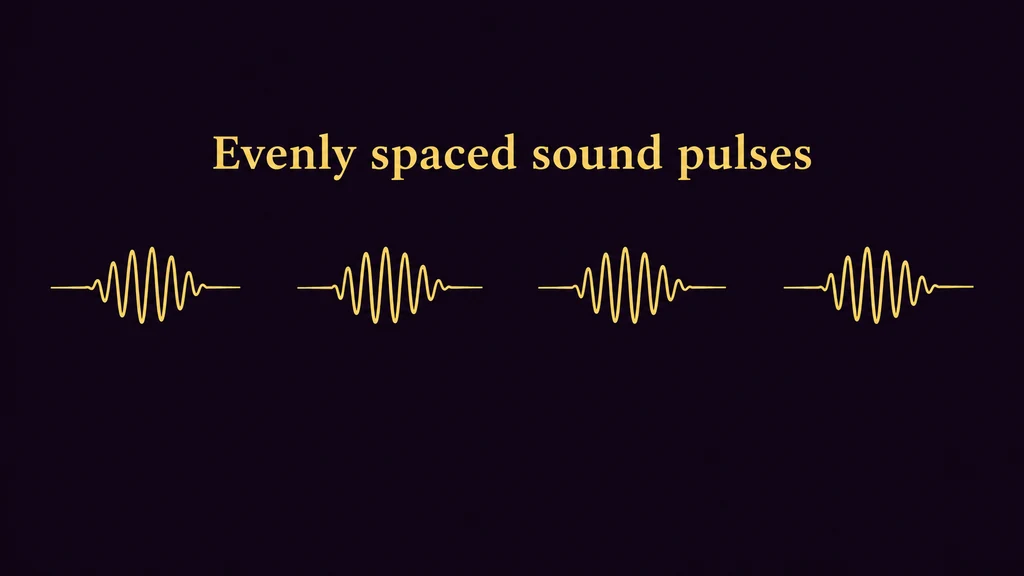
Binaural Beats Vs Isochronic Tones
Compare two common audio techniques, how they are made, and how to listen with grounded expectations.
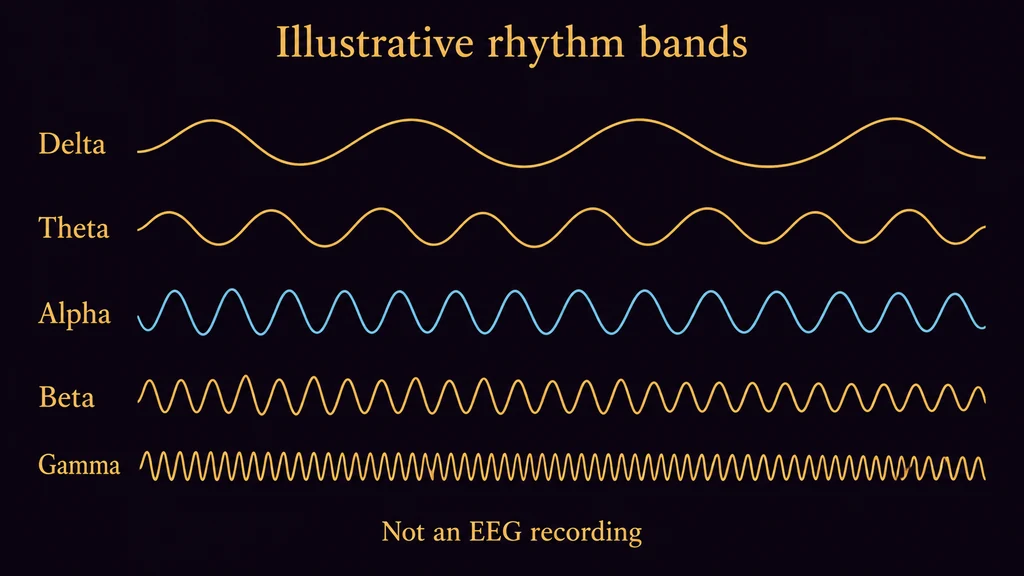
Brainwave Frequencies: Carrier Pitch, Binaural Beats and EEG Bands
Compare audible carrier pitch, binaural differences and delta, theta, alpha, beta and gamma EEG bands, with playable examples and primary-source limits.
Sound And Spirituality: Practices, Culture, And Care
A respectful guide to chanting, bells, bowls, mantra, and listening traditions across spiritual contexts.
Just be curious. This is not a medical device or medical advice. For any health concern, please speak to your doctor.