The golden ratio in music: examples and evidence
The golden ratio, about 1.618, appears in music in three ways. A few twentieth-century composers built it in on purpose, among them Xenakis, Stockhausen and Gubaidulina. Analysts have also read it into Bartók, Debussy and Mozart, where intent is disputed or unlikely. And neighbouring Fibonacci numbers make familiar intervals: 3/2 is a fifth, 8/5 a minor sixth. Whether listeners can hear it is, in one review's word, questionable.
Ready to play Golden Ratio Delta Beat 1.618 Hz
What is the golden ratio?
Cut a line in two so that the whole line is to the longer part as the longer part is to the shorter, and the longer part comes out about 1.618 times the shorter. Euclid called this cutting a line in extreme and mean ratio, and showed how to construct it in Book VI of the Elements. The number is (1 + √5) / 2, or 1.6180339887 to ten places, written with the Greek letter phi (φ).
Two of its properties matter for everything that follows. One divided by phi is phi minus one: 0.618. Phi squared is phi plus one: 2.618. No other positive number does either.
The Fibonacci numbers lead to it. Start with 0 and 1 and add the last two to make the next: 0, 1, 1, 2, 3, 5, 8, 13, 21, 34, 55, 89. As the Online Encyclopedia of Integer Sequences records, the ratios of neighbours close in on the golden section: 8/5 is 1.6, 13/8 is 1.625, 21/13 is 1.615, each one nearer than the last, from alternate sides.
Where does the golden ratio appear in music?
In three different ways, and they deserve different amounts of trust. Some composers built Fibonacci numbers or golden proportions into their scores on purpose, and said so. Analysts have found golden proportions after the fact in music whose composers left no word of it. And the arithmetic of intervals throws up Fibonacci ratios whether anyone intends them or not.
The idea is popular with scholars: a review by the music psychologist Michelle Phillips counted 113 published scholarly items relating the golden section to one or more pieces of music. Popularity is not proof. The Bach scholar Ruth Tatlow notes that the term golden section was coined in 1835, and finds no documentary evidence that composers between about 1600 and 1830 set out to use the ratio. She adds the caution that runs through this whole subject: the proportion occurs naturally, so finding it in a piece does not show that the composer put it there.
Which composers used the golden ratio on purpose?
The clearest cases come from the twentieth century and later, from composers who described their own methods.
Iannis Xenakis, then working in Le Corbusier's architecture studio, set out the plan of Metastaseis (1953 to 1954) in his own analysis of the piece. The durations, he wrote, grow by "the Ø of the golden section (= 0.618...)", and the opening string glissandi are punctuated by breaths and dynamics spaced in "a Fibonacci time series" of beats that begins 34, 13, 8, 3, 1. The musicologist Anne-Sylvie Barthel-Calvet, who published the analysis, notes that the choice was no accident: as an architect, Xenakis had worked closely with the Modulor, Le Corbusier's golden-section scale, though his values here are not the Modulor's own (Xenakis's analysis, with her commentary, in French).
Karlheinz Stockhausen divided the durations of Klavierstück IX by the Fibonacci series. Asked about it by the mathematician Piergiorgio Odifreddi, he confirmed it, and said he had used the series in many other works too, for the density of a sound as well as for time (the interview, in Italian).
Sofia Gubaidulina made the Fibonacci series the foundation of most of her works from the middle of the 1980s, among them Perception and Im Anfang war der Rhythmus, according to the musicologist Valeria Tsenova, and some of her works also use the Lucas numbers, a series built the same way (Tsenova, Paul Sacher Foundation). She explained the idea in a 1999 interview quoted by the music theorist Noah Kahrs:
For example, if we build a composition in such a way that in the first section there is one unit of time, and in the second section two equal units of time (that is, we take this ratio from the Fibonacci series), then the Golden Section is located between these two sections, and something important always happens in this point of the composition.
György Ligeti told Péter Várnai that he gave the first movement of Apparitions the golden section as Ernő Lendvai had read it in Bartók: a low first part and a high second part in golden proportion, with the shorter sections divided the same way. Looking back, he added that some other ratios would have been just as good. He had also tried building sounds from partials in golden ratio in the electronic studio, and called the result meaningless, a very ugly sound (Várnai's conversations with Ligeti, in Hungarian). Per Nørgård wrote that his Third Symphony adds to his infinity series "rhythms with 'Golden' duration proportions" (his programme note for the publisher).
In rock, the famous case is Tool's "Lateralus". The drummer, Danny Carey, told Spin that the song was first titled 9-8-7 after its time signatures, and that it then "turned out" 987 is a Fibonacci number (Spin). From there the band worked the sequence in deliberately: the verse's syllables run 1, 1, 2, 3, 5, 8, 5, 3, and the singer, Maynard James Keenan, later called including the numbers "a very pedestrian, sophomoric move" (Revolver).
Did Bartók use the golden ratio?
The best-known claim in classical music comes from the Hungarian analyst Ernő Lendvai, who argued from 1955 onwards that Bartók built his forms on Fibonacci numbers. His central example is the first movement of Music for Strings, Percussion and Celesta: 89 bars, he said, with the climax after bar 55, so the movement divides 55 to 34, two neighbouring Fibonacci numbers.
The score has 88 bars. Lendvai reached 89 by adding a bar of rest at the end, "in accordance with the Bülow analyses of Beethoven", and the musicologist Roy Howat found other landmarks a bar out too: the mutes come off in bars 33 and 35, not 34, and the fugue's exposition ends in bar 20, not 21. Howat points instead to bar 44, exactly half of 88, where the subject returns a tritone away from where it began (a summary of Howat's corrections by the mathematician Gareth Roberts). Even a supporter writing in the Fibonacci Quarterly conceded the 88 bars (Lowman).
What is missing is any word from Bartók. He said little about his own music, asking that it speak for itself and laying no claim to any explanation of his works, as Roberts reports, and no golden ratio arithmetic has been found in his sketches. László Somfai, who studied some 3,600 pages of Bartók's sketches, drafts and manuscripts, concluded that he composed without preconceived musical theories (University of California Press), and the astrophysicist Mario Livio reports that Somfai "totally discounts" the golden ratio idea (Livio, The Golden Ratio). The Bartók scholar János Kárpáti left Lendvai's time proportions open, but called his Fibonacci reading of Bartók's chords "arbitrary, because the actual intervals represent other ratios" (Kárpáti).
Did Debussy or Mozart use it?
Debussy is the stronger case. In Debussy in Proportion, Roy Howat traces golden proportions through Reflets dans l'eau, L'isle joyeuse and La mer, and calls the proportional structure "not theory but demonstrable fact". He is careful about intent: "The element of hypothesis concerns only how aware Debussy was of it". The nearest thing to a confession is a letter in which Debussy told his publisher that a bar was missing from Jardins sous la pluie and had to go in, because it was "necessary, as regards number" (Howat, Debussy in Proportion). The mathematician Keith Devlin, who finds no concrete support for the Mozart and Bartók claims, puts it plainly: on Debussy, "the experts don't agree" (Devlin).
For Mozart the evidence points the other way. John Putz measured 29 movements from Mozart's piano sonatas that fall into two sections. The fit to 0.618 looks striking at first, but much of it comes from how the ratio is taken: the longer part against the whole always lands nearer the golden ratio than the shorter part against the longer, and that second ratio ranges from 0.534 to 0.833. Putz allowed that Mozart "may have known of the golden section and used it", and concluded that the variation in the data "suggests otherwise" (American Scientist).
Can you hear the golden section in a piece?
Probably not, on the evidence so far. Phillips's review notes that some studies claim the golden section can be perceived by ear, and judges this "questionable given results of empirical work regarding the perception of musical form". In a concert experiment, 259 listeners tapped whenever they felt a section of Ligeti's piano étude Fanfares had ended. They agreed closely with one another, mostly at breaks in the texture, changes in volume and changes in register: things you can hear, not bar counts. The authors conclude that the structures found by analysing a score may not be the ones that matter as the music unfolds, and name the golden section as a case in point (Phillips and colleagues).
The wider psychology is no firmer. Gustav Fechner's rectangle experiments in the 1870s found 35 per cent of choices going to the golden rectangle. Reviewing the century of studies that followed, Christopher Green concluded that the effects "may well be real, but that if they are, they are fragile as well" (Green), and a later study found no clear preference for the golden ratio, explicit or implicit (Stieger and Swami).
Are Fibonacci numbers hidden in musical intervals?
They are in plain sight. Take two neighbouring Fibonacci numbers as a ratio of frequencies and you get intervals every musician knows: 3/2 is the perfect fifth, 5/3 the major sixth, 8/5 the minor sixth, and 13/8 the neutral sixth, which sits between the two (Huygens-Fokker list of intervals). Measured in cents, where 1,200 cents make an octave, each new ratio lands closer to the golden ratio's 833.09 cents.

| Ratio | Interval | Cents |
|---|---|---|
| 3/2 | perfect fifth | 701.96 |
| 5/3 | major sixth | 884.36 |
| 8/5 | minor sixth | 813.69 |
| 13/8 | neutral sixth | 840.53 |
| 21/13 | 830.25 | |
| 34/21 | 834.17 | |
| 55/34 | 832.68 | |
| 89/55 | 833.25 | |
| Golden ratio | 833.09 |
Heinz Bohlen built a scale on this. Reasoning from combination tones, the faint extra tones the ear can make when two notes sound together, he found intervals that "converge to a value close to 833 cents", and only afterwards recognised the Fibonacci sequence in them. He offered 36 equal steps to the octave as an approximation, and was frank that "Not every music theorist agrees that combination tones play a major role" (Bohlen's 833 cents scale). Long before him, Thorvald Kornerup published golden-section tunings in Copenhagen in 1930 and 1935 (Huygens-Fokker bibliography); the Scala scale archive files one as "golden meantone", with a fifth of about 696 cents, 4 cents narrower than a piano's (Scala archive).
The piano keyboard adds a coincidence of its own: from one C to the next, counting both, there are 13 keys, 8 white and 5 black, the black keys in groups of 2 and 3. Instruments draw bolder claims. The luthier R. M. Mottola calls the idea that violin scrolls follow the golden spiral "a myth", while granting that makers can use the golden mean to draft many parts of a violin (Mottola).
What is the 1.618 Hz golden ratio frequency?
It is not a pitch. 1.618 Hz is a binaural beat: two steady tones, 108 Hz in the left ear and 109.618 Hz in the right, set exactly 1.618 Hz apart. Each ear hears a plain low tone. The beat exists only in your hearing, which compares the two ears and turns their difference into a slow movement in the sound.

| Ear | Tone | Waves in one beat |
|---|---|---|
| Left | 108 Hz | 66.75 |
| Right | 109.618 Hz | 67.75 |
| Difference | 1.618 Hz | 1 |
The golden ratio gives this beat one neat property. Because one divided by phi is phi minus one, a beat at 1.618 a second lasts 0.618 of a second: the rate and the length share their digits. Over nine hours that is about 52,400 beats. The number is phi only because we count in seconds, though. Per minute the same beat is 97.08, and the two tones themselves stand in a ratio of about 1.015, nowhere near phi.
We measured the beat in the nine-hour master that plays on the 1.618 Hz golden ratio page. Each ear holds its own tone, 108.000 Hz and 109.618 Hz, and the two slide into step and out again once every 0.618 seconds. Play the same file through one speaker and the tones add together instead: the sound swells and fades at the same rate, a throb rather than a binaural beat.

| Measure | Value |
|---|---|
| Left ear | 108.000 Hz |
| Right ear | 109.618 Hz |
| Beat | 1.618 Hz |
| One beat | 0.618 seconds |
| Beats in nine hours | about 52,400 |
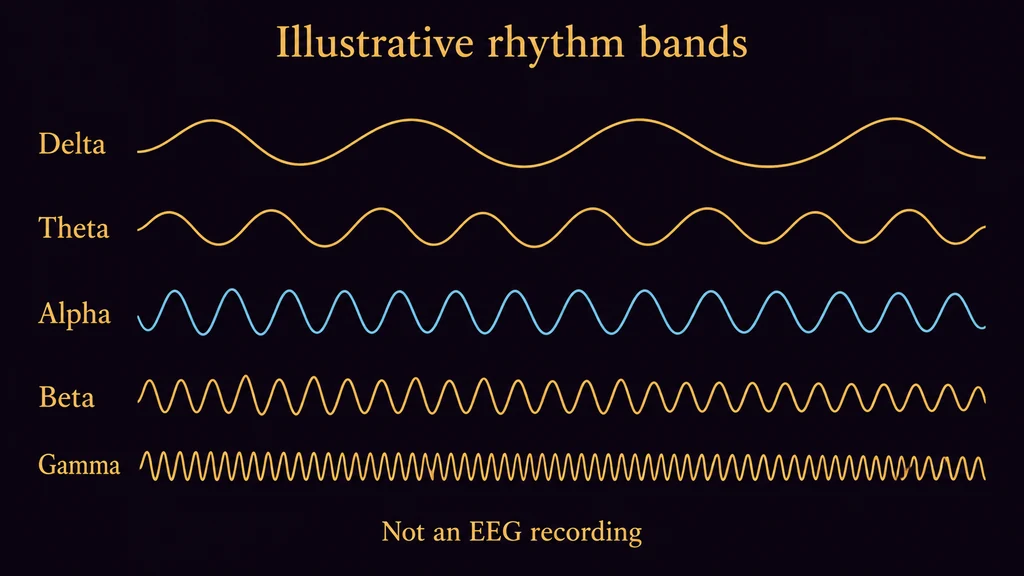
Why 108 Hz? Every beat in the Binaural Beats collection rides on 108 Hz, two octaves below 432 Hz. The channel's earlier golden ratio video paired 432 Hz with 433.618 Hz: the same 1.618 Hz difference, two octaves higher. At 1.618 Hz the beat sits in the delta band, which the clinical EEG glossary puts below 4 Hz (Kane and colleagues). The guide to delta waves covers that band, and the guide to brainwave frequencies sets it beside the others.
Does the brain run on the golden ratio?
There is a serious hypothesis here, but it is about ratios, not frequencies. Pletzer, Kerschbaum and Klimesch proposed that the classical EEG bands form a series in which each band is about 1.618 times the one below, because two rhythms in golden ratio can never lock together: "their excitatory phases never meet" (Pletzer and colleagues). Rhythms recorded in brain slices kept alive in a dish "appear approximately distributed according to 'phi'" (Roopun and colleagues). Wolfgang Klimesch later proposed band centres that double from one band to the next, with phi setting the edges between them (Klimesch), and an EEG study of 51 people found ratios near 1.6 between alpha and theta more often at rest than during mental arithmetic, in an exploratory analysis (Rodriguez-Larios and Alaerts).
In all of this, phi is a ratio between two of the brain's own rhythms. None of it says what a sound at 1.618 Hz does, and a 1.618 Hz beat is not a ratio between rhythms.
What do studies show about binaural beats?
Binaural beats themselves are a real effect of hearing, perceived from about 1 to 30 Hz (Ingendoh and colleagues). At slow rates, one study's authors write, "we perceive a single sound, which is moving across the head between the left and right ears" (Ross and colleagues). That study tested rates from 3 Hz up, so 1.618 Hz is slower than anything it measured.
Whether the beats change brain activity is unsettled. A systematic review found 14 studies split: five in line with the idea that brain rhythms follow the beat, eight contradicting it and one mixed (Ingendoh and colleagues). A meta-analysis of 22 studies reported a medium average effect on measures such as memory and attention, and found that it depended on the beat rate, the listening time and when people listened (Garcia-Argibay and colleagues). Searches of PubMed and Europe PMC find no study of a 1.618 Hz or golden ratio binaural beat: the number is chosen for its maths. The guide to binaural beats covers the wider research.
What do listeners say about the golden ratio beat?
The channel's most watched video is its original 1.618 Hz golden ratio beat, and its comments are candid. The most liked describes the movement:
I don't know how to explain this, but I hear spirals
Another listener asked whether a continuous or a pulsating sound is better. The answer depends on how you listen: headphones keep the two tones apart, and a speaker mixes them into a throb. Not everyone enjoys it, either: one listener found it "irritating. Like tinnitus." And three asked for a far longer version, eight or ten hours. The 1.618 Hz page now plays nine.
How do you listen to the 1.618 Hz beat?
- Use headphones. The beat forms only when each ear hears its own tone.
- Keep the volume low, just loud enough to hear.
- On AirPods or an iPhone, turn off Spatialize Stereo and Mono Audio: both mix the two ears together.
- Stop if anything feels uncomfortable, take care if you have tinnitus or sensitive hearing, and never listen while driving.
Press play at the top of the page, or open the 1.618 Hz golden ratio page, which plays the beat for nine hours, free and with no ads. The 2 Hz delta beat is its nearest neighbour in the collection, if you want to compare the two.
Sources and limits
The maths is checkable arithmetic, and the beat chart is measured from the master audio. The composers' own methods come from their writings and interviews. Claims that Bartók, Debussy or Mozart used the golden ratio rest on analyses of their scores, which scholars dispute, and no study has tested a 1.618 Hz binaural beat. Quotations from French, Italian and Hungarian sources are our translations.
- Euclid, Elements, Book VI, Definition 3 and Proposition 30: the extreme and mean ratio.
- OEIS A000045, the Fibonacci numbers: neighbouring ratios converge on the golden section.
- Phillips, Rethinking the Role of the Golden Section in Music and Music Scholarship, Creativity Research Journal: 113 scholarly items; hearing it is questionable.
- Tatlow, The Use and Abuse of Fibonacci Numbers and the Golden Section in Musicology Today: the term's history and the method problem.
- Barthel-Calvet, Metastassis-Analyse, with Xenakis's own analysis: golden-section durations and Fibonacci spacing.
- Odifreddi, interview with Karlheinz Stockhausen: Fibonacci durations in Klavierstück IX and later works.
- Tsenova, Number and Proportion in the Music of Sofia Gubaidulina and Kahrs, Music Theory Online: her Fibonacci forms in her own words.
- Várnai, Beszélgetések Ligeti Györggyel: the golden section in Apparitions.
- Nørgård, programme note on his symphonies: golden duration proportions in the Third.
- Spin, Tool cover story and Revolver, on Lateralus: 9-8-7 first, Fibonacci after.
- Roberts, Bartók, Fibonacci, and the Golden Ratio and Lowman, Fibonacci Quarterly: Lendvai's 89 bars against the score's 88.
- Somfai, Béla Bartók: Composition, Concepts, and Autograph Sources, Livio, The Golden Ratio and Kárpáti, Studia Musicologica: no word from Bartók.
- Howat, Debussy in Proportion and Devlin, The Myth That Will Not Go Away: Debussy's proportions and the open question of intent.
- American Scientist, Did Mozart Use the Golden Section?: Putz's 29 movements.
- Phillips and colleagues, Frontiers in Psychology, Green, All That Glitters and Stieger and Swami: what listeners and viewers actually pick out.
- Huygens-Fokker, list of intervals, Bohlen, An 833 Cents Scale, Huygens-Fokker bibliography and the Scala archive: Fibonacci intervals and golden tunings.
- Mottola, violin scrolls and the golden mean spiral: a luthier's view.
- Kane and colleagues, revised EEG glossary: the delta band.
- Pletzer and colleagues, Roopun and colleagues, Klimesch and Rodriguez-Larios and Alaerts: the golden mean between brain rhythms.
- Ingendoh and colleagues, PLOS ONE, Ross and colleagues, Journal of Neurophysiology and Garcia-Argibay and colleagues, Psychological Research: binaural beats, heard and measured.
- Comments on the channel's original 1.618 Hz video, quoted without names.
Tones to play while you read
Related guides

174 Hz, 417 Hz and 741 Hz played together
174 Hz 417 Hz 741 Hz played together: why the three Solfeggio tones sit smoothly in the ear, where the numbers come from and what has been studied.
528 Hz benefits: what the studies show
528 Hz benefits, checked against the research: what five small studies in people measured, where the claims began, and what no study has shown.
Alpha Waves And Binaural Beats: A Listening Guide
Understand alpha-wave language, binaural beat basics, and how to use audio as a gentle focus or meditation support.
Just be curious. This is not a medical device or medical advice. For any health concern, please speak to your doctor.