Guide
Plain-language context
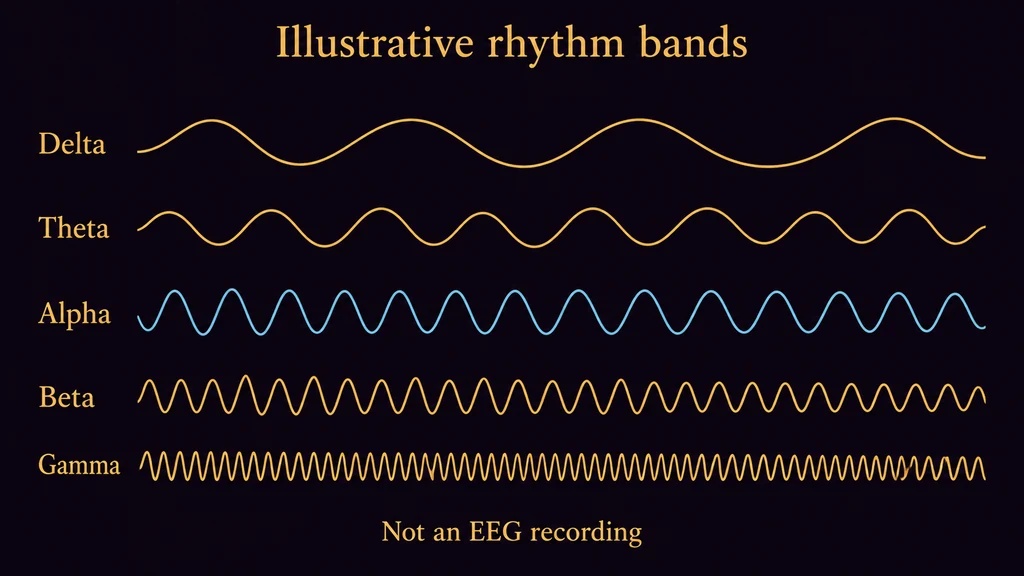
"Lambda waves" is a term that appears in meditation and sound-healing circles, usually describing a very fast band of brain activity said to accompany unusually deep or expansive states. It is worth being careful here: the popular usage is loose, and the science is far thinner than the enthusiasm suggests. This guide explains what the term means and how to avoid overstating it.
What the term means
In clinical neuroscience, "lambda waves" actually refers to specific sharp visual responses recorded over the back of the head when the eyes move across a visual scene, a narrow, well-defined phenomenon. The meditation-culture usage is different and broader, borrowing the name for a supposed high-frequency state linked to peak experiences. The two meanings should not be confused, and the meditative usage is not a settled scientific category.
How the idea is used
- As a label for the sense of spaciousness some people describe in deep practice.
- As a theme for ambient audio aimed at long, quiet sittings.
- As a prompt for patient, unforced meditation rather than a target to chase.
Our companion guide on delta waves covers the slower end of the brainwave spectrum in a similarly grounded way.
What the evidence says
Claims that audio can reliably produce a special "superconscious" state are not supported by solid research. The brainwave bands are real, but the leap from a band to a promised experience is unproven, and much of the popular writing overstates it. Studies of meditation report genuine but modest benefits for calm and attention, and findings remain preliminary and context-specific.
The trouble with borrowed terms
Much of the confusion around "lambda waves" comes from a word being lifted out of a technical setting and given a grander meaning. This happens often in wellbeing writing, and it is worth recognising the pattern, because the same caution applies to many sweeping audio claims. A genuine neuroscience term lends an air of authority; the everyday usage then quietly drops the careful definition. The honest move is to enjoy the practice, long, patient meditation supported by gentle sound, without leaning on the borrowed vocabulary to promise more than is known.
Practising the spaciousness directly
If the appeal of "lambda" is the sense of openness people describe in deep practice, that openness is reached the ordinary way: by sitting longer, expecting less, and letting attention rest rather than chase. A quiet, sustained tone can keep you company through a longer sitting, which is help enough without any grand label attached.
Listening notes
If the appeal here is depth and spaciousness, the practical route is an ordinary one: sit a little longer, expect a little less, and let attention rest rather than chase a special state. A quiet, sustained tone can keep you company through a longer sitting. Keep the volume low, set no goal beyond staying present, and let go of the grand vocabulary entirely, the practice is gentler and more reliable without it.
Listen with this
If this piece sparked your curiosity, a few tones sit naturally alongside it: 963 Hz, 852 Hz, 136.10 Hz Earth Year. Try one softly, in a quiet moment, and notice what shifts for you. There is no need to listen to all of them, and no right order to explore them in; the most rewarding tone is usually the one whose character or story you find yourself returning to.
Sources
Meditation research reports genuine but modest, preliminary benefits for calm and attention. The honest picture is that the evidence is early and mixed, and findings are preliminary and context-specific rather than settled. The cited music overview concerns music-based interventions. That context does not establish a result for one isolated pitch. We share these links so you can read the primary sources and form your own view rather than take any claim, including ours, on trust.
Listening safely
Whatever you explore here, a few simple habits keep the practice gentle and comfortable. Choose a volume you could easily talk over, give yourself a short, unhurried session rather than a marathon, and sit or lie in a supported, comfortable posture so the body can settle. Let attention rest lightly on the breath or the sound, and step away the moment anything feels grating or unpleasant rather than pushing through. Above all, approach it with curiosity and patience: notice what genuinely settles you, keep that, and let the rest go. This is an educational listening practice, not medical advice or a replacement for professional care.
What does lambda mean in brainwave discussions?
The guide distinguishes a specific EEG term from its looser use in meditation culture. A track labelled lambda is not evidence that a listener has reached a special brain state; those meanings should not be conflated.
Does lambda mean the same thing as frequency?
No. In wave notation lambda commonly denotes wavelength, while frequency counts cycles per second. That mathematical use is separate from the brainwave label discussed in this guide.
Listen without turning context into a promise
The related tone buttons below are audible listening examples. Press Play deliberately, begin quietly and pause when you want. A traditional name, simulation or whole-music study is not proof of a clinical effect from the displayed pitch.