Guide
Plain-language context
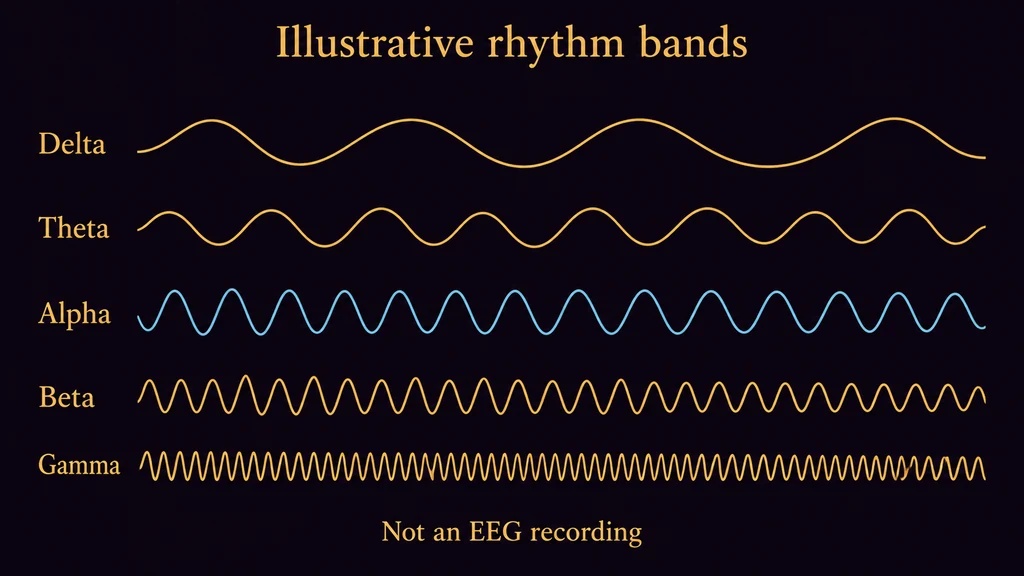
Gamma waves are the fastest of the commonly named brainwave bands, sitting above roughly 30 cycles per second. Researchers associate gamma activity with moments of intense focus, the binding together of different streams of perception, and active problem-solving. In audio culture the term is borrowed for tracks aimed at alertness and concentration. This guide explains the language and keeps the claims grounded.
What the term means
Gamma is a real, measurable band of activity recorded from the scalp. It tends to rise during demanding cognitive tasks and has been studied in connection with attention and memory. That is genuine neuroscience. The harder question is whether playing a gamma-rate audio beat can usefully push the brain into that state, and here the evidence is much weaker than popular tracks imply.
How the idea is used in audio
- As a binaural beat tuned to a fast difference frequency, intended as a focus aid.
- As a backdrop for study or demanding work, in place of music with lyrics.
- As a daytime tool rather than an evening wind-down.
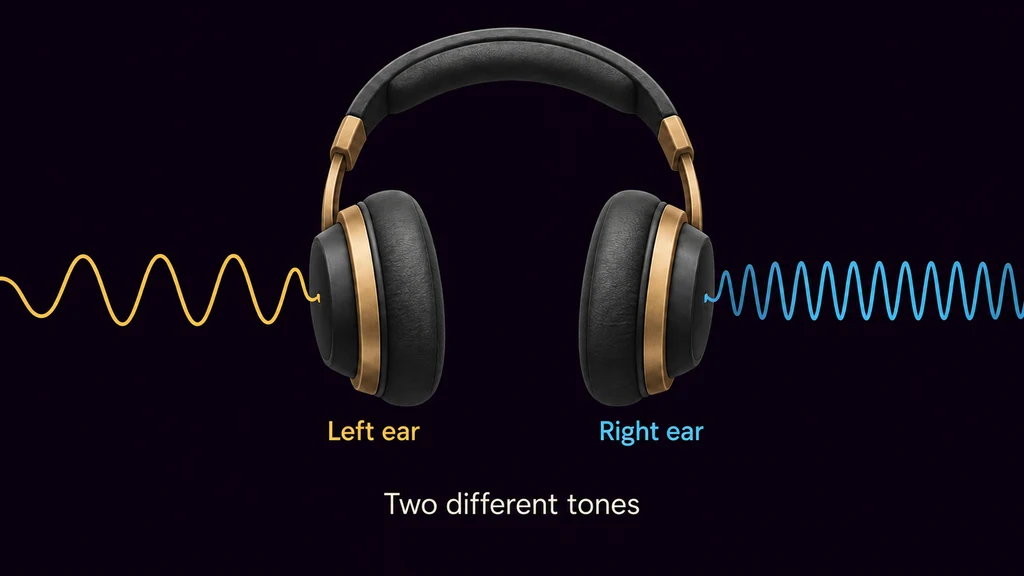
For the underlying mechanics, see our guide on binaural beats versus isochronic tones.
What the evidence says
The claim that gamma-rate audio sharpens thinking is only weakly supported. Some small studies suggest fast binaural beats may nudge attention for some listeners; others find no effect, and results are preliminary and context-specific. Real focus comes from sleep, breaks, and how a task is structured. Use such tracks as a small, optional cue, not a promise.
Why the gamma story is so tempting
Because gamma activity rises during sharp, engaged thinking, it is easy to assume that producing more of it must make you think better, and that an audio beat could deliver it on demand. Both steps are shakier than they sound. Gamma accompanies focused states; it does not straightforwardly cause them, and nudging a measured rhythm from the outside is not the same as switching on the underlying engagement. This is the classic trap of mistaking a marker for a lever.
Using focus audio honestly
None of this means a gamma-themed track is useless. As a consistent "now I work" cue, played low and without lyrics, it can help you settle into a task, much as a familiar playlist does. Keep the expectation modest: the heavy lifting of concentration is still done by rest, environment, and how clearly the task itself is defined.
Listening notes
If you try a gamma-themed track for focus, use headphones, keep the volume low, and play it without lyrics during a defined block of work. Let it act as a "now I begin" cue rather than something you expect to sharpen your mind on its own. Take real breaks, and drop the audio the moment it distracts. The dependable drivers of concentration, rest, a quiet environment, and a clearly defined task, do the real work; the sound is only a small, optional companion.
Listen with this
If this piece sparked your curiosity, a few tones sit naturally alongside it: 741 Hz, 141.27 Hz Mercury, 7.83 Hz Schumann binaural. Try one softly, in a quiet moment, and notice what shifts for you. There is no need to listen to all of them, and no right order to explore them in; the most rewarding tone is usually the one whose character or story you find yourself returning to.
Sources
Reviews of binaural beats and attention report mixed, preliminary findings. The honest picture is that the evidence is early and mixed, and findings are preliminary and context-specific rather than settled. The cited music overview concerns music-based interventions. That context does not establish a result for one isolated pitch. We share these links so you can read the primary sources and form your own view rather than take any claim, including ours, on trust.
- PubMed, A systematic review on the role of binaural beats (2018)
- NCCIH, Music and health: what you need to know
Listening safely
Whatever you explore here, a few simple habits keep the practice gentle and comfortable. Choose a volume you could easily talk over, give yourself a short, unhurried session rather than a marathon, and sit or lie in a supported, comfortable posture so the body can settle. Let attention rest lightly on the breath or the sound, and step away the moment anything feels grating or unpleasant rather than pushing through. Above all, approach it with curiosity and patience: notice what genuinely settles you, keep that, and let the rest go. This is an educational listening practice, not medical advice or a replacement for professional care.
What are gamma brainwaves, and can this audio measure them?
Gamma describes a range of electrical brain activity measured with EEG. An audio frequency and an EEG rhythm are different measurements. A browser sound or visualisation does not show which rhythm a listener is experiencing.
Listen without turning context into a promise
The related tone buttons below are audible listening examples. Press Play deliberately, begin quietly and pause when you want. A traditional name, simulation or whole-music study is not proof of a clinical effect from the displayed pitch.