211.44 Hz benefits: Neptune's tone and where its meanings come from
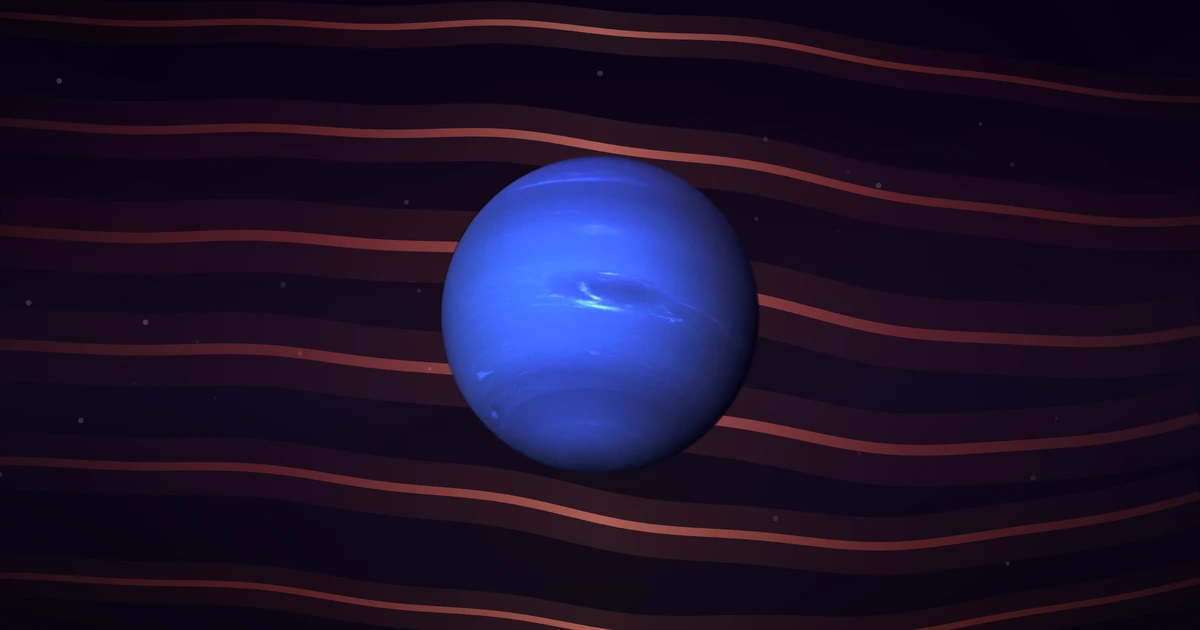
211.44 Hz is the Neptune tone of Hans Cousto's cosmic octave: Neptune's orbit of the Sun, 60,187.64 days or about 164.8 years, raised 40 octaves until it can be heard, as a G sharp. The benefits linked to it, such as intuition, dreaming and creativity, come from Cousto's notes and from modern astrology's Neptune. No study has tested 211.44 Hz itself.
Ready to play Neptune 211.44 Hz
Leave a little room for your imagination to wander.
Where does 211.44 Hz come from?
It comes from Neptune's orbit of the Sun. NASA's Neptune fact sheet times one orbit against the stars at 60,189 days, or 164.79 Earth years. Read as a vibration, that orbit is one cycle every 5.2 billion seconds, a frequency of about a fifth of a billionth of a hertz, slower than anything a person could ever hear.
Doubling a rate raises it by one octave. Double Neptune's rate 40 times, which multiplies it by 1,099,511,627,776, and it reaches 211.44 Hz, just above the G sharp below middle C. The whole sum fits on one line: 1,099,511,627,776 divided by 5,200,212,096 seconds, the 60,187.64 days of Cousto's tables, is 211.44 cycles a second.
Every octave on the way is the same orbit in another register. Hans Cousto's tuning tables list them. The 37th octave, 26.43 Hz, is the first that can be heard at all, as a deep hum near the floor of hearing. The 33rd, 1.65 Hz, is too slow to hear as a pitch, so the tables give it as a tempo instead: 99.11 beats a minute.
NASA's own figure gives almost exactly the same tone. Its 60,189.018 days, raised 40 octaves, come to 211.43 Hz, a hundredth of a hertz lower, a difference of 0.04 cents. Timing the orbit against the equinox instead, 59,799.900 days on the same sheet, gives 212.81 Hz, 11 cents higher. The Neptune tone is the orbit against the stars.
Who first worked it out?
Hans Cousto, a Swiss mathematician and music researcher. His tables date the idea to the autumn of 1978, in a shared flat in Munich: to carry the musical law of the octave beyond the range of hearing, starting with the rhythms of the Earth, the Moon, the planets and the Sun. He set out the method in a book in 1984, translated as The Cosmic Octave. The same tables time Neptune's orbit at 60,187.64 days and name its 40th octave as 211.44 Hz, a G sharp.
They also give the A that belongs to this G sharp: 448.02 Hz, which is 31.26 cents above the 440 Hz A of standard concert pitch. A cent is a hundredth of a semitone, so the Neptune tone sits nearly a third of a semitone above the piano's G sharp, 207.65 Hz. On a tuner it reads as a sharp G sharp, closer to it than to the A above.
Every tone in Harmonance's planetary family comes from the same method. Jupiter's orbit raised 36 octaves is 183.58 Hz, the Jupiter tone; Saturn's raised 37 octaves is 147.85 Hz, the Saturn tone; and the lunar month raised 29 octaves is 210.42 Hz, the Moon tone, which matters for Neptune below. The guide to planetary frequencies sets out the whole cosmic octave, and the planetary collection plays each tone.
What are the benefits of 211.44 Hz?
The benefits named for 211.44 Hz are symbolic. They come from Cousto's own notes and from modern astrology's Neptune, and no study has tested any of them.
Start with Cousto. His page on the Neptune tone, in German, gives its effect in one line: "Fördert die Intuition, das Unbewusste und steigert die Traumwelt", that is, it encourages intuition and the unconscious and heightens the world of dreams. He pairs Neptune with the sign of the Fishes, Pisces, and gives it the trident of the sea god as its symbol.
Astrology carries the rest, and its Neptune is young. The planet was unknown until 1846, so it has no ancient lore; its meanings were given to it after the discovery. Modern astrology makes Neptune the ruler of Pisces and links it with dreams, idealism, empathy and artistry, and also, less kindly, with illusion and confusion. Harmonance's Pisces page plays both of the sign's rulers: Jupiter, the traditional one, and Neptune, the modern one. The guide to astrology frequencies pairs every sign with its ruling planet the same way.
So when a video or a website lists intuition, creativity, dreaming or spiritual connection as benefits of 211.44 Hz, those words come from these two sources. They describe meanings people have given the most distant planet, not something measured in listeners. Read them as interpretation.
Why does 211.44 Hz sound so close to the Moon tone?
Because two very different cycles land within a twelfth of a semitone of each other once both are doubled into hearing. Cousto noticed it himself: Neptune's tone, he writes, is "fast genau oktavanalog gleich dem des Erdenmondes", almost exactly the octave of the Moon's. He saw a second kinship too. Neptune's orbit lasts about twice as long as Uranus's, so, in his words, Neptune is harmonically a lower octave of Uranus.

The arithmetic shows how close each kinship is. The Moon tone, 210.42 Hz, sits 8 cents below the Neptune tone, about a twelfth of a semitone. Uranus's orbit is 30,685.9 days in Cousto's tables, and twice that would be 61,371.8 days; Neptune's actual orbit is 60,187.64 days, so the ratio is 1.96, not 2. That small shortfall leaves the Uranus tone, 207.36 Hz, 34 cents below Neptune's, about a third of a semitone.
Heard together, near tones beat: they swell and fade at the difference between them. The Moon tone and the Neptune tone are 1.02 Hz apart, so played side by side they pulse about once a second. A lunar month of 29.53 days and an orbit of nearly 165 years have nothing to do with each other in the sky; the meeting is a quirk of doubling, which is worth knowing before reading meaning into it.
How long does Neptune take to go round the Sun?
About 165 years, so it has gone round only once since it was found. Neptune was the first planet located by calculation: Urbain Le Verrier worked out where it had to be from the pull on Uranus, and Johann Galle at the Berlin Observatory found it within one degree of that spot in September 1846, the night Le Verrier's letter reached him. In François Arago's phrase, recorded in the history of the discovery, Le Verrier had found a planet "with the point of his pen". It is too faint to see without a telescope, as NASA's Neptune page notes.
To see that one orbit, Harmonance asked NASA JPL's Horizons system for Neptune's place round the Sun every ten days from the night it was found to October 2026, 6,579 readings, and for Uranus's on the same dates, and counted the laps.

| Moment | Neptune's laps | Uranus's laps |
|---|---|---|
| Neptune found, September 1846 | 0 | 0 |
| Uranus back, September 1930 | 0.51 | 1.00 |
| Neptune back, July 2011 | 1.00 | 1.96 |
| Uranus back again, October 2014 | 1.02 | 2.00 |
| October 2026 | 1.09 | 2.14 |
The lap itself took 60,192 days, within three days of NASA's average orbit of 60,189 days, and it closed in July 2011, the year NASA gives for Neptune's first orbit since its discovery. By October 2026 Neptune is 33.7 degrees into its second lap. Uranus, on its shorter orbit, came round in September 1930 and again in October 2014: the near two to one that Cousto heard as an octave.
Seen from Earth, Neptune moves through the zodiac slowly. JPL's positions put it between 13 and 14 years in each sign, in line with the 14 years astrologers quote. It first crossed into Aries in March 2025, slipped back into Pisces in October 2025 as the Earth overtook it, and crossed into Aries for good in January 2026. The last time Neptune entered Aries was in 1861.
Is 211.44 Hz the sound of Neptune?
No. Space is too empty to carry sound. In the words of the University of Iowa's space audio team, pressure waves of the kind we hear as sound "do not propagate at audible frequencies in the extremely low density gases that fill space". Nothing travels from Neptune to Earth as sound, and nothing is heard from it here.
211.44 Hz is a different kind of thing altogether: not a signal from Neptune, but the rhythm of its orbit made audible by arithmetic. The planet takes nearly 165 years to go round once; the tone repeats 211.44 times a second.
Has any study tested 211.44 Hz?
No. No published study has tested 211.44 Hz, or any tone of Cousto's cosmic octave, on people listening. PubMed, the main index of medical research, holds no record for "211.44 Hz", and its few records for "cosmic octave" are about other things, such as astronomy instruments and aircrew hearing.
The nearest evidence concerns music. A 2020 review of 104 randomised trials, with 9,617 people between them, found that music interventions lowered stress. The effect was small to medium on measures of the body, such as heart rate, and medium on how stressed people said they felt.
Those trials played music, not a single steady tone, and none of them used 211.44 Hz. NCCIH, the US National Center for Complementary and Integrative Health, says much of the research on music for health is preliminary, so "few definite conclusions about their effects have been reached". That is why Harmonance shares 211.44 Hz as a tradition and a pitch to listen with, not settled science. The guide to the science of sound healing sets out what listening research does and does not show.
What does the 211.44 Hz page play?
One steady tone at exactly 211.44 Hz, with two faint overtones above it. Harmonance decoded the 100-second loop that the 211.44 Hz Neptune page serves and measured it from its samples. The strongest line sits at 211.44 Hz to a hundredth of a hertz. The octave above, 422.88 Hz, is 23 dB quieter, and the line at 634.32 Hz is 34 dB quieter; nothing else comes within 55 dB of the tone.
Its level swells and settles by under 1 dB every 20 seconds, and the loop's end meets its start, so it can repeat for as long as you leave it. The same page has a Strings mode: strings tuned to octaves of 211.44 Hz, with the tone quiet underneath.
How do you listen to 211.44 Hz?
Press play at a low volume and let the tone run. Any speakers or headphones will do, since it is one steady tone, unlike a binaural beat, which needs a different tone in each ear. The World Health Organization's safe listening advice is to keep a device at no more than 60 per cent of its maximum volume, which matters most if you leave the tone on for hours.
To hum along, find the G sharp below middle C and lift it a little; a higher voice can hum the octave above, 422.88 Hz. To move at Neptune's pace, walk at Cousto's tempo, 99.11 beats a minute. To hear the Moon kinship for yourself, open Harmonance Studio, layer 211.44 Hz with 210.42 Hz and listen for the slow pulse, about once a second.
The 211.44 Hz Neptune page plays the tone in full, or opens with Strings already on. The Need to unwind page gathers it with 285 Hz and 432 Hz, and the planetary collection holds the rest of the cosmic octave.
Sources and limits
Neptune's cycles come from NASA's fact sheet and JPL's ephemeris, the tone and its meaning from Cousto's own tables and page, the astrology from the history of the tradition, and the music findings from the review itself. The lap since 1846, the three tones on one key and the measured page audio are Harmonance's own work from those sources. No study has tested 211.44 Hz itself, and the music research concerns music, never a tone.
- NASA, Neptune fact sheet: the sidereal and tropical orbits, the rotation and the discovery.
- Hans Cousto, tuning data for the planets: Neptune's octaves, its tempo, its A at 448.02 Hz, and the Uranus and Moon tones.
- Hans Cousto, the Neptune tone (in German): its claimed effect, its sign and its kinship with Uranus and the Moon.
- NASA JPL, Horizons ephemeris of Neptune, 1846 to 2026: the data behind the chart and the sign crossings.
- NASA JPL, Horizons ephemeris of Uranus, 1846 to 2026: the chart's second line.
- NASA Science, Neptune facts: the first orbit since discovery, Galle's first night and the planet's true colour.
- Wikipedia, discovery of Neptune: Le Verrier's prediction and Galle's search.
- Wikipedia, planets in astrology: Neptune: its rulership and meanings.
- University of Iowa, space audio: what sound in space does and does not mean.
- de Witte and others (2020), music interventions and stress, Health Psychology Review: 104 trials and their effects.
- NCCIH, music and health: what you need to know: the state of music research.
- World Health Organization, safe listening: volume and time.
Tones to play while you read
Related guides
183.58 Hz benefits: Jupiter's tone and where its meanings come from
183.58 Hz benefits are symbolic: the Jupiter tone is its 11.86-year orbit raised 36 octaves, and no study has tested it. Where the meanings come from.
210.42 Hz benefits: what the Moon tone is, and what is known
210.42 Hz benefits are symbolic: the Moon tone is the 29.53-day lunar month raised 29 octaves, and no study has tested it. Where the claims come from.

432 Hz benefits, chakras and the evidence
432 Hz benefits and chakra claims weighed: the tuning history, the chakra framework, and what studies of 432 Hz music have and have not found.
Just be curious. This is not a medical device or medical advice. For any health concern, please speak to your doctor.