Concentration frequency: the Mercury and 741 Hz pairing
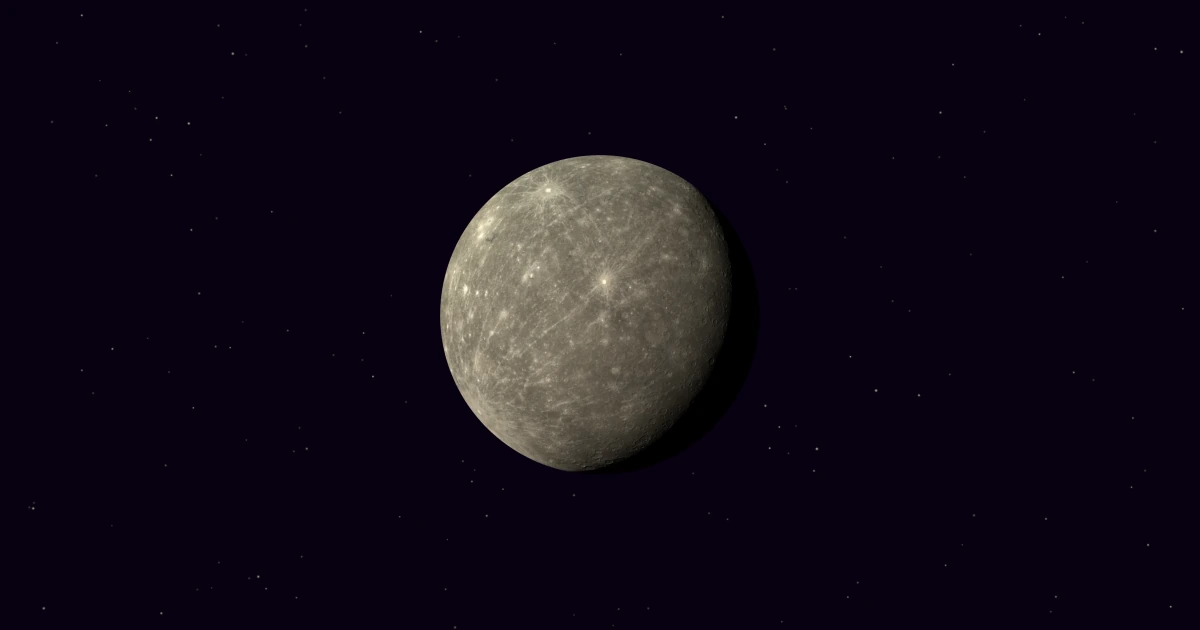
No single tone has been shown to sharpen concentration. Harmonance's Focus pairing joins 141.27 Hz, Hans Cousto's tone for Mercury, the planet named for the swiftest Roman god, with 741 Hz, the Solfeggio tone listed by 2002 as awakening intuition. Research on background sound points elsewhere: in memory experiments, sound disrupted recall only when it changed over time.
Ready to play Mercury 141.27 Hz
Consider the words you want to share.
Is there a frequency for concentration?
Not one that has been tested. No study has played 141.27 Hz, 741 Hz or the two together to people and measured concentration, and PubMed, the main index of medical research, lists none.
What exists is a pairing, with a reason behind each half. Harmonance's YouTube channel joined Mercury at 141.27 Hz with the Solfeggio tone 741 Hz in a 2023 video called Focus, one of its fusion videos named for a state of mind, and the site's Need to focus? page plays the same two tones. People reach for a sound like this at the start of a stretch of work: writing, revising, a page of figures.
This guide takes the pairing apart. It shows where each number comes from, what research on background sound and concentration has actually found, and what the two tones do in the ear, measured from the site's own audio. The research is about steady and changing sound, and about music and noise; none of it used these tones.
Why is Mercury linked with the mind?
Mercury is linked with the mind through its name and its speed. NASA gives the reason for the name: "Mercury is appropriately named for the swiftest of the ancient Roman gods." It is also the fastest planet, going round the Sun in about 88 days.
Hans Cousto, who calculated the planetary tones, ties Mercury to speech and thought. His German text, from Die Töne der Kosmischen Oktave, says Mercury stands for communication and cleverness, and gives the tone an effect in one line:
Fördert das Sprachzentrum und das kommunikativ-intellektuelle Prinzip.
In English: it encourages the speech centre and the communicative, intellectual principle. That is a description from a tradition, not a measurement. The same text pairs Mercury with the signs Gemini and Virgo, and the Gemini and Virgo pages play it as their tone.
Where does 141.27 Hz come from?
141.27 Hz is the length of Mercury's year, turned into a tone by doubling. NASA's Mercury fact sheet gives the planet's orbit against the stars as 87.969 days, which is 7,600,521.6 seconds. Count that whole orbit as one very slow cycle, about 0.00000013 Hz, and double it until it can be heard.
Each doubling raises the pitch by one octave. 2 to the power 30 is 1,073,741,824; divide it by the year in seconds and the 30th octave is 141.2721 Hz. Cousto's own tuning tables use the same 87.969 days and list the 30th octave as 141.27 Hz, a C sharp whose concert A would be 448.51 Hz, 33 cents above the usual 440 Hz.
The guide to 141.27 Hz works through Mercury's other cycles and the notes they give. As the guide to planetary frequencies explains for every planet, the tone is arithmetic applied to a real orbit, not a sound that travels from Mercury.
Why is 741 Hz paired with focus?
741 Hz brings a meaning from the Solfeggio list. It is SOL, the fifth of the six Solfeggio numbers, and a tuning fork maker's page, as the Internet Archive saved it in December 2002, lists it as "Awakening Intuition". Harmonance's own 741 Hz page speaks of expression and clarity, and frames that as cultural context.
So neither half of the pairing was chosen because of a study. Mercury brings a tradition of speech and thought, 741 Hz a modern label about intuition and clarity, and together they put a low tone beside a high one. The guide to 741 Hz follows the number back to its source, and the guide to the Solfeggio frequencies tells the story of the whole set.
What does research say about background sound and concentration?
The clearest finding is about change. Psychologists have long tested what background sound does to serial recall, remembering a list of items in the order they came, because it is one of the tasks most easily disturbed by sound. In 1993 Jones, Macken and Murray, at Cardiff, summed up the pattern in the first line of their paper:
Typically, serial recall performance can be disrupted by the presence of an irrelevant stream of background auditory stimulation, but only if the background stream changes over time (the auditory changing-state effect).
What they looked at. People saw lists and recalled them in order while a sound they were asked to ignore played. The sounds included random pitch glides that never stopped, the same glides broken regularly by silence, and a stream of synthesised vowels with no gaps between them.
What they found. The unbroken glides did not disrupt recall; the glides broken by silence did. The vowels disrupted it even without gaps, since speech changes from one sound to the next on its own.

What it does not show. It measured recall of lists in a laboratory, not an hour of real work. It did not test steady tones like these, or any frequency for concentration. And a steady background is not the only thing that matters: a later study from the same group, Hughes, Vachon and Jones (2007), separated the changing-state effect from a second kind of distraction, a single unexpected sound, and concluded that "the deviation effect reflects a more general attention-capture process". A notification chime belongs to that second kind.
Why it matters for listening. If the aim is a background that does not pull at attention, this research points to sound that holds still: no words, no melody, no sudden events. A steady pair of tones is that kind of sound. Whether it makes any one person concentrate better is a question this research did not test.
Does music or noise in the background help?
On average, music does not, and noise suits only some people. A 2011 meta-analysis by Kämpfe, Sedlmeier and Renkewitz pooled studies of background music in adults and began with the overall picture: "A global analysis shows a null effect". Looking closer, they found that background music "disturbs the reading process, has some small detrimental effects on memory", while it had a positive effect on emotional reactions and on sport.
Noise splits listeners in two. In 2024 Nigg and four colleagues pooled randomised studies of white and pink noise played during attention tasks. For young people with attention deficit hyperactivity disorder, or high levels of its traits, 13 studies with 335 people found "a small but statistically significant benefit of white/pink noise on task performance", an average effect of 0.25 on the scale researchers use to compare studies. For the comparison groups without those traits, 11 studies with 335 people, the effect went the other way, by 0.21: the noise made their performance a little worse.
A tone is not noise, and nobody has run this test with 141.27 Hz or 741 Hz. The lesson still carries: a background that suits one person's attention can cost another's, which is why trying it against silence is worth doing.
Binaural beats are a separate question. They need headphones and a slightly different tone in each ear, and have their own research; the guide to binaural beats and the guide to beta waves cover them, and the Need to focus? page offers a beta session too. The Focus pair plays the same sound in both ears, so it makes no binaural beat.
What happens when the two tones play together?
They stay far apart in the ear and almost perfectly steady. Both facts come from the two Harmonance pages' own audio files, measured played together.
The inner ear sorts sound by pitch along a coiled membrane, and each place along it acts like a filter a few semitones wide. In 1965 Reinier Plomp and Willem Levelt played pairs of pure tones to listeners and found that roughness only arises between tones close enough to share one:
These intervals are evaluated as consonant for frequency differences exceeding critical bandwidth, whereas the most dissonant intervals correspond with frequency differences of about a quarter of this bandwidth.
The width of those filters is measured in Cams, after the formulas of Glasberg and Moore: every filter is one Cam wide, and each Cam is about 0.89 mm along the membrane. The chart places every line the two pages play on that scale.

| Line | Level | Place in the ear |
|---|---|---|
| 141.27 Hz, Mercury | loudest | 4.47 Cams |
| 282.54 Hz, Mercury, 2nd harmonic | 23.1 dB down | 7.47 Cams |
| 423.81 Hz, Mercury, 3rd harmonic | 34 dB down | 9.74 Cams |
| 741 Hz, the Solfeggio tone | loudest | 13.42 Cams |
| 1,482 Hz, 741 Hz's 2nd harmonic | 23.1 dB down | 18.7 Cams |
| 2,223 Hz, 741 Hz's 3rd harmonic | 34 dB down | 22.04 Cams |
Download the measurements (CSV)
The two tones sit 8.95 Cams apart, nearly nine filters. Each page's tone carries two faint harmonics, at twice and three times its pitch, 23.1 dB and 34 dB below it, and none of the six lines shares a filter with another: the closest lines of the two tones, Mercury's third harmonic at 423.81 Hz and 741 Hz itself, are 3.68 Cams apart. On the roughness measure Harmonance uses for its own sound, the pair scores 0.25% of the roughest possible pair of equal tones near 741 Hz. The next strongest line in the mix, at 46.93 Hz, is 56.7 dB below the tones.
The sound also holds still. Across one whole 20-second cycle of the two files, the pair's level rises and falls by 0.81 dB, the slow swell the site gives every tone, and from one tenth of a second to the next it never moves by more than 0.12 dB. There are no gaps, no words and no new events: it is the steady kind of sound in the diagram above, not the changing kind.
As an interval, 741 Hz is 5.245 times 141.27 Hz, or 2,869 cents, where a cent is a hundredth of a semitone: two octaves and 469 cents. On a piano tuned to A at 440 Hz, 141.27 Hz sits 33 cents above the C sharp below middle C, and 741 Hz 2 cents above the second F sharp above middle C. The pair reads as a C sharp and an F sharp two octaves and a fourth apart, with the fourth 31 cents narrow.
The two do not sound equally loud at the same level. The ear is less sensitive to low pitches, so at the pages' shared level Mercury reads 46.8 phon and 741 Hz 63.9 phon in the equal-loudness model (ISO 226) that Harmonance uses for its own sound. For the two to sound even, Mercury would need about 13 dB more, so the gentler way to balance them is to turn 741 Hz down rather than Mercury up.
How do you listen to the Focus pairing?
The Need to focus? page plays both: Mercury in the player at the top, then 741 Hz in the list beneath it, each with its own play button. Each tone also has a page of its own, 141.27 Hz, Mercury and 741 Hz. Nothing plays until you press play, and no account is needed.
To hear the two at once, open Harmonance Studio, which plays several tones together after a free sign-in. Set 741 Hz well below Mercury so the pair sounds about even, and keep both quiet enough to forget. The Need to focus? page suggests a fair test: play it through one work session, work the next in silence, and compare. No study sets a length or promises a result, so notice what you notice.
Keep the volume low. Loud listening is the one risk that is well established: the National Center for Complementary and Integrative Health notes that "listening to music at too high a volume can contribute to noise-induced hearing loss", and the World Health Organization's safe listening advice is that "you can safely listen to a sound level of 80dB for up to 40 hours a week", with your device's volume at no more than 60% of maximum.
Both tones belong to larger sets. The planetary collection plays Mercury beside the other planets, the Solfeggio collection plays 741 Hz with its companions, and the focus theme gathers the tones Harmonance offers for focused work.
For other ways in, the guide to the Mars and 396 Hz pairing takes apart another of the channel's fusions, the guide to 174, 417 and 741 Hz looks at another set of tones played together, and the guide to the science of sound healing sets out what research on sound has and has not found.
Sources and limits
The story of each number rests on primary records: NASA's fact sheet and facts page for Mercury's year and name, Cousto's own tables and text for the Mercury tone, and a 2002 tuning fork page, read in its archived form, for 741 Hz. No study has tested either tone, or the pair, on concentration. The research described is about steady and changing background sound and memory for order, about background music, and about noise during attention tasks, and none of it can say what this pairing does for anyone. The measurements of the two pages' sound are Harmonance's own, made from the site's audio files; the loudness comparison comes from a model of an average ear, not from listeners.
- NASA, Mercury fact sheet: the sidereal orbit of Mercury, 87.969 days.
- Hans Cousto, tuning data for the planets: the Mercury year of 87.969 days and its 30th octave, 141.27 Hz, a C sharp.
- Hans Cousto, Mercury, 141.27 Hz (in German): the symbolism and effect his text gives the Mercury tone.
- NASA Science, Mercury facts: the planet named for the swiftest Roman god, and its 88-day orbit.
- SomaEnergetics, the Solfeggio scale frequencies, Internet Archive copy from 2002: 741 Hz labelled awakening intuition.
- Jones, Macken and Murray (1993), Disruption of visual short-term memory by changing-state auditory stimuli: the role of segmentation, Memory and Cognition: background sound disrupts serial recall only when it changes over time.
- Hughes, Vachon and Jones (2007), Disruption of short-term memory by changing and deviant sounds, Journal of Experimental Psychology: Learning, Memory, and Cognition: changing sound and a single unexpected sound distract in different ways.
- Kämpfe, Sedlmeier and Renkewitz (2011), The impact of background music on adult listeners: a meta-analysis, Psychology of Music: no overall effect, with reading disturbed.
- Nigg, Bruton, Kozlowski, Johnstone and Karalunas (2024), a systematic review and meta-analysis of white and pink noise during attention tasks in young people, Journal of the American Academy of Child and Adolescent Psychiatry: a small benefit for one group, a small cost for the other.
- Plomp and Levelt (1965), Tonal consonance and critical bandwidth, Journal of the Acoustical Society of America: tones further apart than a critical band sound consonant.
- Moore (2014), Development and current status of the Cambridge loudness models, Trends in Hearing: the ear's filter widths and the Cam scale.
- National Center for Complementary and Integrative Health, Music and Health: What You Need To Know: the state of music research, and loud listening.
- World Health Organization, Deafness and hearing loss: safe listening: safe levels and device volume.
Tones to play while you read
Related guides
111 Hz benefits and the ancient chamber story
111 Hz benefits, checked: the angel number behind the tone, the stone chambers that ring near 110 Hz, and what a pilot found when 30 adults listened.
141.27 Hz benefits: what the Mercury frequency is and is not
141.27 Hz benefits, checked: the Mercury tone is its 88-day orbit raised 30 octaves, its spin sounds the fifth above, and no study has tested it.

174 Hz benefits: the claims and what is known
174 Hz benefits, checked: the comfort and natural anaesthetic claims, where the number came from, and how 37 listeners rated the lowest Solfeggio tone.
Just be curious. This is not a medical device or medical advice. For any health concern, please speak to your doctor.