221.23 Hz benefits: what the Venus frequency is and is not
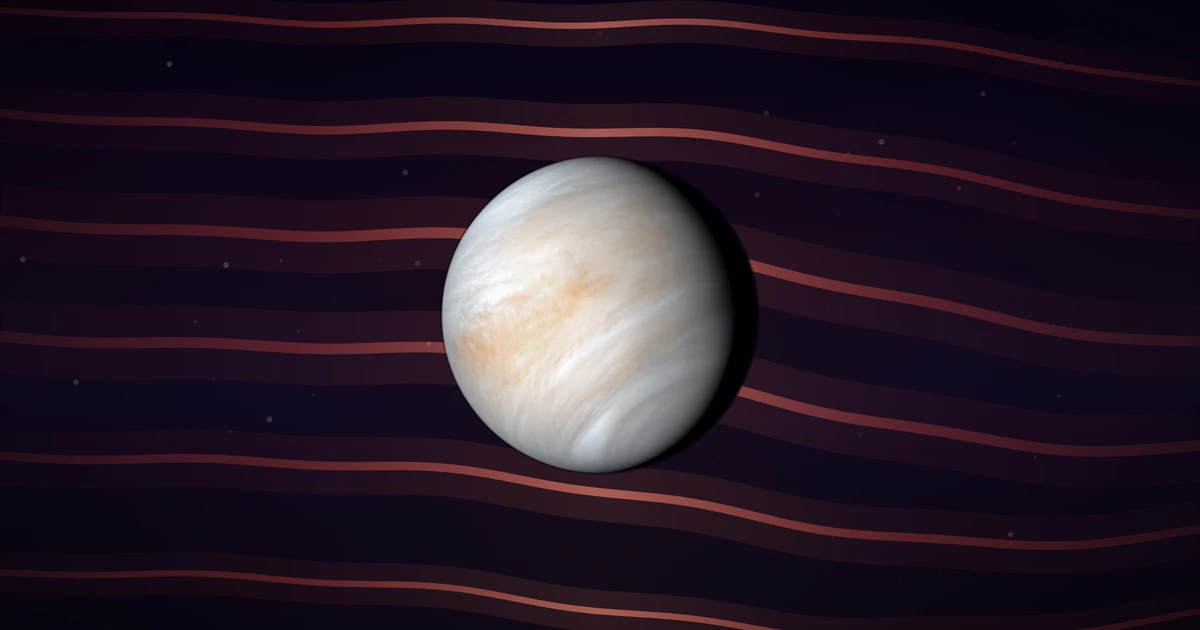
The benefits people link with 221.23 Hz, love, harmony and a gentler mood, come from Hans Cousto's notes on Venus and from astrology, and no published study has tested them. 221.23 Hz is Venus's tone in Cousto's cosmic octave: its orbit of 224.701 days raised 32 octaves, close to the A below middle C. Thirteen Venus years last almost exactly eight of ours.
Ready to play Venus 221.23 Hz
Notice something simple that you appreciate.
What are the benefits of 221.23 Hz?
The benefits most often linked with 221.23 Hz are about the heart in its everyday sense: love, harmony, kindness, a gentler mood. They come from two places. Hans Cousto, the Swiss mathematician and music researcher who first worked out the tone, wrote in his German notes on Venus that it "fördert die höhere Liebesenergie und das Harmoniebestreben": it furthers the higher energy of love and the striving for harmony. Astrology supplies the rest, with Venus as the planet of love and beauty, named for the Roman goddess.
Neither is a measurement. No published study has tested listening to 221.23 Hz, for mood, for love or for anything else, and the nearest research, on music, stress and creativity, used music people chose rather than a single tone, as a section below shows. Even the traditions disagree on the details: Harmonance's own older video of this tone names the sacral and heart chakras, while Cousto gave Venus the third eye. Harmonance's page offers the tone as a warm listening prompt, under a slow meal, a letter or a quiet hour with someone. That is the honest way to use it: as a cue you choose, not an effect anyone has measured.
How does Venus's orbit become 221.23 Hz?
Venus's orbit becomes 221.23 Hz by doubling, 32 times over. Cousto starts from the time Venus takes to circle the Sun once, measured against the stars, which his tuning tables give as 224.701 days, and NASA's Venus fact sheet gives to the same thousandth of a day. Read as a vibration, that is one cycle every 19,414,166.4 seconds, the days multiplied by the 86,400 seconds in each: a frequency of 0.000000051509 Hz, the figure Cousto's tables print as octave 0.
Doubling a frequency raises it by one octave, the same note higher up. Doubling this one 32 times multiplies it by 4,294,967,296 and gives 221.2285 Hz, which rounds to 221.23 Hz. On a piano tuned to A at 440 Hz the nearest note is the A below middle C, at 220 Hz, and 221.23 Hz sits 9.6 cents above it, where a cent is a hundredth of a semitone. Cousto's German page puts it simply: the Venus tone "entspricht" the note A. His tables also give the tuning that makes it exact: set an instrument's A to 442.46 Hz instead of 440 Hz, and 221.23 Hz is its A an octave down.
The same ladder runs on past hearing in both directions. Doubled 25 times, the orbit gives a tempo of 103.7 beats a minute, which Cousto lists as Venus's; octaves 29 to 38, from 27.65 to 14,158.64 Hz, fall inside the range of human hearing, and 221.23 Hz is the fourth of them; 73 doublings reach yellow-orange light at 616 nanometres. The guide to planetary frequencies works the same method through every planet, the Earth and the Moon.
Why do 13 Venus years fit into 8 Earth years?
Thirteen Venus years fit into eight Earth years because the two orbits stand almost exactly in the ratio 13 to 8. NASA gives Venus's orbit as 224.701 days and the Earth's as 365.256 days. Thirteen of the first make 2,921.11 days and eight of the second make 2,922.05 days, about 22 hours apart. In the same eight years Venus passes between the Earth and the Sun five times, once every 583.92 days. As Wikipedia's summary of the orbit puts it, "Five synodic periods of Venus is almost exactly 13 sidereal Venus years and 8 Earth years, and consequently the longitudes and distances almost repeat." Look for Venus as the evening star on a given night, and eight years later it is back in almost the same place in the sky.

Cousto's method turns that astronomy into an interval you can hear. His tables give the Earth's year, doubled the same 32 times, as 136.10 Hz, a C sharp, the tone Harmonance plays as the Earth year. Because both tones are 32 doublings of an orbit, one over the other is simply the ratio of the two orbits: 221.23 divided by 136.10 is 1.6255, and 13 divided by 8 is 1.625. In cents, the Venus tone sits 841.1 cents above the Earth's, against 840.5 for an exact 13 to 8, a gap of half a cent. On a piano it is a minor sixth, C sharp up to A, stretched by about 41 cents.
Thirteen and eight are neighbours in the Fibonacci series, which is why the ratio also sits close to the golden ratio, 1.618. The 13 to 8 is the closer fit by far: the interval between the two tones is half a cent from an exact 13 to 8 and 8 cents from the golden ratio. Play the Venus page and the Earth year page together in Harmonance Studio and you hear the interval itself, the sound of eight years of the two planets' orbits, written as a chord. The guide to the Om frequency tells the Earth year tone's own story.
Which Venus cycle gives which tone?
Each of Venus's rhythms gives its own tone, and the orbit is only the best known. The same doubling works on any cycle, so the table below takes each of them from NASA's fact sheets and doubles it until it can be heard.
| Cycle | Tone |
|---|---|
| Orbit, Cousto and NASA: 224.701 days | 221.23 Hz, A (32 doublings) |
| Tropical orbit, NASA: 224.695 days | 221.23 Hz, A (32 doublings) |
| Earth's year, NASA: 365.256 days | 136.10 Hz, C sharp (32 doublings) |
| Meeting to meeting, NASA: 583.92 days | 170.26 Hz, F (33 doublings) |
| Turn, backwards, NASA: 5,832.6 hours, about 243 days | 204.55 Hz, G sharp (32 doublings) |
| Day, NASA: 2,802 hours, about 116.75 days | 212.89 Hz, G sharp (31 doublings) |
Venus keeps the strangest clock of any planet. It turns so slowly, and backwards, that a single turn outlasts its year: in the words of NASA's Venus facts, a day measured against the stars is "longer even than a Venus year (one trip around the Sun), which takes only 225 Earth days", while "sunrise to sunset would take 117 Earth days", and "the Sun would rise in the west and set in the east, because Venus spins backward compared to Earth." Cousto's table of planetary rotations lists both turns: 204.55 Hz for the turn against the stars and 212.89 Hz for the day, each a G sharp.
The meeting tone needs one correction. Cousto's table of synodic periods takes 583.9205 days and prints 170.53 Hz, but 33 doublings of 583.9205 days make 170.26 Hz, the value in the table above; 170.53 Hz would need a period of 583.01 days. The orbit itself is settled: NASA's fact sheet gives 224.701 days today, Cousto's own figure, though his tables warn that it could change: "If science obtains more detailed data about a distant space object, it may lead to a more accurate determination of the orbital period, resulting in slightly different octave frequencies." The tropical orbit, counted from the spring equinox as the zodiac of Western astrology is, is six thousandths of a day shorter and gives the same 221.23 Hz.
Why is Venus linked with love, Taurus and Libra?
Venus is linked with love because of its name and its brightness. It is, in NASA's words, "named for the ancient Roman goddess of love and beauty, who was known as Aphrodite to the ancient Greeks", and after the Moon it is the brightest thing in the night sky, so bright that the ancients took it for two objects, "a morning star and an evening star". Ptolemy's Tetrabiblos, an astrology handbook written in Greek in the second century, counts Venus with Jupiter and the Moon as the gentle planets, "beneficent because of their tempered nature".
The same book explains the signs: "To Venus, which is temperate and beneath Mars, were given the next two signs, which are extremely fertile, Libra and Taurus", in part because the planet "at most is never more than two signs removed from the sun in either direction." Cousto kept both, with a twist of his own. As morning star Venus belongs to Taurus, as evening star to Libra, he writes, and he calls it the symbol of femininity. Harmonance's Taurus and Libra pages both play the Venus tone, as symbolism to listen with, not a forecast, and the guide to astrology and frequencies explains how signs, planets and tones connect.
What does 221.23 Hz sound like?
221.23 Hz is a warm, mid-low tone at about the pitch of the A below middle C, inside the range of a speaking voice. Halve it and you get its lower octaves, 110.62 and 55.31 Hz; double it and you get 442.46, 884.92 and 1,769.84 Hz, the same note higher up. The 221.23 Hz page plays it in two ways, and we measured both from the page's own audio files.

| Octave band | Tone alone | Strings |
|---|---|---|
| 1,769.84 Hz, three octaves up | 0% | 0.2% |
| 884.92 Hz, two octaves up | 0% | 4.1% |
| 442.46 Hz, one octave up | 0.5% | 28.9% |
| 221.23 Hz, the tone itself | 99.5% | 43.6% |
| 110.61 Hz, one octave down | 0% | 23.2% |
| 55.31 Hz, two octaves down | 0% | 0% |
Download the measurements (CSV)
With Strings off, the page plays the tone on its own, from a file of 100 seconds that loops. It is close to a pure sine: two faint overtones sit above it, at 442.46 Hz, 23.1 dB quieter, and at 663.69 Hz, 34 dB quieter.
With Strings on, the sound spreads either side of the tone. The strings play notes of the A major scale, the scale of the tone's own A, and their eight strongest lines are C sharp at 139.3 Hz, D at 147.8 Hz, E at 166.6 Hz, the strongest of all, F sharp at 186.4 Hz, A at 222.3 Hz, C sharp at 277.1 Hz, E at 328.9 Hz and F sharp at 369.8 Hz. The exact 221.23 Hz tone still plays underneath, 35.3 dB below the music. The C sharp at 139.3 Hz is the note of the Earth year tone, 40 cents above its 136.10 Hz: switch Strings on and the 13 to 8 pair is in the music, tuned the way a piano tunes it.
What have listeners written about the Venus tone?
Harmonance's Taurus and Libra videos on YouTube play the Venus tone with a nature sound, and two listeners have left short comments under them so far:
Love this one
HARMONIOUS!!! ✨🙏🩷😇
The first is under the Taurus video, the second under the Libra video, the two signs Ptolemy gave to Venus. Two comments are two people's experience, not a finding, and both praise the sound rather than any effect. If 221.23 Hz feels too insistent, turn it down, stop, or try it with Strings on, where the sound spreads out around the tone. Everyone hears it in their own way.
Is there research on 221.23 Hz, or on music for calm and creativity?
No published study has tested listening to 221.23 Hz. PubMed, the main index of medical research, holds no record for "221.23 Hz", and its four records for "cosmic octave" are about other things, such as aircrew hearing and astronomy instruments. Europe PMC, a wider index, finds the number once, in a study of telling speakers apart by their voices, not of listening to a tone. So the benefits people describe for the Venus tone, from warmth to harmony, come from tradition and personal experience, not from research.
The nearest research is on music and stress. When de Witte and colleagues pooled 104 randomised trials with 9,617 people in 2020, they found that "music interventions had an overall significant effect on stress reduction in both physiological (d = .380) and psychological (d = .545) outcomes": small to moderate average effects, on measures such as heart rate and on how stressed people said they felt. Those trials used music, chosen for the setting or by the listener, not a single planetary tone.
Venus's old association with creative expression has a small study of its own. In an experiment by Ritter and Ferguson, people who heard lively, happy classical music came up with more varied ideas than people working in silence: "No effect of music was found for convergent creativity", the kind that finds one right answer. That was one study of classical music, not a tone. Research on music and health as a whole is still early, as the US National Center for Complementary and Integrative Health sums it up:
However, because much of the research on music-based interventions is preliminary, few definite conclusions about their effects have been reached.
None of that research used planetary tones. If you listen to 221.23 Hz, what you notice is yours to weigh: it is not an effect anyone has measured.
How do you listen to 221.23 Hz on Harmonance?
Press play on the 221.23 Hz Venus page. With Strings off it plays the tone alone; switch Strings on beside the player, or open the page with Strings already on, and evolving strings play around a quiet 221.23 Hz tone. Nothing plays until you press play, and no account is needed.
No study sets a length for 221.23 Hz. The Venus page suggests ten to twenty minutes as a soft bookend to the working day, low enough to sit underneath the moment, perhaps with one small act of care in mind. Keep the volume comfortable whatever you choose: loud sound is the one listening risk that is well established. The same page from the National Center for Complementary and Integrative Health warns that "listening to music at too high a volume can contribute to noise-induced hearing loss", and the World Health Organization's safe listening advice is that "you can safely listen to a sound level of 80dB for up to 40 hours a week", with your device at no more than 60% of its maximum volume.
In Harmonance Studio you can set Venus beside the Earth year, or beside any other tone, and shape your own mix. The feelings page Feeling disconnected? pairs Venus with 639 Hz, to play while you think of someone. The planetary collection plays every planet's tone, and the astrological collection pairs the tones with the signs. For the other planetary guides, read the guide to 141.27 Hz, the Mercury tone, and the guide to 210.42 Hz, the Moon tone; for what research on sound has and has not shown, the science of sound healing.
Sources and limits
The number rests on Cousto's tables and NASA's fact sheets, read in their original form, and the arithmetic is worked again here from both. The 13 to 8 between the Venus tone and the Earth year tone is our own arithmetic on NASA's figures; Cousto's tables give the same two tones, and the correction to his synodic tone is arithmetic on his own period. The astrology is quoted from Ptolemy in the Loeb translation and from Cousto's own page, as tradition, not evidence. The research on stress and creativity concerns music in general, not this tone. No study of listening to 221.23 Hz turned up in PubMed or Europe PMC, so none is reported. The listeners' words come from public comments under Harmonance's own videos, quoted whole and without names, and the measurements of the 221.23 Hz page are Harmonance's own, made from the page's audio files.
- Hans Cousto, tuning data of the planets (Planetware, English edition): Venus's orbit, its octaves, its note and its tuning, the Earth year, and the synodic and rotation tables.
- Hans Cousto, Venus, from Die Töne der Kosmischen Oktave (Planetware, in German): the tone's effect, the signs and the chakra in his words.
- NASA Space Science Data Coordinated Archive, Venus fact sheet: the orbit, the turn, the day and the synodic period.
- NASA Space Science Data Coordinated Archive, Earth fact sheet: the Earth's year.
- NASA Science, Venus facts: the backward turn, the long day, the morning and evening star and the planet's name.
- Wikipedia, Orbit of Venus: five meetings, thirteen Venus years and eight Earth years.
- Ptolemy, Tetrabiblos, Book 1, translated by F. E. Robbins (Loeb Classical Library, 1940), on LacusCurtius: Venus's nature and its houses.
- A comment under Harmonance's Taurus video, which plays the Venus tone, quoted without the name.
- A comment under Harmonance's Libra video, which plays the Venus tone, quoted without the name.
- de Witte and colleagues (2020), Effects of music interventions on stress-related outcomes: a systematic review and two meta-analyses, in Health Psychology Review: what 104 trials of music and stress found when pooled.
- Ritter and Ferguson (2017), Happy creativity: listening to happy music facilitates divergent thinking, in PLOS ONE: one experiment on music and ideas.
- National Center for Complementary and Integrative Health, Music and Health: the state of music research, and loud listening.
- World Health Organization, safe listening: weekly limits and device volume.
Tones to play while you read
Related guides
111 Hz benefits and the ancient chamber story
111 Hz benefits, checked: the angel number behind the tone, the stone chambers that ring near 110 Hz, and what a pilot found when 30 adults listened.
141.27 Hz benefits: what the Mercury frequency is and is not
141.27 Hz benefits, checked: the Mercury tone is its 88-day orbit raised 30 octaves, its spin sounds the fifth above, and no study has tested it.
174 Hz benefits: the claims and what is known
174 Hz benefits, checked: the comfort and natural anaesthetic claims, where the number came from, and how 37 listeners rated the lowest Solfeggio tone.
Just be curious. This is not a medical device or medical advice. For any health concern, please speak to your doctor.