Happy frequency: the Sun tone and 528 Hz pairing
No frequency has been shown to make people happy. Harmonance's Happiness pairing joins 126.22 Hz, Hans Cousto's tone for the Sun, worked out from its mass, and 528 Hz, the third of the Solfeggio numbers a 1999 book introduced. In experiments, music lifted happiness most when people listened with the intention of feeling happier, and music sounds happy through tempo and mode, which a steady tone lacks.
Ready to play The Sun 126.22 Hz
Choose one thing you would like to create.
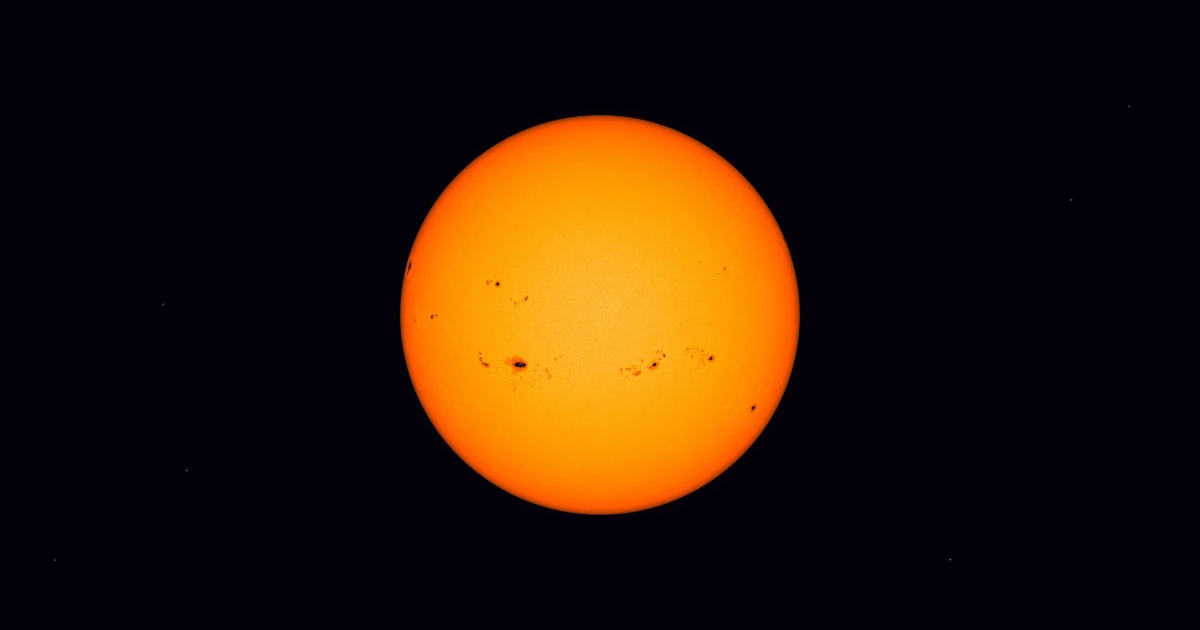
Is there a happy frequency?
Not one that has been shown to work. No published study has played 126.22 Hz, 528 Hz or the two together to people and measured happiness. A search of PubMed, the main index of medical research, finds no study of 528 Hz and happiness, and no study of 126.22 Hz at all.
What exists is a pairing with a story behind each number. It comes from Happiness, a 2023 video on Harmonance's own YouTube channel that plays the Sun tone with 528 Hz. It belongs to a set of fusion videos, each named for a state of mind, such as Focus or Fearless.
This guide takes the pairing apart. It shows where each number comes from, what the ear does with the two together, measured from the site's own audio, and what research on music and happiness has actually found. That research turns out to be about music people enjoy and the intention they bring to it, not about any single tone.
Why is the Sun linked with happiness?
Mostly through everyday life rather than through the tone. Sunshine and good spirits share a vocabulary: in English, a sunny person is a cheerful one. The tone itself was never described as happy by the man who calculated it.
Hans Cousto, who worked out the planetary tones, ties the Sun tone to the solar plexus and gives it this effect in his German text from Die Töne der Kosmischen Oktave:
Fördert das Gefühl für die eigene Mitte, für das Magische und Transzendentale.
In English: it encourages a feeling for your own centre, for the magical and the transcendental. The same text adds advice that rarely travels with the number. Cousto says the Sun tone should be used only after gaining experience with the other planetary tones, and suits above all advanced "Psychonautiker", travellers of the mind. That is a description from a tradition, not a measurement, but it is worth knowing before taking 126.22 Hz for an easy, everyday happy tone.
Where does 126.22 Hz come from?
It comes from the Sun's mass, by way of a thought experiment. Every other tone in Cousto's system raises a real cycle, such as a planet's year, into hearing. The Sun tone, in his words, is the only one "bei dem nicht eine vorhandene astronomische Periode hoch oktaviert wird": the only one not raised from an existing astronomical period.
His tuning tables imagine a planet circling the centre of the Sun at its gravitational length, a distance physicists derive from its mass, about 1.5 km, and going round at nearly the speed of light. In his words: "The 8th sub-octave has then the frequency of 126.22 Hz."
The arithmetic can be redone from NASA's own figures. The Jet Propulsion Laboratory gives the Sun's gravitational parameter as 1.32712440041 × 10²⁰ cubic metres per second squared, and the speed of light as 299,792,458 metres a second. Divide the first by the square of the second and the gravitational length is 1,476.625 metres. Light would go round a circle of that radius 32,312.50 times a second. Halve that eight times and it reaches 126.22 Hz.
On a piano tuned to A at 440 Hz, 126.22 Hz sits 38 cents above the B an octave and a semitone below middle C, where a cent is a hundredth of a semitone; Cousto names it H, the German B. The guide to the Sun frequency works the calculation four ways and explains why the tone is arithmetic, not a sound that travels from the Sun.
Where does 528 Hz come from?
It comes from a book published in 1999. Healing Codes for the Biological Apocalypse presented six numbers as the lost tones of an ancient Solfeggio scale, and its publisher's press release placed 528 third:
The third note, frequency 528, relates to the note "MI" on the scale
MI opens the Latin words mira gestorum, "the wonders of your deeds", in the medieval hymn the singing syllables come from, and the release translated mira as a single word for a supernatural wonder. It also called 528 "the exact frequency used by genetic biochemists", naming no study. By the end of 2002 a tuning fork maker's page, as the Internet Archive saved it, listed MI, 528 Hz, as a tone of transformation, and its labels have followed the number since.
Neither early source ties 528 Hz to happiness. Harmonance's own 528 Hz page calls it love and renewal, and the guide to 528 Hz traces the claim about genes back to where it started and sets out what the studies of the tone actually measured.
What happens when the two tones play together?
They sit far apart in the ear and never rub against each other. Harmonance measured the two pages' own audio files, played together, to find out exactly how far apart they sit.
The inner ear sorts sound by pitch along a coiled membrane, and each place along it acts like a filter a few semitones wide. In 1965 Reinier Plomp and Willem Levelt played pairs of pure tones to listeners and found where roughness comes from:
These intervals are evaluated as consonant for frequency differences exceeding critical bandwidth, whereas the most dissonant intervals correspond with frequency differences of about a quarter of this bandwidth.
The width of those filters is measured in Cams, after the formulas of Glasberg and Moore: on that scale every filter is one Cam wide, and each Cam is about 0.89 mm along the membrane. Every line the two Harmonance pages play is placed on that scale below.

| Line | Level | Place in the ear |
|---|---|---|
| 126.22 Hz, the Sun tone | loudest | 4.08 Cams |
| 252.44 Hz, the Sun tone's 2nd harmonic | 23.1 dB down | 6.91 Cams |
| 378.66 Hz, the Sun tone's 3rd harmonic | 34 dB down | 9.07 Cams |
| 528 Hz, the Solfeggio tone | loudest | 11.12 Cams |
| 1,056 Hz, 528 Hz's 2nd harmonic | 23.1 dB down | 16.04 Cams |
| 1,584 Hz, 528 Hz's 3rd harmonic | 34 dB down | 19.24 Cams |
Download the measurements (CSV)
The two tones are 7.03 Cams apart, seven filters, so by Plomp and Levelt's finding they sound smooth together. Each page's tone also carries two faint harmonics, at twice and three times its pitch, 23.1 dB and 34 dB below it. None of them falls in the same filter as a line of the other tone: the closest pair, the Sun tone's third harmonic at 378.66 Hz and 528 Hz itself, are 2.05 Cams apart.
On the roughness measure Harmonance uses for its own sound, the pair scores 0.5% of the roughest possible pair of equal tones near 528 Hz. Nothing else in the mix comes close to the tones: the next strongest line, at 41.62 Hz, is 57 dB below them.
Is 528 Hz in tune with the Sun tone?
Nearly, but not quite. 528 Hz is 4.183 times 126.22 Hz. Each doubling raises a tone by one octave, so four times the Sun tone, 504.88 Hz, is the same note two octaves up. 528 Hz lands 23.12 Hz above that: 77.5 cents, about three quarters of a semitone.

On paper, two octaves and nearly a semitone is a tense interval: on a piano, the Sun tone is a B, 38 cents sharp, and 528 Hz is the C two octaves and a semitone above it, 16 cents sharp. With pure tones, the ear does not hear that tension as roughness. Plomp and Levelt's finding is that roughness comes from lines that fall inside one filter, and the clash between two notes on an instrument comes mostly from their harmonics colliding.
This pairing has one place where that could happen, and the measurement shows it does not. If the Sun tone carried a fourth harmonic, it would sound at 504.88 Hz, inside the same ear filter as 528 Hz, and the two would beat about 23 times a second. The site's Sun tone has no fourth harmonic to speak of: it measures 82 dB below the tone, so there is nothing there to beat against 528 Hz.
The two do not sound equally loud at the same level, though. The ear is less sensitive to low pitches, so at the pages' shared level the Sun tone reads 44.7 phon and 528 Hz 62.4 phon in the equal-loudness model (ISO 226) that Harmonance uses for its own sound. For the two to sound even, the Sun tone would need about 13 dB more, so the gentler way to balance them is to turn 528 Hz down.
What makes music sound happy?
Above all its tempo, and then its mode. In 2003 Lise Gagnon and Isabelle Peretz played the same short melodies to listeners who were not musicians, in versions that changed only the mode, major or minor, or only the tempo, fast or slow, and asked how happy or sad each sounded. Their results:
The results confirm that both mode and tempo determine the "happy-sad" judgements in isolation, with the tempo being more salient, even when tempo salience was adjusted.
That matters for this pairing, because two steady tones have neither. There is no tempo, since nothing in the sound marks a beat, and no mode, since a mode needs a scale of several notes. Whatever people feel while the Happiness pairing plays, it is not the happy sound that music research describes, and it is honest to say so.
What does research say about music and happiness?
The clearest experiment is about intention as much as sound. Yuna Ferguson and Kennon Sheldon published two studies in 2013 as Trying to be happier really can work in The Journal of Positive Psychology.
What they looked at. In the first study people listened to 12 minutes of music. Some were asked to try to lift their mood while they listened, and others simply listened. The music was either positive in tone, by Copland, or by Stravinsky. In the second study people came back to the lab five times over two weeks to listen to positive music, either trying to become happier or not.
What they found. Trying helped, but only with music that was positive in tone: the effect needed Copland, not Stravinsky. Over the two weeks, the people who tried reported larger rises in happiness. The authors sum it up:
These studies demonstrate that listening to positive music may be an effective way to improve happiness, particularly when it is combined with an intention to become happier.
What it does not show. It measured mood and happiness by questionnaire, over minutes and then a fortnight, with orchestral music, not steady tones. It does not show that any frequency lifts mood, and nobody has tested 126.22 Hz or 528 Hz this way.
Why it matters for listening. The part of the experiment that made the difference was the listener's intention. That is something anyone can bring to any sound, the Happiness pairing included.
Brain imaging points the same way, towards music people find deeply pleasurable rather than towards a pitch. In a 2011 study in Nature Neuroscience, Valorie Salimpoor and colleagues in Montreal scanned listeners at the peaks of their pleasure in music and saw the brain's reward chemical, dopamine, released in the striatum, part of the brain's reward system. In the study's own summary:
These results indicate that intense pleasure in response to music can lead to dopamine release in the striatal system.
The guide to the science of sound healing sets out what research on sound and music has and has not found more widely. The US National Center for Complementary and Integrative Health sums up the field plainly:
However, because much of the research on music-based interventions is preliminary, few definite conclusions about their effects have been reached.
Has 528 Hz been tested on mood?
Once, in nine people, and inside music rather than as a steady tone. In a 2018 study from Tokyo, Akimoto and colleagues played nine healthy adults five minutes of piano music tuned so that 528 Hz fell in its scale, and on another day music in standard tuning, without telling them which was which.
After the 528 Hz music, scores for tension and for overall mood disturbance on a mood questionnaire fell, and in the authors' words, "all positive mood scores tended to increase": a lean in that direction, not a significant change. After the standard music, no score changed significantly.
Nine people is far too few to settle anything, and the tone was one note in a tuned scale, not a steady 528 Hz, so the study cannot speak for the Happiness pairing. The authors' own introduction is blunt about the wider claims:
Various effects have been ascribed to the solfeggio frequency, but none of these have any scientific basis.
The guide to 528 Hz sets out every published study that has played the tone to people, and the guide to 528 Hz and 432 Hz compares it with the other famous tuning.
How do you listen to the Happiness pairing?
Play each tone on its own page, or both together in Studio. On the Sun page, press play to hear 126.22 Hz; switch Strings on beside the player and strings tuned to octaves of 126.22 Hz play, with the tone itself quietly underneath. The 528 Hz page plays the other half. Nothing plays until you press play, and no account is needed.
To hear the two at once, open Harmonance Studio, which plays several tones together after a free sign-in. Set 528 Hz well below the Sun tone so the pair sounds about even. Then borrow the one ingredient research has measured: decide before you press play that you mean to feel a little lighter, and listen for a few minutes. No study sets a length or promises a result, so notice what you notice.
Keep the volume low. Loud listening is the one risk that is well established: the National Center for Complementary and Integrative Health notes that "listening to music at too high a volume can contribute to noise-induced hearing loss", and the World Health Organization's safe listening advice is that "you can safely listen to a sound level of 80dB for up to 40 hours a week", with your device's volume at no more than 60% of maximum.
Both tones belong to larger sets. The planetary collection plays the Sun beside the planets, and the Solfeggio collection plays 528 Hz with its companions. The Connection and Joy theme gathers the tones Harmonance links with happiness, both of these among them, and the Sun also plays on the Low on energy page.
For other ways in, the guide to the frequency for confidence takes apart a sister pairing, Mars with 396 Hz, the guide to planetary frequencies explains Cousto's whole cosmic octave, the guide to the Solfeggio frequencies tells the story of the set tone by tone, and the Studio guide shows how to build and save a mix.
Sources and limits
The story of each number rests on primary records: Cousto's own tables and text and NASA's published constants for the Sun tone, and the 1999 press release and a 2002 tuning fork page, read in their archived form, for 528 Hz. No study has tested either tone, or the pair, on happiness. The research described is about music and mood, with orchestral pieces and pieces people love, and the one study of 528 Hz on mood heard it inside piano music, in nine people. The measurements of the two pages' sound are Harmonance's own, made from the site's audio files; the loudness comparison comes from a model of an average ear, not from listeners.
- Hans Cousto, Sonne, 126.22 Hz (in German): the effect, the solar plexus and the advice his text gives the Sun tone.
- Hans Cousto, tuning data for the planets: the imaginary planet and its 8th sub-octave, 126.22 Hz.
- NASA Jet Propulsion Laboratory, astrodynamic parameters: the Sun's gravitational parameter and the speed of light.
- Tetrahedron Publishing (1999), press release for Healing Codes for the Biological Apocalypse, Internet Archive copy: 528 as the third note, MI.
- SomaEnergetics, the Solfeggio scale frequencies, Internet Archive copy from 2002: 528 Hz labelled a tone of transformation.
- Plomp and Levelt (1965), Tonal consonance and critical bandwidth, Journal of the Acoustical Society of America: tones further apart than a critical band sound consonant.
- Moore (2014), Development and current status of the Cambridge loudness models, Trends in Hearing: the ear's filter widths and the Cam scale.
- Gagnon and Peretz (2003), Mode and tempo relative contributions to happy-sad judgements in equitone melodies, Cognition and Emotion: tempo and mode make music sound happy or sad.
- Ferguson and Sheldon (2013), Trying to be happier really can work: Two experimental studies, The Journal of Positive Psychology: positive music and the intention to feel happier.
- Salimpoor, Benovoy, Larcher, Dagher and Zatorre (2011), Anatomically distinct dopamine release during anticipation and experience of peak emotion to music, Nature Neuroscience: dopamine at the peak of pleasure in music.
- Akimoto, Hu, Yamaguchi and Kobayashi (2018), Effect of 528 Hz Music on the Endocrine System and Autonomic Nervous System, Health: nine adults, mood scores after music tuned to include 528 Hz.
- National Center for Complementary and Integrative Health, Music and Health: What You Need To Know: the state of music research, and loud listening.
- World Health Organization, Deafness and hearing loss: safe listening: safe levels and device volume.
- Harmonance, Happiness: the Sun's 126.22 Hz with 528 Hz, on YouTube: the video the pairing comes from.
Tones to play while you read
Related guides
111 Hz benefits and the ancient chamber story
111 Hz benefits, checked: the angel number behind the tone, the stone chambers that ring near 110 Hz, and what a pilot found when 30 adults listened.
141.27 Hz benefits: what the Mercury frequency is and is not
141.27 Hz benefits, checked: the Mercury tone is its 88-day orbit raised 30 octaves, its spin sounds the fifth above, and no study has tested it.

174 Hz benefits: the claims and what is known
174 Hz benefits, checked: the comfort and natural anaesthetic claims, where the number came from, and how 37 listeners rated the lowest Solfeggio tone.
Just be curious. This is not a medical device or medical advice. For any health concern, please speak to your doctor.