Frequency for confidence: the Mars and 396 Hz pairing
No frequency has been shown to raise confidence. Harmonance's Fearless pairing joins two tones: 144.72 Hz, Hans Cousto's tone for Mars, the planet named after the Roman god of war, and 396 Hz, the Solfeggio tone listed by 2002 as liberating guilt and fear. Experiments have tied a feeling of power to music with more bass, not to any single tone.
Ready to play Mars 144.72 Hz
Choose a small first step towards your next task.
Is there a frequency for confidence?
Not one that has been tested. No study we could find has played 144.72 Hz, 396 Hz or the two together to people and measured confidence, courage or fear, and PubMed, the main index of medical research, lists none.
What exists is a pairing with a story behind each half. It comes from Fearless, a video on Harmonance's YouTube channel that joins Mars at 144.72 Hz with the Solfeggio tone 396 Hz, and the most watched of the channel's nine fusion videos, each named for a state such as Focus or Grounding. People reach for a sound like this before something daunting: a hard conversation, a performance, a first day.
This guide takes the pairing apart. It shows where each number comes from, what the ear does with the two together, measured from the site's own audio, and what research on sound and confidence has actually found, which is about music and words rather than any single tone.
Why is Mars linked with courage?
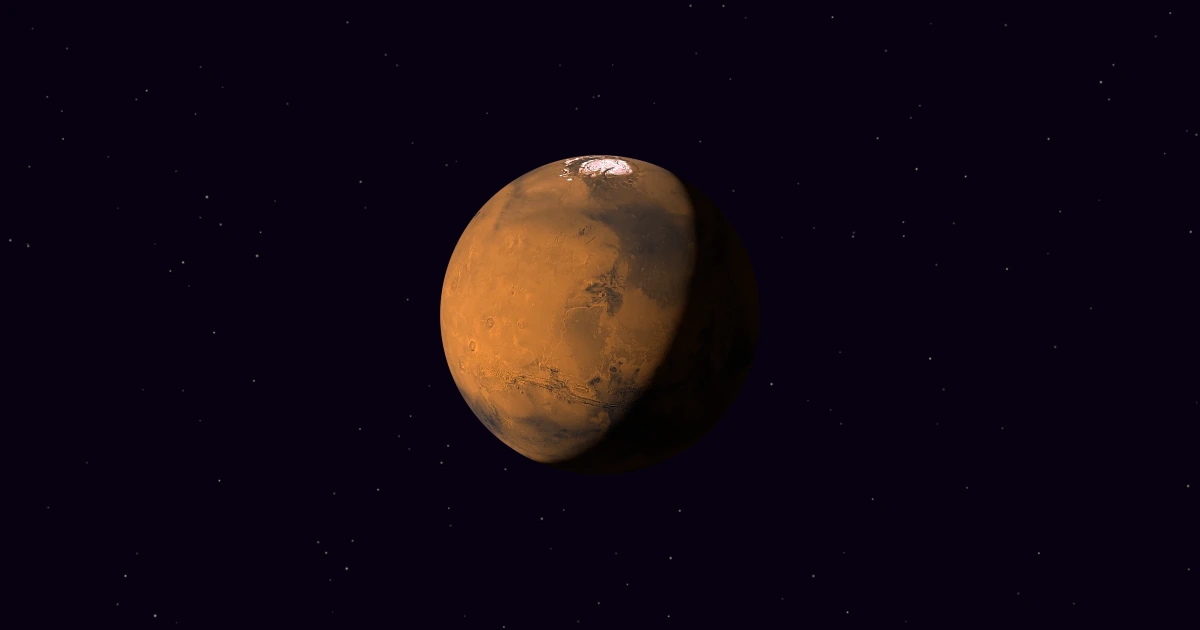
Mars is linked with courage through its name. The Romans named the planet after their god of war, and NASA gives the reason: the planet "was named by the ancient Romans for their god of war because its reddish color was reminiscent of blood".
Its two small moons carry the same story further. The astronomer Asaph Hall found both in 1877 and named them after the sons of Ares, the Greek god of war. In NASA's words, "Phobos means fear", and "Deimos, whose name means dread", circles further out. The planet of courage travels with Fear and Dread at its side, which is a fitting picture for a pairing meant for facing fear.
Hans Cousto, who calculated the planetary tones, carries the old symbolism into his description of the Mars tone. His German text, from Die Töne der Kosmischen Oktave, says Mars symbolises will and assertiveness, recalls that Mars was the god of war in antiquity, and gives the tone an effect in one line:
Fördert die Willenskraft und die zielgerichtete Energie.
In English: it encourages willpower and goal-directed energy. That is a description from a tradition, not a measurement. The same text ties Mars to the sign of Aries, and the Aries page plays it as that sign's tone.
Where does 144.72 Hz come from?
144.72 Hz is the length of the Mars year, turned into a tone by doubling. Mars takes 686.98 days to go once round the Sun against the stars; NASA's Mars fact sheet gives its sidereal orbit as 686.980 days. Count that whole orbit as one slow cycle and its frequency is one cycle in 686.98 × 86,400 seconds, about 0.0000000168 Hz.
Double it and the pitch rises by one octave. Double it 33 times and it reaches 144.72 Hz, which is Cousto's method for every planet.

The arithmetic is short enough to redo. 2 to the power 33 is 8,589,934,592. Divide it by the Mars year in seconds, 59,355,072, and the answer is 144.7212 Hz. Cousto's own tuning tables use a year of 686.9798 days and list the 33rd octave as 144.72 Hz, a D whose concert A would be 433.67 Hz. On NASA's figure and on Cousto's, the result is the same to four decimal places.
On a piano tuned to A at 440 Hz, 144.72 Hz sits 25 cents below the D below middle C, at 146.83 Hz, where a cent is a hundredth of a semitone. The rung above it, 289.44 Hz, is the same note an octave higher. As the guide to planetary frequencies explains for every planet, the tone is arithmetic applied to a real orbit, not a sound that travels from Mars.
Why is 396 Hz called a tone for fear?
396 Hz was called a tone for fear after the number had already been published. It first appeared as the opening tone, UT, of the six Solfeggio numbers in a 1999 book, Healing Codes for the Biological Apocalypse. The publisher's press release gave the number without any meaning:
It has a frequency of 396 cycles per second
The meaning arrived within a few years. A tuning fork maker's page, as the Internet Archive saved it in December 2002, lists the six with a purpose each, and against UT, 396 Hz, it reads "Liberating Guilt and Fear". That label has followed the number ever since.
So the link between 396 Hz and fear is a modern naming, added to a number drawn from arithmetic on verse numbers. Harmonance's own 396 Hz page calls it release and steadying, and the guide to the Solfeggio frequencies tells the story of the whole set, tone by tone.
What happens when the two tones play together?
They stay out of each other's way. The two tones sit far enough apart in the ear that they neither beat nor roughen each other, and we measured exactly how far.
The inner ear sorts sound by pitch along a coiled membrane, and each place along it acts like a filter about a few semitones wide. In 1965 Reinier Plomp and Willem Levelt played pairs of pure tones to listeners and found where roughness comes from:
These intervals are evaluated as consonant for frequency differences exceeding critical bandwidth, whereas the most dissonant intervals correspond with frequency differences of about a quarter of this bandwidth.
The width of those filters is measured in Cams, after the formulas of Glasberg and Moore: on that scale every filter is one Cam wide, and each Cam is about 0.89 mm along the membrane. We placed every line the two Harmonance pages play on that scale, measured from the pages' own audio files played together.

| Line | Level | Place in the ear |
|---|---|---|
| 144.72 Hz, Mars | loudest | 4.55 Cams |
| 289.44 Hz, Mars, 2nd harmonic | 23.1 dB down | 7.60 Cams |
| 396 Hz, the Solfeggio tone | loudest | 9.34 Cams |
| 434.16 Hz, Mars, 3rd harmonic | 34 dB down | 9.89 Cams |
| 792 Hz, 396 Hz's 2nd harmonic | 23.2 dB down | 13.90 Cams |
| 1,188 Hz, 396 Hz's 3rd harmonic | 34 dB down | 16.94 Cams |
Download the measurements (CSV)
The two tones themselves are 4.78 Cams apart, nearly five filters, so by Plomp and Levelt's finding they sound consonant. Each page's tone also carries two faint harmonics, at twice and three times its pitch, 23.1 dB and 34 dB below it. One of them lands close to the other tone: Mars's third harmonic, 434.16 Hz, sits 0.55 Cams from 396 Hz, inside the same filter.
Those two beat 38.16 times a second, but the harmonic is so quiet that the beat moves the sound's level by only 1.99%. On the roughness measure Harmonance uses for its own sound, the pair scores 3% of the roughest possible pair of equal tones near 396 Hz. Nothing else in the mix comes close: the next strongest line, at 66.12 Hz, is 59 dB below the tones.
As an interval, 396 Hz is 2.736 times 144.72 Hz, or 1,742.7 cents: an octave and a fourth, played 43 cents wide. On the piano that is close to a D and the G an octave and a fourth above it, with 396 Hz sitting 18 cents above the G at 392 Hz.
The two do not sound equally loud at the same level. The ear is less sensitive to low pitches, so at the pages' shared level Mars reads 47.3 phon and 396 Hz 60.5 phon in the equal-loudness model (ISO 226) that Harmonance uses for its own sound. For the two to sound even, Mars would need about 10 dB more, so the gentler way to balance them is to turn 396 Hz down rather than Mars up.
What does research say about sound and confidence?
The closest research is about music and the feeling of power, and it used songs, not tones. Five researchers, Hsu, Huang, Nordgren, Rucker and Galinsky, ran a series of experiments published in 2015 as The Music of Power in Social Psychological and Personality Science.
What they looked at. First, pretests picked out songs that people rated as making them feel powerful. Later experiments played those songs, or versions of one piece that differed only in their bass, and then measured how people thought and chose.
What they found. Songs pretested as powerful brought the idea of power to mind and led people towards abstract thinking, a sense of control and choosing to go first. When only the bass changed, the result held:
Experiments 5a and 5b held all features of music constant except for the level of bass and found that music with more bass increased participants' sense of power.
What it does not show. It measured feelings and choices in a laboratory, minutes after listening, not confidence in daily life. It used music, with melody and rhythm, not a steady tone. It is one paper from one team, and nobody has tested 144.72 Hz or 396 Hz this way.
Why it matters for listening. If you want something to play before a daunting moment, the research points to music you already find powerful, and to bass. The Mars tone is low, a D below middle C, but a pure tone is not a song, so the study suggests a direction to explore rather than a result for this pairing.
The guide to the science of sound healing sets out what research on sound and music has and has not found more widely. The US National Center for Complementary and Integrative Health sums the field up plainly:
However, because much of the research on music-based interventions is preliminary, few definite conclusions about their effects have been reached.
Can what you say to yourself matter more than the tone?
On the evidence so far, yes: self-talk has been studied many times, and the tones have not. A 2011 review pooled the research on self-talk in sport, the short phrases people say to themselves while they play.
It found 32 studies with 62 measured effects, and across them "a positive moderate effect size (ES = .48)" on how well people performed the task. The effect was larger for fine skills that need precision than for gross ones that need strength or stamina, and larger for new tasks than for well-learned ones. Those studies measured performance in sport, not confidence itself, and none of them involved sound.
Under the Fearless video, one listener left exactly this kind of self-talk, written as it was meant to be said over the sound:
Empower me I am empowered we are empowered we are being empowered and so it is Thank you so much!
That may be the most useful way to use the pairing: let the tones set the scene, and say your own words over them. The words are the part research has measured.
How do you listen to the Fearless pairing?
Play each tone on its own page, or both together in Studio. On the Mars page, press play to hear 144.72 Hz; switch Strings on beside the player and strings tuned to octaves of 144.72 Hz play, with the tone itself quietly underneath. The 396 Hz page plays the other half. Nothing plays until you press play, and no account is needed.
To hear the two at once, open Harmonance Studio, which plays several tones together after a free sign-in. Set 396 Hz well below Mars so the pair sounds about even, then listen for a few minutes before the thing you are preparing for, saying out loud what you mean to do. No study sets a length or promises a result, so notice what you notice.
Keep the volume low. Loud listening is the one risk that is well established: the National Center for Complementary and Integrative Health notes that "listening to music at too high a volume can contribute to noise-induced hearing loss", and the World Health Organization's safe listening advice is that "you can safely listen to a sound level of 80dB for up to 40 hours a week", with your device's volume at no more than 60% of maximum.
Both tones belong to larger sets. The planetary collection plays Mars beside the other planets, and the Solfeggio collection plays 396 Hz with its eight companions. Mars also appears on the Running low on energy page, and 396 Hz on the Want to feel grounded page.
For other ways in, the guide to astrology and frequencies explains how the planetary tones are paired with the signs, the Studio guide shows how to build and save a mix, and the guide to 174, 417 and 741 Hz looks at another set of tones played together.
Sources and limits
The story of each number rests on primary records: NASA's fact sheet and pages for the Mars year and its moons, Cousto's own tables and text for the Mars tone, and the 1999 press release and a 2002 tuning fork page, read in their archived form, for 396 Hz. No study has tested either tone, or the pair, on confidence or fear. The research described is about songs and the feeling of power, and about self-talk in sport, and neither can say what this pairing does for anyone. The measurements of the two pages' sound are Harmonance's own, made from the site's audio files; the loudness comparison comes from a model of an average ear, not from listeners. The listener's words are one comment under one video, quoted whole and without a name.
- NASA, Mars fact sheet: the sidereal orbit of Mars, 686.980 days.
- Hans Cousto, tuning data for the planets: the Mars year of 686.9798 days and its 33rd octave, 144.72 Hz.
- Hans Cousto, Mars, 144.72 Hz (in German): the symbolism and effect his text gives the Mars tone.
- NASA Science, Mars facts: why the Romans named the planet after their god of war.
- NASA Science, Phobos and Deimos: the moons found in 1877, named fear and dread.
- Tetrahedron Publishing (1999), press release for Healing Codes for the Biological Apocalypse, Internet Archive copy: 396 cycles per second, with no meaning attached.
- SomaEnergetics, the Solfeggio scale frequencies, Internet Archive copy from 2002: 396 Hz labelled liberating guilt and fear.
- Plomp and Levelt (1965), Tonal consonance and critical bandwidth, Journal of the Acoustical Society of America: tones further apart than a critical band sound consonant.
- Moore (2014), Development and current status of the Cambridge loudness models, Trends in Hearing: the ear's filter widths and the Cam scale.
- Hsu, Huang, Nordgren, Rucker and Galinsky (2015), The Music of Power, Social Psychological and Personality Science: music, bass and the feeling of power.
- Hatzigeorgiadis, Zourbanos, Galanis and Theodorakis (2011), Self-Talk and Sports Performance: A Meta-Analysis, Perspectives on Psychological Science: 32 studies of self-talk in sport.
- National Center for Complementary and Integrative Health, Music and Health: What You Need To Know: the state of music research, and loud listening.
- World Health Organization, Deafness and hearing loss: safe listening: safe levels and device volume.
- Harmonance, Fearless: Mars 144.72 Hz and Solfeggio 396 Hz, on YouTube: the listener's comment quoted above.
Tones to play while you read
Related guides
111 Hz benefits and the ancient chamber story
111 Hz benefits, checked: the angel number behind the tone, the stone chambers that ring near 110 Hz, and what a pilot found when 30 adults listened.
141.27 Hz benefits: what the Mercury frequency is and is not
141.27 Hz benefits, checked: the Mercury tone is its 88-day orbit raised 30 octaves, its spin sounds the fifth above, and no study has tested it.
174 Hz benefits: the claims and what is known
174 Hz benefits, checked: the comfort and natural anaesthetic claims, where the number came from, and how 37 listeners rated the lowest Solfeggio tone.
Just be curious. This is not a medical device or medical advice. For any health concern, please speak to your doctor.