528 Hz benefits: what the studies show
528 Hz is the best known of the Solfeggio frequencies, six tones made popular by a 1999 book that drew them from verse numbers in the Bible. Its boldest claim, about genetic material, has never been tested in people. A few small studies played 528 Hz inside music or chant and found calmer moods or lower stress markers, but none shows the pitch made the difference.
What are the claimed benefits of 528 Hz?
The claims for 528 Hz run from calm and love to changes in the body's genetic material, and almost all of them trace back to one book from 1999 rather than to a study. Many people also describe it simply as a sound they like to sit with.
Under Harmonance's own 528 Hz video, two listeners wrote:
Loving your work here! I can feel the power ❤ sending love
Thank you so much! This frequency is really powerful!
Everyone hears it in their own way. What follows is where the number came from, what each study of 528 Hz measured, and where each one stops.
Where does 528 Hz come from?
528 Hz comes from arithmetic on verse numbers in the Bible, set out in Healing Codes for the Biological Apocalypse, a 1999 book by Leonard Horowitz and a co-author who wrote under the pen name Dr Joseph Barber. The publisher's press release told the story:
principal investigator Dr. Joseph Barber was intuitively guided to find the pattern of six repeating codes in the Book of Numbers, Chapter 7, verses 12 through 83. When deciphered using the ancient Pythagorean method of reducing the verse numbers to their single digit integers, the codes revealed a series of six electromagnetic sound frequencies that correspond to the six missing tones of the ancient Solfeggio scale.
Numbers 7, verses 12 to 83, lists the gifts the twelve tribal leaders brought to the tabernacle, one leader a day for twelve days, six verses to each day. The wording repeats almost exactly from one day to the next; only the names change.
Reducing a number means adding its digits until one is left: verse 14 gives 1 + 4 = 5, verse 20 gives 2, and verse 26 gives 2 + 6 = 8. Set the verse numbers out in rows of six, one day to a row, and read down each column.
| 12 to 17 | 3 | 4 | 5 | 6 | 7 | 8 |
|---|---|---|---|---|---|---|
| 18 to 23 | 9 | 1 | 2 | 3 | 4 | 5 |
| 24 to 29 | 6 | 7 | 8 | 9 | 1 | 2 |
The pattern belongs to counting, not to the words. Any run of numbers that starts on one whose digits add up to 3 gives the same six columns, so pages 12 to 29 of any book would do. Start the rows at verse 10 instead, and the columns give 174 and 285 in place of 741 and 852.
Whatever the starting point, the method can only ever make nine numbers: 174, 285, 396, 417, 528, 639, 741, 852 and 963, the full set now known as the Solfeggio frequencies. In each one, every digit is six more than the digit before, counting round past 9 back to 1: 5, then 11, which reduces to 2, then 8. That is why the digits of every Solfeggio number add up to 3, 6 or 9.
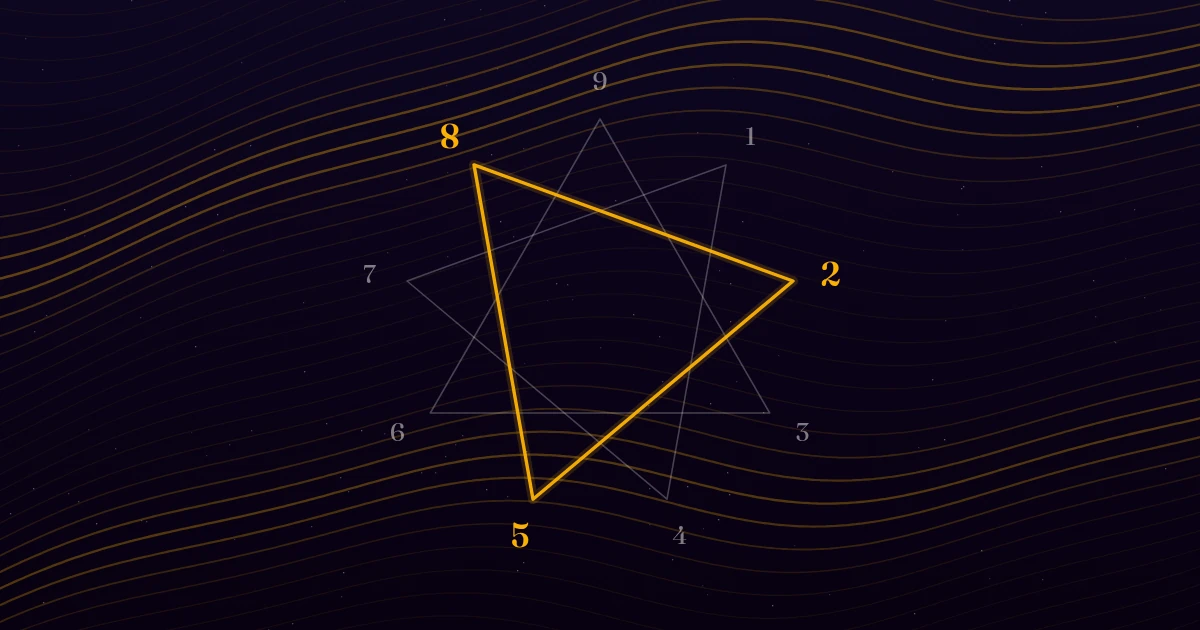
Drawn on nine points, each of the nine numbers traces one of just three triangles, the figure at the top of this guide. 528 traces the triangle through 5, 2 and 8, the same one as 285 and 852.
Why is 528 Hz called MI?
528 Hz is called MI because the book matched its six numbers to the six syllables of a medieval singing scale, and 528 came third. The syllables come from Ut queant laxis, a Latin hymn to Saint John the Baptist whose words are traditionally credited to Paul the Deacon, an eighth-century historian. Each of its first six half lines starts one step higher than the one before, on UT, RE, MI, FA, SOL and LA. Naming the notes after those openings is usually credited to Guido of Arezzo, who taught singing in the eleventh century.
MI opens the words mira gestorum, "the wonders of your deeds". The 1999 press release translated mira as a single word for a supernatural wonder, and that word became 528 Hz's best-known nickname.
The match does not hold up as music. In the hymn the six syllables are the steps of one scale, tone, tone, semitone, tone, tone, and MI is the third step, the note now called E. The six numbers climb by uneven steps instead, from under one semitone (396 to 417 Hz) to about four semitones (417 to 528 Hz), and 528 Hz sits closest to C, the note Guido called UT.
The syllables could not have carried a number of hertz either. A note only has a fixed frequency against a tuning standard, and the one most music uses, A at 440 Hz, was formalised as the international standard ISO 16 in 1975.
Where does the claim about genes come from?
It comes from the same 1999 press release, which called 528 Hz "the exact frequency used by genetic biochemists" to mend damaged genetic material, and named no study to support it.
The one supporting voice in the release was Lee Lorenzen, introduced as a biochemist, who said the frequency had been added to a Clustered Water preparation his team had patented.
The claim then entered the journals without new evidence. A 2017 laboratory paper from the University of Tehran states it as documented fact, and its reference for it is the 2000 edition of the same book.
That paper grew human astrocytes, a kind of brain cell, in dishes with ethanol, with 528 Hz playing from four speakers around some of them. At the ethanol dose that halved survival, the authors report about 20% more living astrocytes with the tone. It is a culture dish, not a person listening, and it counted survival, not genetic material.
A 2025 trial repeats the story in its discussion and cites, as its source, a study of heart rhythm and amplified music that does not mention 528 Hz.
A PubMed search for 528 Hz together with genes or genetic material finds one paper, the rat study described below, which measured the activity of three genes in rat brains. None has tested whether listening to 528 Hz changes anyone's genetic material.
What did the studies of 528 Hz in people measure?
Our search found five published studies that have played 528 Hz to people, and each measured something different: stress markers in saliva, mood scores, heart rhythm, systolic pressure and recovery after a stroke. None was large, and each set the tone inside music, chant or meditation.
| Study | What was played, and for how long | People who heard 528 Hz |
|---|---|---|
| Tokyo, 2018 | Piano music tuned to include 528 Hz, for 5 minutes once | 9 |
| Gujarat, 2025 | A recording of OM chanting at 528 Hz, 15 minutes a day for a month | 30 |
| Tamil Nadu, 2026 | 528 Hz audio with bowls, gongs and bells, an hour a day for four weeks, plus home practice | 50 |
| Ankara, 2026 | 528 Hz instrumental music, for 20 minutes once | 54 |
| Katowice, 2026 | 528 Hz in a musical background, two half hours a day for three months | 70 |
Nine adults and five minutes of piano music, Tokyo
Nine healthy adults heard five minutes of soothing piano music tuned so that 528 Hz fell in its scale, and on another day music in standard tuning, without being told which they were hearing (Akimoto and colleagues, 2018).
After the 528 Hz music, average saliva cortisol fell from 0.43 to 0.25 over the next 30 minutes, oxytocin rose, and tension scores on a mood questionnaire dropped. After the standard music, none of those changes was statistically significant, though one heart rhythm measure fell after both.
The paper tested each kind of music only against itself, before and after, and never the two against each other, so it cannot show that one tuning did more than the other. Nine people is also too few to settle the question. The authors' own introduction says:
Various effects have been ascribed to the solfeggio frequency, but none of these have any scientific basis.
162 students before an exam, Ankara
Students were split into three groups of 54 shortly before an exam: 20 minutes of 528 Hz instrumental music, 20 minutes of 432 Hz instrumental music, or no music. Each then gave one saliva sample and took a Stroop test of attention (Bozok and colleagues, 2026).
The 528 Hz group had the highest level of CREB, a protein linked to memory (a median of 1.5 against 1.13 with no music), and slightly the lowest of GRP78, a protein that rises under strain. The abstract also says 528 Hz raised BDNF, a protein that supports nerve growth, but the paper's own results table marks the 528 Hz and no-music groups as not significantly different (medians of 3.84 and 3.54), and its conclusion calls them comparable.
The Stroop scores did not differ between any of the groups.
The paper reports saliva levels from after the music only, so it shows the groups differing at one moment, not a change in anyone. The music is described only by its frequency, and the authors call the work a pilot.
60 adults with hypertension and a month of chant, Gujarat
Adults with stage 1 hypertension were split in two: 30 listened for 15 minutes a day, for a month, to a recording of OM chanting that one of the authors had composed at 528 Hz, and 30 carried on with standard care alone (Bhoot and colleagues, 2025).
The listeners' average systolic pressure went from 143.9 to 133.9 mmHg over the month, while the comparison group's went from 138.3 to 142.1. Pulse fell as well; between the groups, the heart rhythm measures showed only a marginal trend.
The comparison group listened to nothing in its place, so the result cannot separate 528 Hz from fifteen quiet minutes a day, or from the chant itself.
100 adults and a month of sound meditation, Tamil Nadu
Adults recruited from meditation centres were randomised to four weeks of hour-long sound meditation in person, using recorded 528 Hz audio with singing bowls, gongs, bells and tingshas plus 40 minutes of home practice a day, or to hour-long sessions over Google Meet built around two licensed music tracks (Ravikumar and Sathyanarayanan, 2026).
Against the music group, the meditation group ended with lower scores for tension and low mood on a standard hospital questionnaire, saliva cortisol 2.54 nmol/L lower and systolic pressure 7.62 mmHg lower.
One group met in person and the other joined online, and the authors write that the effects of the recorded sound, the 528 Hz audio, the instruments, the supervised meditation and the home practice "cannot be separated". The study was supported by UNS Digital Technologies.
140 patients after a stroke, Katowice
Patients who had just had an ischaemic stroke all received standard care, and 70 of them also heard 528 Hz set in a musical background through a phone app and earphones, for two half-hour sessions a day over three months (Rybicki and colleagues, 2026).
At day 10 the listening group scored better on neurological, functional and thinking tests. By day 90 the differences had gone, and listening did not predict who recovered well.
The groups were not randomised and did not start alike: diabetes was about twice as common in one group as in the other (52.9% against 25.7%) and obesity four times as common (28.6% against 7.1%), and the paper's table and text disagree about which group that was.
What the five add up to
Taken together, they point the same way as research on music in general: calm listening often goes with lower stress markers and kinder mood scores. None of them separates 528 Hz from the music, chant, meditation or setting it came in. The US National Center for Complementary and Integrative Health sums up the wider field:
However, because much of the research on music-based interventions is preliminary, few definite conclusions about their effects have been reached.
Is it the pitch or the music?
Most likely the music, because "528 Hz music" and ordinary music are closer in pitch than the average listener can tell apart.
In the Tokyo study, 528 Hz music meant music tuned with its A at 444 Hz instead of 440 Hz, which moves its C from 523.25 Hz up to 528.01 Hz. Every note rises by 15.7 cents, about a sixth of a semitone.
In a Berlin listening test built around a 528 Hz tone, 50 non-musicians could on average tell a second tone apart from it only once it reached 539.8 Hz; 50 musicians managed it at 531.1 Hz (Arndt and colleagues, 2020).
| Gap | Size |
|---|---|
| Smallest step musicians could hear from 528 Hz | 3.1 Hz |
| 528 Hz above the C of standard tuning | 4.75 Hz |
| Smallest step non-musicians could hear from 528 Hz | 11.8 Hz |
| One semitone up from 528 Hz | 31.4 Hz |
A trained ear can pick out that gap side by side. The average non-musician in the Berlin test could not.
Against standard pitch, 528 Hz is also a simple ratio: 528 is 440 multiplied by 6/5, the interval musicians call a just minor third. Six waves of 528 Hz take exactly as long as five waves of 440 Hz, so the two line up again 88 times a second.
| Wave | Frequency |
|---|---|
| The pattern the two share | 88 Hz |
| A of standard tuning | 440 Hz |
| 528 Hz | 528 Hz |
What do animal studies of 528 Hz show?
The animal studies of 528 Hz so far were done on rats and on zebrafish, and none can tell us what a tone does for a person listening at home.
In Tehran, rats exposed to 528 Hz at 100 decibels made more testosterone in the brain and had fewer reactive oxygen species there, and with longer exposure they showed fewer anxious behaviours in the authors' tests (Babayi Daylari and colleagues, 2019). The authors set out to study sound as a physical stress on the animals.
For people, the World Health Organization puts the safe listening time at 100 decibels, about the noise of a hair dryer, at 20 minutes a week (WHO, safe listening).
In Vadodara, zebrafish embryos heard 40, 174 or 528 Hz for 90 minutes a day in a soundproof box for their first ten days (Mehta and Uggini, 2026). 40 Hz harmed them. 528 Hz caused no visible damage and no deaths, but a modest rise in GST, an enzyme that responds to oxidative stress.
Can you listen to 528 Hz all night, and is it safe?
None of the studies in people reported harm from listening, and the known risk, at any pitch, is loudness.
The World Health Organization's guide allows 80 decibels, about a doorbell, for 40 hours a week, and 90 decibels for 4 hours. The US National Center for Complementary and Integrative Health notes that music played too loud "can contribute to noise-induced hearing loss". Through the night, set the tone low enough to sit quietly in the room.
Music at bedtime has been studied far more than any single tone. A Cochrane review of 13 trials with 1,007 adults who slept poorly found, with moderate certainty, that 25 to 60 minutes of recorded music a day raised how well people rated their sleep. The review is about music in general, not 528 Hz.
How long should you listen? There is no studied dose. The studies above used 5 minutes in Tokyo, 15 and 20 minutes in Gujarat and Ankara, an hour in Tamil Nadu and two half hours a day in Katowice.
How does 528 Hz sound, and how do you listen to it?
On its own, 528 Hz is a clean, bright tone just above the C one octave over middle C.
On the 528 Hz page it plays free, with no account, and stays silent until you press play. Try a few minutes at a low volume, then stop and notice the quiet afterwards. Harmonance Studio is there for longer sessions.
To hear where it sits, play it beside 432 Hz, the other tuning in the Ankara study, or through the rest of the Solfeggio collection.
The guide to the Solfeggio frequencies covers the whole family. The history of sound healing sets the 1999 book in a much longer story, and the science of sound healing sets out what research can and cannot say. For the chakra tradition, read chakras and frequencies and 432 Hz and the chakras.
Sources and limits
The origin story rests on the publisher's own pages from 1999, kept by the Internet Archive; everything else comes from the published papers and public health pages below. Every study of 528 Hz so far is small or early, and none has compared it with the same sound at another pitch in a large, properly analysed trial.
- Tetrahedron Publishing, press release for the 1999 book (Internet Archive copy): the Numbers 7 method, the MI syllable and the claim about genes.
- A review of the book, with the author's reply, on the publisher's site (Internet Archive copy): the co-author's pen name.
- Numbers 7, verses 12 to 83, Sefaria: twelve days of gifts, six verses each.
- Ut queant laxis, Wikipedia: the hymn and Guido's syllables.
- A440 pitch standard, Wikipedia: A at 440 Hz as ISO 16.
- Akimoto and colleagues, Effect of 528 Hz Music on the Endocrine System and Autonomic Nervous System, Health, 2018: the Tokyo study.
- Bozok and colleagues, Brain and Behavior, 2026: the Ankara study.
- Bhoot and colleagues, Annals of Neurosciences, 2025: the Gujarat study.
- Ravikumar and Sathyanarayanan, Cureus, 2026: the Tamil Nadu study.
- Rybicki and colleagues, Healthcare, 2026: the Katowice study.
- Babayi Daylari and colleagues, Genes and Genomics, 2019: the rat study.
- Babayi and Riazi, Journal of Addiction Research and Therapy, 2017: the astrocyte study and its reference to the book.
- Nakajima and colleagues, Behavioural Neurology, 2016: the heart rhythm study the 2025 trial cites.
- Mehta and Uggini, Marine Environmental Research, 2026: the zebrafish study.
- Arndt and colleagues, Experimental Brain Research, 2020: the Berlin listening test.
- World Health Organization, safe listening: weekly listening times by loudness.
- NCCIH, Music and health: where research on music stands, and the volume warning.
- Jespersen and colleagues, Cochrane review of music for adults who sleep poorly, 2022: music at bedtime.
- The comments quoted at the top are from Harmonance's 528 Hz video on YouTube, without names.
Tones to play while you read
Related guides

174 Hz, 417 Hz and 741 Hz played together
174 Hz 417 Hz 741 Hz played together: why the three Solfeggio tones sit smoothly in the ear, where the numbers come from and what has been studied.
Alpha Waves And Binaural Beats: A Listening Guide
Understand alpha-wave language, binaural beat basics, and how to use audio as a gentle focus or meditation support.
Astrology And Frequencies: Zodiac Sound Associations
Explore zodiac signs, ruling planets, and frequency associations as reflective prompts rather than health or destiny claims.
Just be curious. This is not a medical device or medical advice. For any health concern, please speak to your doctor.