174 Hz, 417 Hz and 741 Hz played together
174 Hz, 417 Hz and 741 Hz are three of the nine Solfeggio tones, the first column of the grid their numbers make, each a reshuffle of the same three digits. Played together they make a smooth chord, because each one lands on its own stretch of the inner ear, so no two beat or turn rough. No study has tested the combination, so listen and judge for yourself.
Ready to play Comfort And Grounding 174 Hz
Settle into a comfortable place and listen.

What are 174 Hz, 417 Hz and 741 Hz?
They are three of the nine tones in the modern Solfeggio set. The tradition gives each its own meaning: 174 Hz for comfort and grounding, 417 Hz for change and clearing, and 741 Hz for expression and clarity. Each one has its own page where you can play it alone, and the Solfeggio collection plays all nine.
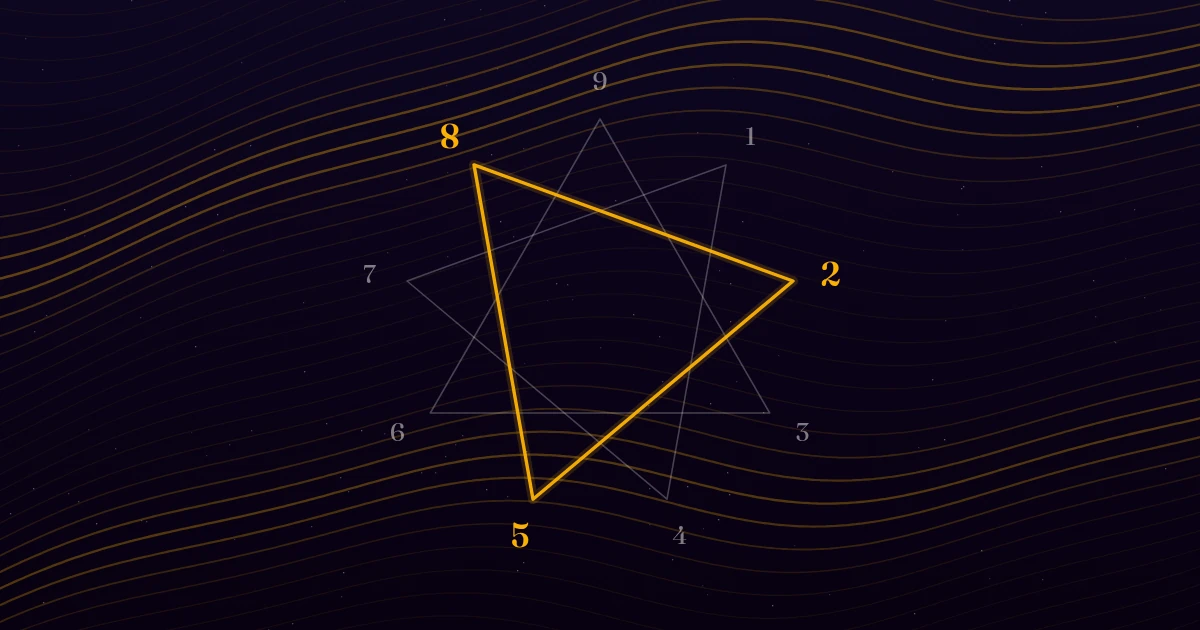
Write the nine numbers in three rows of three, in order, and the reason these three travel together appears. Across each row the numbers climb by 111. Down the first column, 174, 417 and 741 reuse the same three digits in turn. Add the digits of any number in that column and add again, and you reach 3 every time: 1 + 7 + 4 makes 12, and 1 + 2 makes 3. The second column reduces to 6 and the third to 9.
That pattern is arithmetic, and it is the whole of what connects the three. It says nothing about what a tone does to a listener. The numbers themselves are recent, as the next part shows, and the Solfeggio frequencies guide tells their full story.
Where do the Solfeggio numbers come from?
The name is about a thousand years old. The numbers are not. Around 1030 the Italian monk Guido of Arezzo gave singers a way to learn chants they had never heard, built on the hymn Ut queant laxis, whose six phrases each begin one step higher than the last. The first syllable of each phrase became the name of its note:
Ut queant laxis resonare fibris mira gestorum famuli tuorum, solve polluti labii reatum, sancte Iohannes.
Those syllables named steps, not pitches. In his letter on singing unknown chants, Guido describes notes only by the distances between them: a tone, a semitone, a third, a fourth. As the music theorist Rosemary Killam explains, what mattered was where the half-step fell, and the same six syllables could start on C, F or G. Singing a scale on them is what solfeggio means. A medieval sol had no fixed frequency at all: fixed reference pitches, the kind a tuning fork gives, came centuries later.
The numbers arrived in 1999, when Leonard Horowitz and Joseph Puleo printed six of them, 396, 417, 528, 639, 741 and 852, in their book Healing Codes for the Biological Apocalypse. In a later essay in the journal Prabuddha Bharata, Horowitz credits Puleo with realising that ancient priests "sealed or encoded the Solfeggio frequencies in the Old Testament, in the Book of Numbers, Chapter 7, verses 12 through 84."
The verse numbers do produce them, by simple digit arithmetic. In Numbers 7, each day's offering begins six verses after the one before. Take verses 13, 19 and 25 and reduce each number to one digit by adding its digits: 1 + 3 makes 4, 1 + 9 makes 10 and then 1, and 2 + 5 makes 7, which gives 417. Verses 16, 22 and 28 give 741 the same way. Horowitz later stretched the six to nine, a set he called the Perfect Circle of Sound, and the three he added, 174, 285 and 963, follow the same pattern: verses 19, 25 and 31 give 174.
So of the three tones in this guide, 417 and 741 Hz date from 1999, and 174 Hz joined later. Horowitz grouped the three himself, too: in The Book of 528 he calls 417, 741 and 174 Hz a "central triad" of his nine. None of the nine numbers comes from Guido's time.
What happens when the three play together?
A speaker cone can only move one way at a time, so three tones played at once reach you as a single wave: the three added together. Drawn over the same seventeen thousandths of a second, 174 Hz completes three waves, 417 Hz a little over seven and 741 Hz almost thirteen. Their sum is the restless shape at the bottom, and that shape is what actually travels through the air.
Inside the ear, that single wave is pulled apart again. The cochlea holds a long membrane that vibrates most strongly at a different place for each frequency, low tones near its far end and high tones near its entrance. Georg von Békésy measured that travelling wave and won the 1961 Nobel Prize for it; the presentation speech describes it plainly:
The position of the maximal amplitude was found to be dependent on the frequency of the stimulating sound waves in such a way that the highest crest of the travelling wave appears near the apex of the cochlea at low-frequency tones and near its base at high frequencies.
So the ear hears three tones, not one strange wave. To see exactly what the site sends to your ear, we played its own 174, 417 and 741 Hz files together and measured the result.
| Line | Comes from | Level, dB | Nearest other line |
|---|---|---|---|
| 174 Hz | 174 Hz, the tone itself | 0 | 348 Hz, 174 Hz away |
| 348 Hz | 174 Hz, its second harmonic | -23.1 | 417 Hz, 69 Hz away |
| 417 Hz | 417 Hz, the tone itself | 0 | 348 Hz, 69 Hz away |
| 522 Hz | 174 Hz, its third harmonic | -34 | 417 Hz, 105 Hz away |
| 741 Hz | 741 Hz, the tone itself | 0 | 834 Hz, 93 Hz away |
| 834 Hz | 417 Hz, its second harmonic | -23.1 | 741 Hz, 93 Hz away |
| 1,251 Hz | 417 Hz, its third harmonic | -34 | 1,482 Hz, 231 Hz away |
| 1,482 Hz | 741 Hz, its second harmonic | -23.1 | 1,251 Hz, 231 Hz away |
| 2,223 Hz | 741 Hz, its third harmonic | -34 | 1,482 Hz, 741 Hz away |
The measurement shows three strong lines at 174, 417 and 741 Hz, level with each other, because every tone on the site is mastered to the same level. Each tone also carries its second harmonic, at twice its frequency and 23 dB quieter, and a third harmonic 34 dB down, which gives the tone a little warmth. Nothing else in the files comes within 43 dB of the tones.
Why do the three sound so smooth together?
Because, in the ear's own terms, they sit far apart. The ear analyses sound through a bank of overlapping filters called critical bands, and hearing scientists measure their width in ERBs, from the work of Brian Glasberg and Brian Moore. Moore's open review of loudness models gives the formula, and it puts the filter around 174 Hz at about 43 Hz wide, around 417 Hz at about 70 Hz and around 741 Hz at about 105 Hz. Counted on the same scale from the bottom of hearing, 174 Hz lands at band 5.3, 417 Hz at band 9.6 and 741 Hz at band 13.4.
| Pair | Gap | Gap in ear bands |
|---|---|---|
| 174 Hz and 417 Hz | 243 Hz | 4.4 |
| 417 Hz and 741 Hz | 324 Hz | 3.8 |
| 174 Hz and 741 Hz | 567 Hz | 8.2 |
Each step on that scale is about 0.89 millimetres along the membrane, so neighbouring tones here peak roughly 3.4 to 3.9 millimetres apart. That distance matters. Two pure tones inside one band interfere: close together they beat, a slow swell and fade at the difference between their frequencies, and a little further apart the beats come too fast to follow, so the sound turns rough. The UNSW physics notes on beats put the limit simply: beats faster than about 20 or 30 a second stop being heard as beats. Binaural beats use that arithmetic on purpose, with two tones a few hertz apart, one in each ear, as the binaural beats guide explains.
In 1965 Reinier Plomp and Willem Levelt asked listeners to rate pairs of pure tones and found that the band decides how pleasant a pair sounds. Their paper concludes:
These intervals are evaluated as consonant for frequency differences exceeding critical bandwidth, whereas the most dissonant intervals correspond with frequency differences of about a quarter of this bandwidth.
174 and 417 Hz sit 4.4 bands apart, 417 and 741 Hz 3.8 bands apart. Neither pair can beat or roughen, which is the physical side of the way the three seem to complement each other. It is worth being honest about the limit of that. The same holds for any pure tones this far apart, and Plomp and Levelt found that, for pure tones, simple ratios between frequencies made no special difference: distance in the ear decided it. The smoothness is real acoustics, and it does not single out these three numbers.
Whether the three melt into one sound or stay three notes is a separate question. The ear tends to fuse tones that fit one harmonic series, and Moore and colleagues showed that nudging one low harmonic off that series by a few per cent is enough for it to stand out as a tone of its own. In a study of more than 250 listeners, McDermott, Lehr and Oxenham found that the liking for harmonic sounds, more than the dislike of beats, tracked which chords people called consonant. 174, 417 and 741 Hz come close to one harmonic series without fitting it exactly, and nobody has tested how listeners hear this chord, so your own ears are the test.
The closest pair in the whole sound is not two of the tones. It is 741 Hz and 834 Hz, the faint second harmonic of 417 Hz, 93 Hz apart and so inside one band. That harmonic is 23 dB quieter than 741 Hz, about a fourteenth of its strength, a far weaker partner than the tones themselves.
Does the ear add tones of its own?
It can. The inner ear is very slightly nonlinear, and two tones can make it produce faint extra tones that were never played, called combination tones. The strongest of them falls at twice the lower frequency minus the higher, and it needs the two tones close together. Measured as the faint sound the ear itself gives back, it peaks when the higher tone is about 1.22 times the lower, according to Gaskill and Brown, and Goldstein found it falls sharply as the gap widens. The closest ratio here is 741 to 417, which is 1.78, far past that peak.
The simple difference tone, the difference between two frequencies (243, 324 or 567 Hz here), behaves another way: it depends on loudness rather than spacing, and in Goldstein's listeners it was audible only when the tones were more than 50 dB above the threshold of hearing. Plomp's 1965 study of combination tones found that at ordinary levels for speech and music the ear's distortion stays too low to make them audible. At a comfortable volume, what you hear is the three tones. Played loud, a faint low hum at one of those difference frequencies is possible, and turning the volume down removes it. The guide to listening safely has more on comfortable levels.
Do the three sound equally loud?
No, even though the files are mastered to the same level. The ear is less sensitive to low pitches, and the equal-loudness contours, which Suzuki and Takeshima rebuilt from twelve studies, show by how much at every frequency. Run through those contours at a typical listening volume, 741 Hz sounds about two and a half times as loud as 174 Hz.
| Tone | Level, phon | Extra to match 741 Hz, dB | Loudness |
|---|---|---|---|
| 174 Hz | 50.6 | 17 | 2.1 sones |
| 417 Hz | 60.9 | 4.7 | 4.3 sones |
| 741 Hz | 63.9 | 0 | 5.2 sones |
That is why 174 Hz can seem to sink beneath the other two. Played quietly, it needs about 17 dB more than 741 Hz to sound as loud, and 417 Hz needs about 5 dB more. In Studio, each tone in a mix has its own volume, so you can raise 174 Hz until the three sit level.
What is each tone said to do, and what has been studied?
The tradition gives each tone a role. 174 Hz is described as grounding and soothing, the floor beneath the other tones; 417 Hz as the tone for change and clearing the ground; 741 Hz as the tone for expression and clarity. The site's chakra guide pairs 174 Hz with the root centre and 741 Hz with the throat, as a symbolic map for attention rather than a description of the body. None of these roles can be older than the numbers, and none came from an experiment.
Tests are scarce. PubMed, the US National Library of Medicine's index of medical research, holds no study of 174, 417 and 741 Hz played together, and none that plays 417 Hz to people. It holds none for 741 Hz either. The one study of 741 Hz found elsewhere, a short 2026 report in the Journal of Scientific Exploration, says 741 and 852 Hz raised skin conductance, a sign of arousal rather than calm, and only its summary could be read.
174 Hz appears in three studies, and none tests the tone itself. A sleep study of 20 students used 174 Hz as the carrier of a slow binaural beat, so it tested the beat. In a study of 10 volunteers, practitioners using a 174 Hz tuning fork could not agree with each other on what they detected. And a study of zebrafish embryos found that 174 Hz did them no harm. A 2026 review of music, binaural beats and "healing frequencies" reaches the same verdict for 741 Hz and two of its neighbours, 639 and 852 Hz: "there is currently little direct empirical evidence supporting these individual frequencies."
The fairer evidence concerns music in general. A Cochrane review of 13 trials with 1,007 adults judged, with moderate certainty, that listening to music can improve how people with poor sleep rate their own sleep. The US National Center for Complementary and Integrative Health adds a caution: "because much of the research on music-based interventions is preliminary, few definite conclusions about their effects have been reached." None of that research used these three tones.
So the roles belong to a modern tradition, the smoothness is physics, and the combination itself is untested. That is a reason to listen with curiosity rather than expectation.
How do you listen to 174, 417 and 741 Hz together?
Start with each tone alone for a minute, using the players here, so you know its colour: the low, steady hum of 174 Hz, the brighter 417 Hz and the clear, high 741 Hz. Then put the three together. Studio, the free Harmonance instrument, can play several tones at once after you sign in with a free account: add 174, 417 and 741 Hz, raise 174 Hz until the three sound level, and keep the whole mix low enough to talk over. The Studio guide shows how a mix is built.
The idea behind playing them together is simple. Each tone keeps its own character, and the three make a sound of their own, a small assembly of frequencies. Whether that adds up to anything beyond the three alone has never been tested, so it is yours to try. Listen for a few minutes, stop, and notice the quiet afterwards.
Sources and limits
Every measurement here was made on the site's own tone files, added together in software rather than played through a speaker. The ear-band and loudness figures are averages for young adults with typical hearing, and single ears differ. The study search covered PubMed and the open full texts in Europe PMC, and papers without an open full text were judged by their abstracts. The 1999 book could not be opened, so its method is described from Horowitz's later writing. No source here tests 174, 417 and 741 Hz together.
- Guido of Arezzo, letter on unknown chant, about 1030, in the Thesaurus Musicarum Latinarum: the hymn and its six phrases.
- Killam, Solmization with the Guidonian Hand, Journal of Music Theory Pedagogy, 1988: the syllables as relative steps.
- Horowitz and Puleo, Healing Codes for the Biological Apocalypse, 1999: where the six numbers first appeared.
- Horowitz, The Love/528 Revolution, Prabuddha Bharata, 2015: the Numbers 7 account and the nine-tone circle.
- Horowitz, The Book of 528, Tetrahedron, 2011, pages 72 and 350: the three added tones and the central triad.
- Presentation speech for Georg von Békésy, Nobel Prize in Physiology or Medicine, 1961: where each frequency peaks in the cochlea.
- Moore, the Cambridge loudness models, Trends in Hearing, 2014: the formula for the width of the ear's filters.
- UNSW Physics, interference beats and Tartini tones: how beats form and when they stop being heard as beats.
- Plomp and Levelt, Tonal consonance and critical bandwidth, 1965: smoothness and the critical band.
- Moore, Glasberg and Peters, hearing mistuned partials as separate tones, 1986: when one tone stands out from a harmonic sound.
- McDermott, Lehr and Oxenham, Individual differences reveal the basis of consonance, 2010: harmonicity and the liking for chords.
- Gaskill and Brown, the acoustic distortion product from the human ear, 1990: where the ear's strongest added tone peaks.
- Goldstein, Auditory nonlinearity, 1967: how added tones fade as the tones move apart, and when difference tones are heard.
- Plomp, Detectability threshold for combination tones, 1965: added tones at ordinary listening levels.
- Suzuki and Takeshima, Equal-loudness-level contours for pure tones, 2004: how loud each tone sounds.
- Dabiri and colleagues, delta binaural beats and sleep, Acta Psychologica, 2026: 174 Hz as a carrier tone.
- Hammerschlag and colleagues, inter-rater agreement of Biofield Tuning, 2020: the 174 Hz tuning fork.
- Mehta and Uggini, 40, 174 and 528 Hz sound and zebrafish embryos, Marine Environmental Research, 2026: 174 Hz and fish embryos.
- Presley, Stamps and Davis Alexander, pure tone Solfeggio frequencies and skin conductivity, Journal of Scientific Exploration, 2026: 741 and 852 Hz.
- Whitney and colleagues, a review of music, frequencies and binaural beats, Cureus, 2026: the evidence for 639, 741 and 852 Hz.
- Jespersen and colleagues, Cochrane review of listening to music for sleep, 2022: music and self-rated sleep.
- NCCIH, Music and health: what you need to know: where the research on music stands.
Tones to play while you read
Related guides
528 Hz benefits: what the studies show
528 Hz benefits, checked against the research: what five small studies in people measured, where the claims began, and what no study has shown.
Alpha Waves And Binaural Beats: A Listening Guide
Understand alpha-wave language, binaural beat basics, and how to use audio as a gentle focus or meditation support.
Astrology And Frequencies: Zodiac Sound Associations
Explore zodiac signs, ruling planets, and frequency associations as reflective prompts rather than health or destiny claims.
Just be curious. This is not a medical device or medical advice. For any health concern, please speak to your doctor.