What frequency is good for creativity? The Sun and 417 Hz
No frequency has been shown to make people more creative. Harmonance's Creativity pairing joins two tones: 126.22 Hz, Hans Cousto's tone for the Sun, and 417 Hz, the Solfeggio tone listed by 2002 for facilitating change. Studies have tested music, not single tones: cheerful music lifted idea generation, while background music made word puzzles harder.
Ready to play The Sun 126.22 Hz
Choose one thing you would like to create.
Is there a frequency for creativity?
Not one that has been tested. No study has played 126.22 Hz, 417 Hz or the two together to people and then measured creative thinking. The research that does exist tested music and binaural beats, and it points two ways at once.
What exists is a pairing with a story behind each half. Creativity is one of nine fusion videos on Harmonance's YouTube channel, each named for a state such as Focus or Grounding, and it joins the Sun tone at 126.22 Hz with the Solfeggio tone 417 Hz. People reach for a sound like this before they write, draw, compose or come back to a problem that will not move.
This guide takes the pairing apart. It shows where each number comes from, what the ear does with the two together, measured from the site's own audio, and what research on sound and creative thinking has actually found.
Where does 126.22 Hz come from?
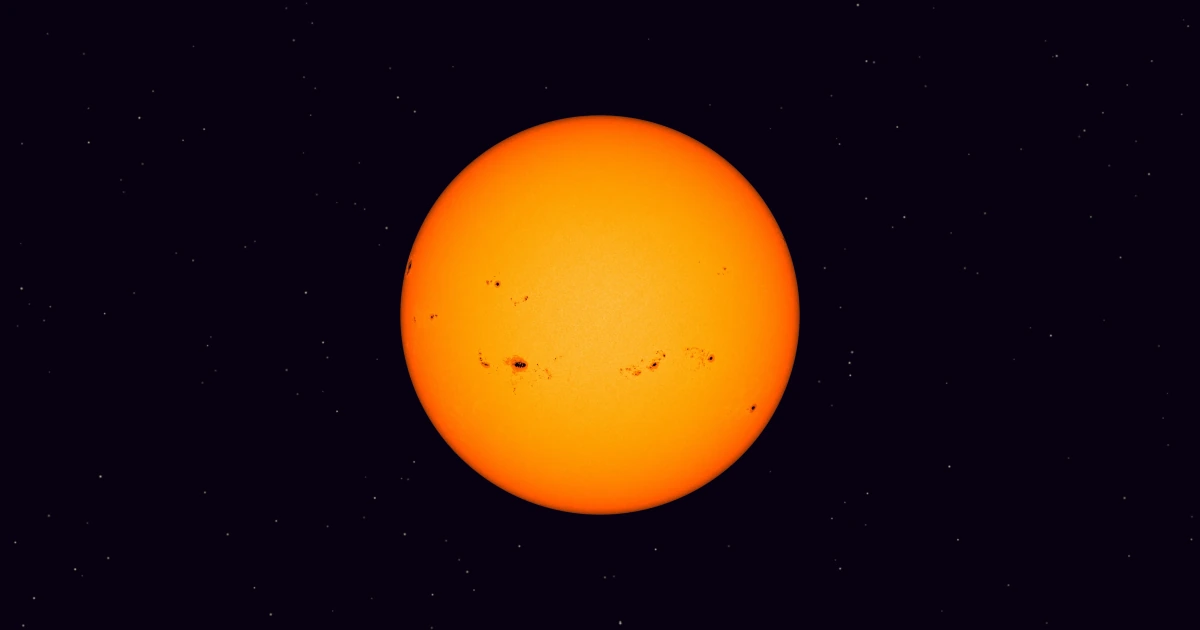
126.22 Hz comes from an orbit that does not exist. Hans Cousto, who calculated the tones of the cosmic octave, made his other tones by doubling a real cycle in the sky, such as a day, a year or a month, until it could be heard. For the Sun he did something different, and his German text says so: of all his tones, the Sun tone is the only one not raised from an existing astronomical period.
Instead he asked how often something could circle the centre of the Sun at its gravitational length, a radius set by the Sun's mass. His tuning tables describe an imaginary planet there, moving "with approximate speed of light", that "would do this in the second well 32 000 times". Halve that rate eight times and it is 126.22 Hz.

The arithmetic can be redone from NASA's own constants. The Jet Propulsion Laboratory gives the Sun's gravitational parameter, its mass times the gravitational constant, as 132,712,440,041 cubic kilometres per second squared, and the speed of light as 299,792,458 metres a second. Divide the first by the square of the second and the gravitational length is 1,476.63 m. A circle of that radius is 9,278 m round, and light goes round it 32,312.50 times a second. Halve that eight times, which is to divide by 256, and the result is 126.2207 Hz, Cousto's number exactly.
On a piano tuned to A at 440 Hz, 126.22 Hz sits 38 cents above the second B below middle C, at 123.47 Hz, where a cent is a hundredth of a semitone. The rung above it, 252.44 Hz, is the same note an octave higher. The guide to the Sun frequency tells this tone's story in full, and the guide to planetary frequencies explains Cousto's method for every planet.
Cousto gives the Sun tone a meaning in one line, and it is not creativity:
Fördert das Gefühl für die eigene Mitte, für das Magische und Transzendentale.
In English: it encourages a feeling for your own centre, and for the magical and the transcendent. The same text links the tone to the middle of the body, because the Sun is the middle of the solar system. That is a description from a tradition, not a measurement.
Why is 417 Hz linked with change?
417 Hz was linked with change after the number was already in print. It is the second of the six Solfeggio numbers set out in a 1999 book, Healing Codes for the Biological Apocalypse, and its syllable, RE, comes from the line resonare fibris in a medieval hymn. The publisher's press release explained the syllable and nothing more: RE was short for resonare fibris, "or resonance".
The meaning arrived within a few years. A tuning fork maker's page, as the Internet Archive saved it in December 2002, lists the six with a purpose each, and against RE, 417 Hz, it reads "Undoing Situations and Facilitating Change". Harmonance's 417 Hz page keeps that idea as change and clearing, and the guide to 417 Hz follows the number and its claims in full.
Neither source mentions creativity. Side by side, though, the two meanings describe how a lot of creative work begins: a settled centre to work from, and a push to change what is already there. That reading is Harmonance's own, and it is the whole basis of the pairing.
What happens when the two tones play together?
They stay out of each other's way. The two tones sit far enough apart in the ear that they neither beat nor roughen each other, and the site's own audio shows exactly how far.
The inner ear sorts sound by pitch along a coiled membrane, and each place along it acts like a filter a few semitones wide. In 1965 Reinier Plomp and Willem Levelt played pairs of pure tones to listeners and found where roughness comes from:
These intervals are evaluated as consonant for frequency differences exceeding critical bandwidth, whereas the most dissonant intervals correspond with frequency differences of about a quarter of this bandwidth.
The width of those filters is measured in Cams, after the formulas of Glasberg and Moore: on that scale every filter is one Cam wide, and each Cam is about 0.89 mm along the membrane. The chart places every line the two Harmonance pages play on that scale, measured from the pages' own audio files played together.

| Line | Level | Place in the ear |
|---|---|---|
| 126.22 Hz, the Sun tone | loudest | 4.08 Cams |
| 252.44 Hz, the Sun's 2nd harmonic | 23.1 dB down | 6.91 Cams |
| 378.66 Hz, the Sun's 3rd harmonic | 34 dB down | 9.07 Cams |
| 417 Hz, the Solfeggio tone | loudest | 9.64 Cams |
| 834 Hz, 417 Hz's 2nd harmonic | 23.1 dB down | 14.27 Cams |
| 1,251 Hz, 417 Hz's 3rd harmonic | 34 dB down | 17.35 Cams |
Download the measurements (CSV)
The two tones themselves are 5.56 Cams apart, more than five filters, so by Plomp and Levelt's finding they sound consonant. Each page's tone also carries two faint harmonics, at twice and three times its pitch, 23.1 dB and 34 dB below it. One of them lands close to the other tone: the Sun tone's third harmonic, 378.66 Hz, sits 0.57 Cams below 417 Hz, inside the same filter.
Those two beat 38.34 times a second, but the harmonic is so quiet that the beat moves the sound's level by only 2%. On the roughness measure Harmonance uses for its own sound, the pair scores 2.3% of the roughest possible pair of equal tones near 417 Hz. Nothing else in the mix comes close: the next strongest line, at 41.6 Hz, is 56.7 dB below the tones.
As an interval, 417 Hz is 3.304 times 126.22 Hz, or 2,068.9 cents: an octave and a major sixth, played 31 cents narrow. On the piano that is close to a B and the G sharp an octave and a sixth above it, with 417 Hz sitting 7 cents above the G sharp at 415.30 Hz.
The two do not sound equally loud at the same level. The ear is less sensitive to low pitches, so at the pages' shared level the Sun tone reads 44.7 phon and 417 Hz 60.9 phon in the equal-loudness model (ISO 226) that Harmonance uses for its own sound. For the two to sound even, the Sun tone would need about 12 dB more, so the gentler way to balance them is to turn 417 Hz down rather than the Sun tone up.
What does research say about music and creativity?
It says music can help one kind of creative thinking and get in the way of another. Psychologists split creative thinking in two: divergent thinking, which produces many possible answers, such as uses for a brick, and convergent thinking, which homes in on one right answer, such as the word that links three others.
What the study looked at. Simone Ritter and Sam Ferguson, in a 2017 paper in PLOS ONE, gave 155 people creative tasks while they listened to one of four classical excerpts, chosen to vary in mood and energy, or worked in silence. The divergent task asked them to "List as many different and creative uses for a brick".
What it found. The cheerful, energetic music stood out:
Creativity was higher for participants who listened to 'happy music' (i.e., classical music high on arousal and positive mood) while performing the divergent creativity task, than for participants who performed the task in silence.
The overall divergent score averaged 93.87 with that music against 76.10 in silence. No music changed convergent thinking.
What it does not show. The gap between happy music and silence rested on one test, at p = .039, and across all five groups the differences did not survive the authors' own correction for running six tests. The music was recorded orchestral music with melody and rhythm, not a steady tone, and the people taking part averaged 22 years old. Nobody has tested 126.22 Hz or 417 Hz this way.
The other side. A 2019 series of three experiments by Threadgold, Marsh, McLatchie and Ball in Applied Cognitive Psychology tested convergent puzzles instead, the kind where three words share a fourth. Its finding runs the other way:
Background music with foreign (unfamiliar) lyrics (Experiment 1), instrumental music without lyrics (Experiment 2), and music with familiar lyrics (Experiment 3) all significantly impaired CRAT performance in comparison with quiet background conditions.
The music got in the way even when it lifted people's mood, and even for people who usually study with music on. The authors discuss it as a kind of auditory distraction.
Why it matters for listening. Taken together, the two papers point to sound for the stage where the aim is many possibilities, and quiet for the stage that needs one right answer. Neither tested a pure tone, so for the Creativity pairing this is a direction to explore rather than a result.
The guide to the science of sound healing sets out what research on sound and music has and has not found more widely. The US National Center for Complementary and Integrative Health sums the field up plainly:
However, because much of the research on music-based interventions is preliminary, few definite conclusions about their effects have been reached.
Can a steady tone or a binaural beat change creative thinking?
The one study close to this question used a steady tone as its baseline, not as the thing being tested. In 2013 Reedijk, Bolders and Hommel at Leiden University played binaural beats to 24 students: a 10 Hz beat in one session, a 40 Hz beat in another and, in a third, as the control, "a constant tone of 340 Hz".
The beats moved one kind of thinking only. In the paper's own summary:
Results showed that binaural beats, regardless of the presented frequency, can affect divergent but not convergent thinking.
The effect depended on the person. Students with low blink rates, which the authors used as a rough sign of the brain's dopamine level, did best with the 10 Hz beat, while those with high blink rates were unaffected or did worse with both beats.
A study of 24 students cannot settle the question, and binaural beats need headphones and a slightly different tone in each ear, which is not what the Creativity pairing plays. The guide to binaural beats explains how they work.
How do you listen to the Creativity pairing?
Play each tone on its own page, or both together in Studio. On the Sun page, press play to hear 126.22 Hz; switch Strings on beside the player and strings tuned to octaves of 126.22 Hz play, with the tone itself quietly underneath. The 417 Hz page plays the other half. Nothing plays until you press play, and no account is needed.
To hear the two at once, open Harmonance Studio, which plays several tones together after a free sign-in. Set 417 Hz well below the Sun tone so the pair sounds about even. Given what the studies found, one way to try it is to let it play while you gather ideas, then turn it off when you edit or solve. No study sets a length or promises a result, so notice what you notice.
Keep the volume low. Loud listening is the one risk that is well established: the National Center for Complementary and Integrative Health notes that "listening to music at too high a volume can contribute to noise-induced hearing loss", and the World Health Organization's safe listening advice is that "you can safely listen to a sound level of 80dB for up to 40 hours a week", with your device's volume at no more than 60% of maximum.
Both tones belong to larger sets. The planetary collection plays the Sun beside the other planets, and the Solfeggio collection plays 417 Hz with its companions. For more sounds to make things with, the creative block page plays 417 Hz, Uranus and 741 Hz, and the creativity theme gathers tones for writing, drawing and music.
For other ways in, the guide to 174, 417 and 741 Hz looks at another set of tones played together, the guide to the Solfeggio frequencies tells the story of the whole set, tone by tone, and the Studio guide shows how to build and save a mix.
Sources and limits
The story of each number rests on primary records: Cousto's own tables and text for the Sun tone, NASA's Jet Propulsion Laboratory for the constants behind it, and the 1999 press release and a 2002 tuning fork page, read in their archived form, for 417 Hz. No study has tested either tone, or the pair, on creativity. The research described is about classical music, background music and binaural beats, each in a single small set of experiments, and none can say what this pairing does for anyone. The measurements of the two pages' sound are Harmonance's own, made from the site's audio files; the loudness comparison comes from a model of an average ear, not from listeners.
- Hans Cousto, tuning data for the planets: the light-speed orbit at the Sun's gravitational length, 32,312.5 Hz, and its eighth sub-octave, 126.22 Hz.
- Hans Cousto, Der Sonnenton, 126.22 Hz (in German): the only tone not raised from an astronomical period, and the meaning his text gives it.
- NASA Jet Propulsion Laboratory, astrodynamic parameters: the Sun's gravitational parameter and the speed of light.
- Tetrahedron Publishing (1999), press release for Healing Codes for the Biological Apocalypse, Internet Archive copy: RE named from resonare fibris, with no meaning attached.
- SomaEnergetics, the Solfeggio scale frequencies, Internet Archive copy from 2002: 417 Hz labelled undoing situations and facilitating change.
- Plomp and Levelt (1965), Tonal consonance and critical bandwidth, Journal of the Acoustical Society of America: tones further apart than a critical band sound consonant.
- Moore (2014), Development and current status of the Cambridge loudness models, Trends in Hearing: the ear's filter widths and the Cam scale.
- Ritter and Ferguson (2017), Happy creativity: Listening to happy music facilitates divergent thinking, PLOS ONE: classical music, silence and two kinds of creative thinking.
- Threadgold, Marsh, McLatchie and Ball (2019), Background music stints creativity, Applied Cognitive Psychology: background music and word puzzles.
- Reedijk, Bolders and Hommel (2013), The impact of binaural beats on creativity, Frontiers in Human Neuroscience: binaural beats against a steady 340 Hz tone.
- National Center for Complementary and Integrative Health, Music and Health: What You Need To Know: the state of music research, and loud listening.
- World Health Organization, Deafness and hearing loss: safe listening: safe levels and device volume.
Tones to play while you read
Related guides
111 Hz benefits and the ancient chamber story
111 Hz benefits, checked: the angel number behind the tone, the stone chambers that ring near 110 Hz, and what a pilot found when 30 adults listened.
141.27 Hz benefits: what the Mercury frequency is and is not
141.27 Hz benefits, checked: the Mercury tone is its 88-day orbit raised 30 octaves, its spin sounds the fifth above, and no study has tested it.

174 Hz benefits: the claims and what is known
174 Hz benefits, checked: the comfort and natural anaesthetic claims, where the number came from, and how 37 listeners rated the lowest Solfeggio tone.
Just be curious. This is not a medical device or medical advice. For any health concern, please speak to your doctor.