Frequency guide
Listening context
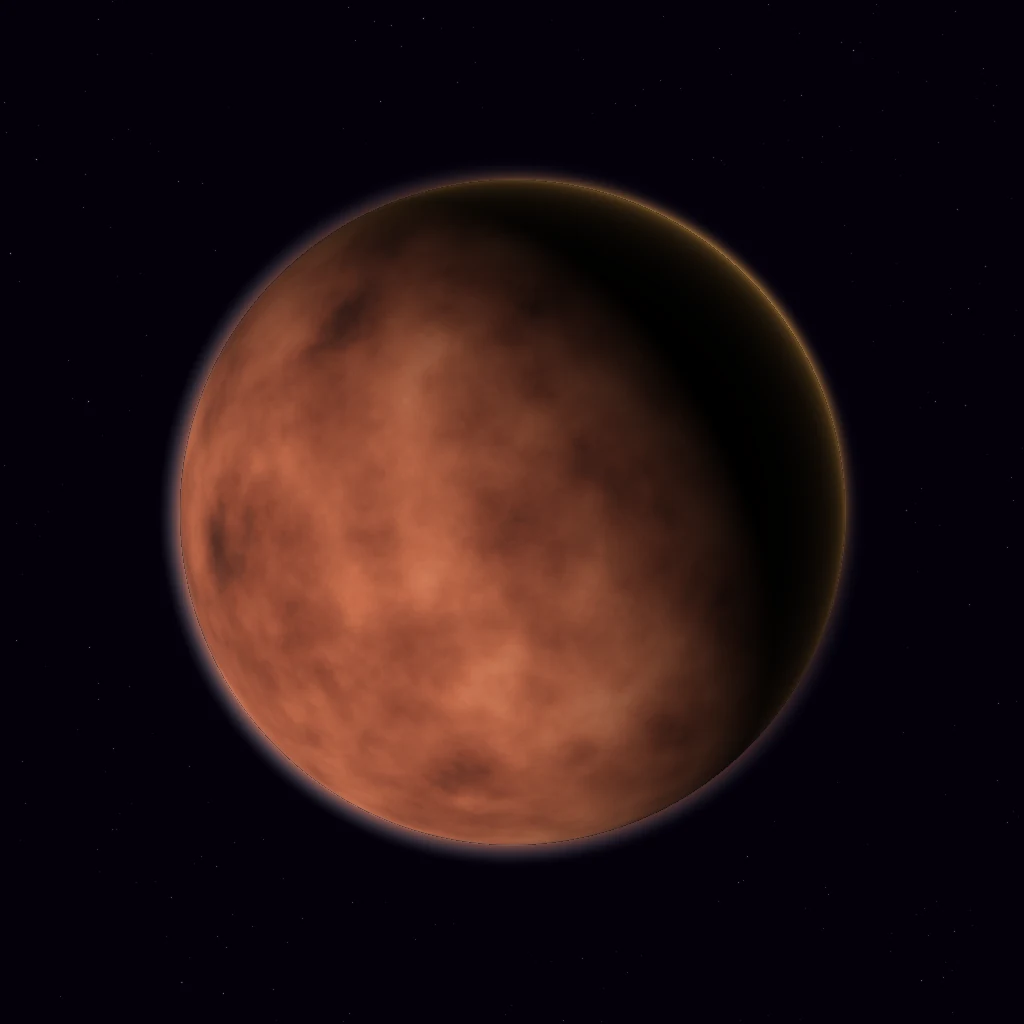
144.72 Hz is the tone that Hans Cousto's cosmic-octave system assigns to Mars, the fourth planet from the Sun and our nearest outward neighbour. The pitch sits close to a D in standard tuning, with a slightly bright, propulsive character compared with the warmer Sun tone.
Origin: the astronomy and the octave maths
In Cousto's method, a real orbital period is read as an extremely low frequency and doubled through octaves until it climbs into the hearing range. Each doubling lifts the pitch by exactly one octave while preserving its proportions, so even a year almost twice the length of ours can become an audible note.
Mars takes 686.98 days, very nearly two Earth years, to orbit the Sun. Cousto read that period as a frequency of a tiny fraction of a cycle per second and doubled it through thirty-three octaves, arriving at about 144.72 Hz. The result is a clear, focused frequency, one of the more active in the planetary family. As with every cosmic-octave tone, it is arithmetic applied to a real orbit, not a sound from the planet itself: audible waves cannot cross the empty space between worlds.
Tradition and mythology
Mars is named for the Roman god of war, though in Roman thought he stood as much for initiative, courage, and the protection of fields as for conflict. His Greek counterpart Ares carried a fiercer reputation. In Vedic astrology Mangala, the red planet, is tied to energy, drive, and decisive action. The planet's rusty colour, from iron-rich dust on its surface, made the link to fire and blood natural to ancient sky-watchers. Western astrology ties Mars to momentum, assertion, and the willingness to begin something difficult.
Mars has held human attention more than any other planet, partly because it is the most Earth-like world we can easily see. A Martian day is almost exactly the length of ours, just over 24 hours, and the planet has polar ice caps, seasons, and the tallest volcano and one of the deepest canyons in the solar system. Its reddish glow comes from iron oxide, essentially rust, coating the surface dust. Ancient sky-watchers also noticed that Mars occasionally seems to halt and loop backwards across the sky, an effect we now know as apparent retrograde motion, caused by Earth overtaking the slower planet on the inside track. That wandering, unpredictable quality reinforced the planet's restless, contrary reputation long before telescopes revealed it as a world.
How listeners use it
- A bright, slightly metallic quality that feels alert without being sharp.
- A sense of being more willing to begin a task that had been sitting on the list.
- A soundtrack for short workouts, stretching, or a brisk walk.
- Best for active or creative work rather than wind-down moments.
What the evidence says
The idea that a Mars-derived tone lends courage or drive is traditional and experiential, not established science. No solid research supports it, and any sense of momentum during a session is shaped by the room, your mood, and what you bring to the practice. Studies of music and energy are early and mixed: brisker music can lift arousal and motivation for some listeners, but findings are preliminary and context-specific. Use the tone as a small anchor inside a wider routine.
How to listen
- Try it in the morning or early afternoon rather than just before sleep.
- Start with a short session of five to ten minutes and notice your response.
- Pair it with one small action you would like to begin.
- Keep the volume comfortable; this is a tone, not a workout playlist.
- Stop or change the source if listening ever feels uncomfortable.
144.72 Hz: The Mars Tone in Cousto's Planetary System
144.72 Hz is the planetary tone assigned to Mars within the octave-based tuning system developed by Hans Cousto in the late 1970s. The number is derived from Mars's orbital period of about 687 Earth days, shifted upward through successive doublings until the result lands in the human hearing range. The pitch is close to a low D in standard tuning, with a slightly bright, propulsive character compared with the warmer Sun reference in the same system. This piece is a grounded look at where the tone comes from, what listeners often describe, and how a curious listener can fold it into a small, repeatable practice.
Where this frequency comes from
In Cousto's system, set out in the cosmic-octave system he developed in 1978, any recurring motion in nature can be expressed as a sound. Mars's roughly two-year journey around the Sun, octave-shifted into audio, produces a clear, focused frequency that many practitioners pair with the qualities Mars has long carried in older symbolism: initiative, momentum, courage, and the willingness to begin something difficult.
The Roman god Mars stood for the start of a campaign and for the energy needed to put plans into motion, not only for conflict. The Greek equivalent Ares carried a similar bundle of meanings. In Hindu astrology the planet Mangala has been associated with strength of will and assertiveness. Across these traditions, the symbolism gathers around a posture of doing rather than waiting. Cousto's tuning preserves that older thread and gives it a sounded reference at 144.72 Hz, a pitch that many listeners describe as feeling more forward-leaning than the warmer planetary tones nearby.
As with all the planetary tones, it is worth holding the tradition lightly. Sound does not travel through the near-vacuum of space, so 144.72 Hz is not the literal noise of Mars. It is a creative mathematical translation, and the meanings attached to it draw from older astrological and mythological readings rather than from astronomy. The tone is interesting because of the long human conversation it sits inside and the careful way Cousto derived it, not because the planet itself is broadcasting a pitch.
How people describe listening to it
Subjective reports vary, and a tone that one listener finds energising another may find too busy to sit with for very long. Some common impressions from people who have written about their sessions:
- A bright, slightly metallic quality that feels alert without being sharp.
- A sense of being more willing to begin a task that had been sitting on the to-do list.
- A useful soundtrack for short workouts, stretching, or a brisk walk indoors.
- Best as a backdrop for active or creative work rather than wind-down moments.
- A pleasant pairing with a clearly stated intention for the next hour.
- A daytime feel rather than a soft pre-sleep one.
How to use it in a listening practice
A short, steady practice with the Mars tone might look like this:
- Try it in the morning or early afternoon rather than just before sleep.
- Start with a brief session of five to ten minutes and notice your response.
- Pair it with a simple intention: one small action you would like to begin today.
- Keep the volume comfortable; this is a steady reference tone, not a workout playlist.
- If it feels too restless, layer it under quieter ambient sound or step away for a while.
- Use it as a warm-up before a piece of work, then let silence carry the actual task.
- Switch off the tone if listening ever starts to feel uncomfortable.
The blend of science and symbolism
Cousto's planetary system is one of several modern frameworks that sit at the intersection of mathematics and older meaning-making traditions. The maths is straightforward and well documented: an orbital period, expressed in seconds, halved through successive octaves until the resulting frequency falls within human hearing. The symbolism, on the other hand, comes from older astrologies, mythologies, and the long human habit of finding meaning in the movements of the sky.
That blend is part of why the planetary tones feel so distinctive in a modern listening practice. They are tied to a careful calculation, which gives them a recognisable identity in pitch. They are also tied to a much older story about what each planet has meant to human cultures across many centuries. You can find one, the other, or both interesting, and the practice still works either way.
Honest limits
The Mars tone is a reference point drawn from tradition and a creative tuning system, not a prescription. It will not make you bolder by itself, and it is not a stand-in for the harder work of building habits, holding honest conversations, or seeking qualified support when you need it. Research on sound and behaviour is still very early, and any sense of momentum you might notice during a session is shaped by many things beyond the audio itself, including the room, your mood, the kind of day you are having, and what you bring to the practice.
Use it as a small, repeatable anchor inside a wider routine and let your own experience set the pace. Some listeners reach for the Mars tone before a piece of focused work; others use it as a warm-up before a walk; others rarely use it at all because they prefer warmer references. All of those choices are reasonable, and your own response over a few weeks is a better guide than any single description online.
Where this fits in the Harmonance library
The 144.72 Hz tone sits in the planetary section of the Harmonance frequency library, alongside the warmer Sun reference at 126.22 Hz, the buoyant Jupiter tone at 183.58 Hz, and the softer Neptune pitch further out. Many listeners begin with the Sun tone and then move to the Mars or Jupiter references when they want a different feel. Others step through the planetary family in order, taking a few sessions with each pitch and keeping short notes on what they noticed.
You may also want to compare the Mars tone with brighter angel-number references in the library, such as 444 Hz or 555 Hz, which sit a little higher in pitch and come from a different tradition. Held lightly, as one small ritual among many, the 144.72 Hz tone can be a friendly companion to a quick stretch, a piece of focused work, or the kind of short pause that helps the next hour begin with a steadier footing.
For related reading, see planetary frequencies and astrology and frequencies.
Listen with this
If this piece speaks to you, you might explore these tones gently as part of a wind-down or focus routine: 141.27 Hz Mercury 126.22 Hz Sun 183.58 Hz Jupiter.
Sources
NCCIH’s overview concerns music-based interventions. Our inference is that this evidence does not establish a clinical benefit from one isolated listening tone. Personal enjoyment is a listening response, not a clinical measurement. Read the music research and its limits.
- NCCIH: Music and Health, What You Need To Know
- Music and activation studies (PubMed)
- Music intervention reviews (Cochrane Library)
What benefits are claimed for 144.72 Hz?
The traditional associations described above are listening themes, not measured outcomes. NCCIH’s overview concerns music-based interventions. Our inference is that this evidence does not establish a clinical benefit from this isolated 144.72 Hz tone. Personal enjoyment is a listening response, not a clinical measurement. Read the music research and its limits.
What is 144.72 Hz?
144.72 Hz means 144.72 cycles per second. Cousto doubles Mars's 686.98-day orbit through octaves into this tone; Mars is the god of initiative and war, Ares to the Greeks, and the Vedic Mangala, his rusty colour long tying him to fire.
How do Air Force MARS radio frequencies differ from this tone?
Air Force MARS is the Military Auxiliary Radio System, a radio-communications programme. It is different from this 144.72 Hz planetary listening pitch, which comes from octave arithmetic applied to an orbital period. This library is not a guide to operational radio channels. Read the Air Force’s own MARS description.
Try the pitch, then notice
Press Play above when you are ready. Start quietly, listen briefly, and use the player’s volume control. Compare the neighbouring tones without judging one as medically superior. Stop if the sound is uncomfortable. Signed-in Studio lets you choose layers and timers; public listening needs no account.