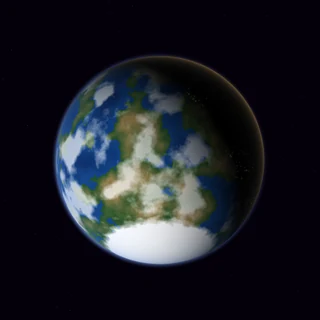
Frequency guide
Listening context
172.06 Hz is the tone that Hans Cousto's cosmic-octave system links to the Platonic Year, sometimes called the Great Year: the very long cycle that describes the slow wobble of Earth's axis against the backdrop of the stars. The pitch sits close to an F in standard tuning, with a clear, open character.
Origin: the astronomy and the octave maths
Cousto's method takes a real astronomical period and doubles its frequency through octaves until it becomes audible. Because the underlying cycle here is so vast, the arithmetic needs an unusually large number of doublings to bring it into the range of hearing.
The Platonic Year refers to the precession of the equinoxes, the slow change in the direction of Earth’s axis. The 172.06 Hz tuning uses a traditional 25,920-year input and 47 octave doublings. The later astronomical estimate of roughly 25,772 years is a different input, not the number used to produce this player’s pitch. Read the precession tuning table.
Tradition and mythology
The Great Year was already discussed by ancient Greek thinkers; the Greek astronomer Hipparchus is usually credited with discovering precession in the second century BCE, and Plato mused on the great cycles of cosmic time, which is how the name attached itself. Many cultures wove the slow turning of the heavens into ideas of ages succeeding one another. Listeners often associate this tone with perspective, patient timescales, and the way a single human life fits inside much longer rhythms.
The scale here is genuinely humbling, and worth sitting with. A full precessional cycle is so long that the entire span of recorded human history, from the first cities to today, fits inside roughly a fifth of one turn. Over the cycle the celestial pole drifts among the stars, so the role of pole star passes from one to another: today it is Polaris, but around 12,000 years ago the bright star Vega marked north, and in time it will again. The constellation rising behind the Sun at the spring equinox also shifts very slowly, which is the origin of talk about astrological ages. Cousto's tone is a way of bringing that almost unimaginable rhythm down to a pitch a person can hear in a single breath.
How listeners use it
- A bright, open quality that feels roomy without being thin.
- A backdrop that suits long-form reflection rather than short focus bursts.
- A companion to slow reading, journaling, or quiet stargazing.
- A spacious feel that some listeners reach for during seasonal transitions.
What the evidence says
NCCIH’s overview concerns music-based interventions. Our inference is that this evidence does not establish a clinical benefit from this isolated 172.06 Hz tone. Personal enjoyment is a listening response, not a clinical measurement. Read the music research and its limits.
How to listen
- Try a session of fifteen to thirty minutes when you want a roomy backdrop.
- Keep the volume low so the tone supports the moment rather than fills it.
- Pair it with writing about long arcs in your life: a year, a decade, a season.
- Use it under quiet reading about astronomy or history, or a slow evening walk if the weather allows.
- Take it off if your attention scatters instead of widening.
172.06 Hz Earth Platonic Year: Cosmic Cycles And Listening Context
For direct playback, use the related frequency page: 172.06 Hz: Earth Platonic Year.
172.06 Hz Earth Platonic Year: cosmic cycles and listening context
This tone belongs to Hans Cousto's cosmic-octave system, which doubles a real astronomical period through octaves until it becomes audible. Here the underlying cycle is the Platonic Year, also called the Great Year, the slow wobble of Earth's axis against the backdrop of the stars. Because the cycle is so vast, the arithmetic needs an unusually large number of doublings to bring it into the range of hearing, producing a clear, open reference near an F in standard tuning.
Where the symbolism comes from
Astronomers know the Platonic Year as the precession of the equinoxes. Like a slowing top, Earth's axis traces a wide circle in the sky, completing a single loop roughly every 25,772 years, which is why the pole star changes over the ages. The Greek astronomer Hipparchus is usually credited with discovering precession, and Plato's musings on great cycles gave the name. Many cultures wove that slow turning into ideas of ages succeeding one another.
The scale is genuinely humbling: the whole span of recorded human history fits inside roughly a fifth of one turn. The tone is a way of bringing that almost unimaginable rhythm down to a pitch you can hear in a single breath. It is a translation of motion into sound, not a sound from the heavens, and listeners associate it with perspective rather than any specific effect.
How listeners use it
- A bright, open quality that feels roomy without being thin.
- A backdrop that suits long-form reflection rather than short focus bursts.
- A companion to slow reading, journaling, or quiet stargazing, especially around seasonal transitions.
Please reach for qualified human support whenever a question in your life calls for more than a quiet listening session can hold. For neighbouring Earth tones, see our 136.10 Hz Earth Year guide.
How to listen
- Try a session of fifteen to thirty minutes when you want a roomy backdrop.
- Keep the volume low so the tone supports the moment rather than fills it.
- Pair it with writing about long arcs in your life: a year, a decade, a season.
- Take it off if your attention scatters instead of widening.
Listen with this
If this tone suits you, these neighbouring references give you something to compare it with.
Sources
NCCIH’s overview concerns music-based interventions. Our inference is that this evidence does not establish a clinical benefit from one isolated listening tone. Personal enjoyment is a listening response, not a clinical measurement. Read the music research and its limits.
Harmonance is for relaxation, reflection, and educational exploration. It is not medical advice and should not replace professional care.
What benefits are claimed for 172.06 Hz?
The traditional associations described above are listening themes, not measured outcomes. NCCIH’s overview concerns music-based interventions. Our inference is that this evidence does not establish a clinical benefit from this isolated 172.06 Hz tone. Personal enjoyment is a listening response, not a clinical measurement. Read the music research and its limits.
What is 172.06 Hz?
172.06 Hz means 172.06 cycles per second. Cousto doubles the traditional 25,920-year precession input of the equinoxes (the Platonic or Great Year) through octaves into this tone; Hipparchus discovered precession and Plato's musings on great cycles gave it its name.
Try the pitch, then notice
Press Play above when you are ready. Start quietly, listen briefly, and use the player’s volume control. Compare the neighbouring tones without judging one as medically superior. Stop if the sound is uncomfortable. Signed-in Studio lets you choose layers and timers; public listening needs no account.