Guide
Plain-language context
Two ideas often travel together in modern sound work: the chakra map borrowed from yogic tradition, and the Solfeggio set of tones reintroduced in the late twentieth century. This guide explains where each comes from and how listeners use them as a reflective framework rather than a fixed system.
Where the chakra map comes from
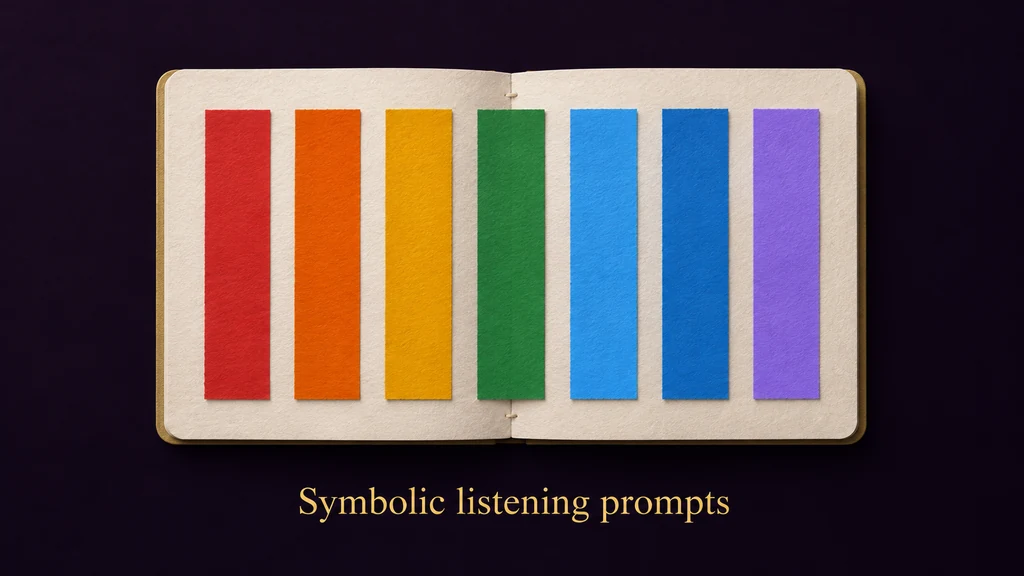
The chakra system is a symbolic map of energy centres along the body, drawn from older South Asian yogic and tantric traditions. Each centre is associated with a colour, a theme and, in many modern readings, a tone. It is a framework for attention and reflection, not a description of anatomy, and you do not need to accept any particular version to find it a useful way to organise a listening practice. For a fuller walk-through, see our guide to chakra sound tuning.
Where the Solfeggio tones come from
The modern Solfeggio set, including pitches such as 396, 528 and 741 Hz, was popularised in the late 1990s through the work of Joseph Puleo and Leonard Horowitz, who paired Latin chant syllables with specific Hertz values. It is honest to note that medieval chant did not use fixed Hertz values; the precise numbers are a contemporary construction told in older language. That history makes the framework rich and evocative, and it is also a reminder to hold it as a modern tradition rather than a recovered ancient artefact.
How listeners pair the two
Many practitioners loosely map Solfeggio tones onto chakra centres, choosing a tone whose theme matches the area they would like to reflect on. Held lightly, this is a pleasant way to give a session a focus.
- Pick one tone and one theme rather than working through the whole set at once.
- Listen at a conversational volume for a short session and notice what shifts.
- Pair the tone with a simple journaling prompt or a slow breath count.
What the evidence says
Research on whether specific Solfeggio pitches produce measurable effects beyond the general relaxation any soothing music can support is very limited, and most sweeping claims outrun what the available evidence shows. The most honest framing holds both the chakra map and the Solfeggio set as symbolic frameworks for attention.
Listen with this
If this piece speaks to you, you might explore these tones gently as part of a wind-down or focus routine: 396 Hz 528 Hz 741 Hz.
Sources
NCCIH’s overview concerns music-based interventions. Our inference is that this evidence does not establish a clinical benefit from one isolated listening tone. Personal enjoyment is a listening response, not a clinical measurement. Read the music research and its limits.
- NCCIH: Music and Health, What You Need To Know
- Solfeggio frequency studies (PubMed)
- Music-based listening reviews (Cochrane Library)
Safety note: Harmonance is for relaxation, reflection, and educational exploration. It is not health advice or a replacement for professional care.
What do chakra balancing and cleansing mean in this tradition?
These terms describe symbolic practices and ways of directing attention. They are not measurements of anatomical structures or a clinical result. The guide explains the tradition without turning it into a promise about the body.
Listen without turning context into a promise
The related tone buttons below are audible listening examples. Press Play deliberately, begin quietly and pause when you want. A traditional name, simulation or whole-music study is not proof of a clinical effect from the displayed pitch.