Guide
Plain-language context
Planetary frequencies translate the steady cycles of celestial bodies into audible tones. This guide explains the mathematics behind the cosmic octave, the symbolism that travels with each planet, and how listeners use these tones for reflective listening.
Where the idea comes from
Hans Cousto developed the cosmic-octave system in 1978 and later explained it in his writing: any recurring motion in nature can be expressed as a tone if it is octave-shifted upward enough times. Applied to the planets, an orbital period becomes a pitch in the human hearing range. The Sun’s 126.22 Hz reference uses a separate theoretical-limit calculation; Jupiter’s orbital reference is 183.58 Hz and Mars’s is 144.72 Hz. Compare the calculations in the source table. It is a creative, mathematically inspired tradition rather than a finding from physics; sound does not travel through the near-vacuum of space, so these tones are translations of motion, not the noise of the planets.
The symbolism each planet carries
Each planetary tone gathers the meanings that older astrologies and mythologies attached to the planet: the Sun with steady warmth and a clear sense of self, Jupiter with breadth and growth, Mars with initiative and momentum. You do not need to accept any astrological reading to find these themes useful as listening cues. For how this connects to zodiac thinking, see astrology and frequencies.
How listeners use them
- Choose a tone whose theme matches the kind of session you want.
- Compare two or three across a week and notice how your response shifts.
- Keep the volume low so the tone fades into the background of reflection or work.
What the evidence says
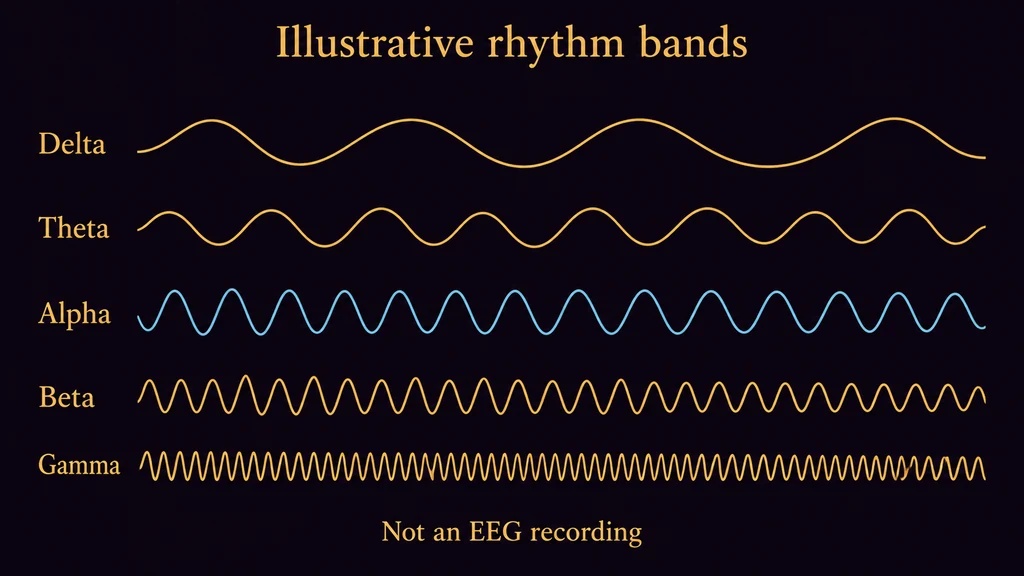
There is no research showing that planetary tones produce planet-specific effects; the system is symbolic and mathematical, not physiological. What evidence exists for slow, sustained tones points to general relaxation responses. Held lightly, the planetary set is a rich and characterful way to organise a listening practice.
Listen with this
If this piece speaks to you, you might explore these tones gently as part of a wind-down or focus routine: 126.22 Hz Sun 183.58 Hz Jupiter 144.72 Hz Mars.
Sources
NCCIH’s overview concerns music-based interventions. Our inference is that this evidence does not establish a clinical benefit from one isolated listening tone. Personal enjoyment is a listening response, not a clinical measurement. Read the music research and its limits.
- NCCIH: Music and Health, What You Need To Know
- Sustained tone and relaxation studies (PubMed)
- Music intervention reviews (Cochrane Library)
Safety note: Harmonance is for relaxation, reflection, and educational exploration. It is not health advice or a replacement for professional care.
Listen without turning context into a promise
The related tone buttons below are audible listening examples. Press Play deliberately, begin quietly and pause when you want. A traditional name, simulation or whole-music study is not proof of a clinical effect from the displayed pitch.