Guide
Plain-language context
Physical vibration makes a pattern in material
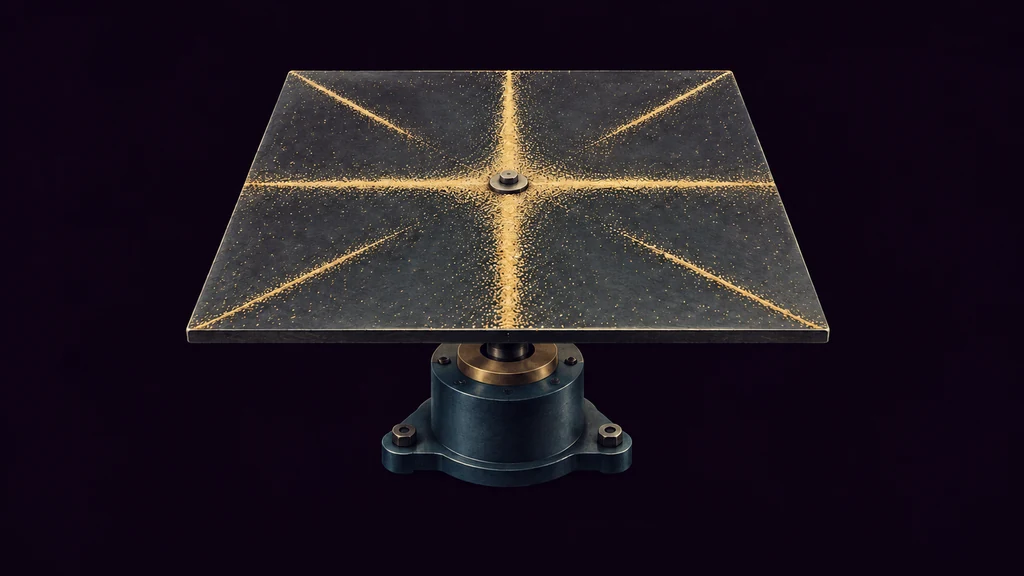
A Chladni plate is a metal plate driven mechanically. Sand moves as the plate vibrates and can gather along nodal lines. The pattern depends on plate dimensions, material, support and the excited mode. It is not a picture of what one number does to a person.
MIT’s Physics of Waves, section 11.5: Chladni plates
The website field is an animation
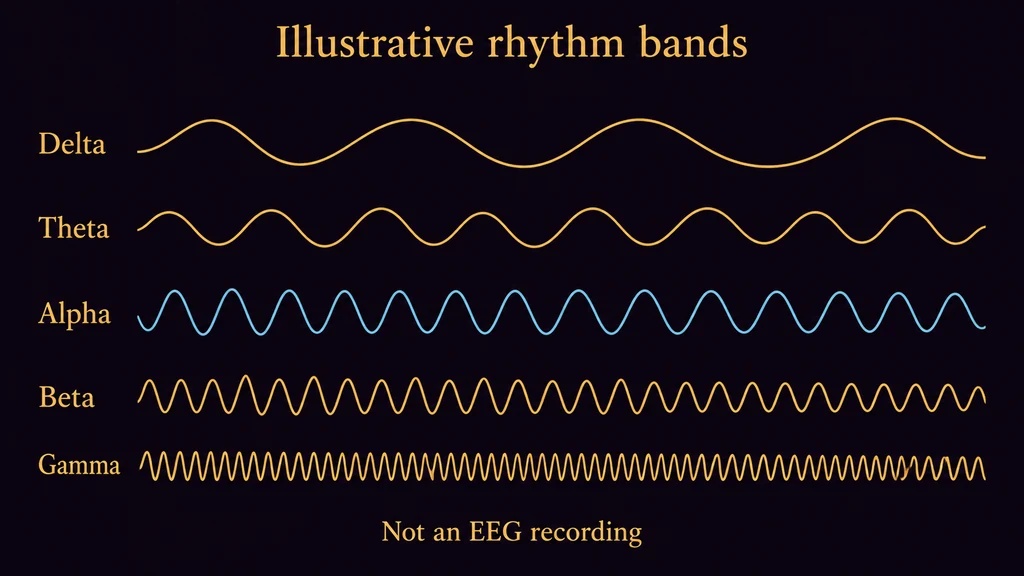
Harmonance’s moving background is a designed visual response to playback. It is not a vibrating plate, a physical sand experiment, an EEG recording or proof of a bodily effect. The accompanying plate image is explicitly a simulated illustration.
A reproducible physical experiment checklist
- Use a purpose-built square metal plate securely mounted on an appropriate mechanical exciter. Record its material, side length, thickness and mounting arrangement.
- Place a small amount of dry sand on the plate and connect the exciter to a suitable signal generator and amplifier. Keep electronics away from liquids.
- Begin with low drive amplitude and change the generator frequency slowly. The apparatus, not the listener’s earphones, must move the plate.
- When a stable pattern forms, record the exact drive frequency, amplitude setting, boundary support and grain distribution. Stop the drive before adjusting the plate or sand.
- Repeat from the same starting conditions, then change one parameter such as support or drive frequency. Record what actually changes rather than assigning a universal pattern to that frequency.
This checklist follows the plate-and-boundary model in the MIT text. A browser speaker alone is not this apparatus. Do not raise playback volume to force grains to move, and do not present the simulated image as an experiment you performed.
Hear a pitch comparison
Use the 432 Hz and 528 Hz play buttons to compare audible pitches at a comfortable level. These previews help distinguish pitch; they do not claim to generate a particular Chladni pattern or a clinical result.