Guide
Plain-language context
A sound bath is a group or solo session in which you lie down comfortably and let waves of sustained sound, usually from gongs, singing bowls, chimes, and the voice, wash over you. Nothing is asked of you but to rest and listen. This beginner-friendly guide covers what happens, the instruments involved, and a few simple safety checks before you begin.
What to expect
You will typically lie on a mat with a blanket and perhaps a cushion under the knees. The facilitator plays long, overlapping tones, letting them rise and fade with plenty of space between sounds. There is no rhythm to follow and no performance to watch; the point is to soften and drift. Sessions usually run between thirty and sixty minutes. Many people feel pleasantly heavy and settled; some drift toward sleep; a few find the louder gong swells too intense, which is entirely normal and worth knowing in advance.
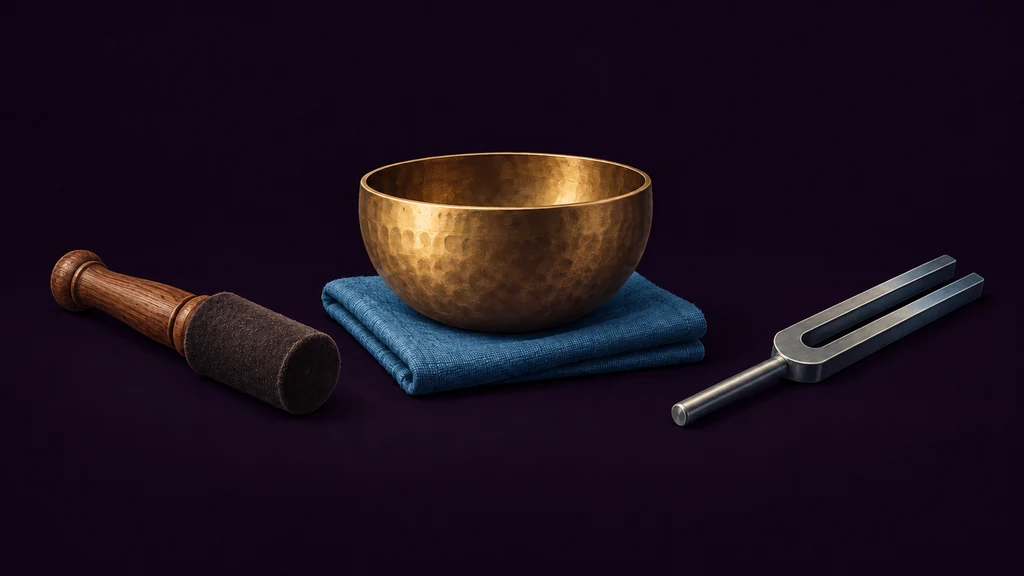
Common instruments
- Singing bowls, metal or crystal, producing sustained ringing tones.
- Gongs, capable of huge, washing swells of sound.
- Chimes and bells, bright, brief accents.
- The voice, humming and toning, which our guide on using the human voice explores further.
How to listen safely
- Sit toward the back or further from the gong if you are sensitive to volume.
- Tell the facilitator if you find loud, sudden sound uncomfortable.
- Keep yourself warm; body temperature drops when you lie still.
- Rise slowly afterwards and drink some water before driving or rushing off.
What the evidence says
Small studies of sound baths and meditative listening report that participants often feel calmer and more relaxed afterwards. The research is early and mixed, with small samples and a strong role for expectation and simply resting quietly. Enjoy it as a restful experience rather than a clinical one.
The roots of the sound bath
Although the modern sound bath is a contemporary format, its ingredients are old. Singing bowls have a long history across the Himalayas, gongs feature in ceremony across Asia, and the use of sustained, enveloping sound to gather a group's attention appears in many traditions. The current popularity owes much to the way a sound bath asks nothing of the participant: no posture to perfect, no technique to master, simply lying down and letting sound move around the room. That low barrier is a real part of its appeal.
After the session
People often feel pleasantly spacious and a little dreamy afterwards. Give yourself a few minutes before standing, sip some water, and avoid rushing straight back into a noisy, demanding task if you can. The settled feeling tends to last longer when you ease out of the session rather than snapping out of it.
Listening notes
Arrive a few minutes early, settle comfortably with a blanket, and position yourself further from the gong if you are sensitive to volume. There is nothing to do but rest and listen; you may drift toward sleep, and that is fine. Afterwards, rise slowly, drink some water, and give yourself a gentle transition rather than rushing straight into a demanding task. If loud, sudden swells of sound feel uncomfortable, say so to the facilitator beforehand, a good one will welcome it.
Listen with this
If this piece sparked your curiosity, a few tones sit naturally alongside it: 174 Hz, 136.10 Hz Earth Year, 432 Hz. Try one softly, in a quiet moment, and notice what shifts for you. There is no need to listen to all of them, and no right order to explore them in; the most rewarding tone is usually the one whose character or story you find yourself returning to.
Sources
A small study of singing-bowl meditation reported improved mood and relaxation. The honest picture is that the evidence is early and mixed, and findings are preliminary and context-specific rather than settled. The cited music overview concerns music-based interventions. That context does not establish a result for one isolated pitch. We share these links so you can read the primary sources and form your own view rather than take any claim, including ours, on trust.
- PubMed, Tibetan singing-bowl meditation and mood (2016)
- NCCIH, Music and health: what you need to know
Listening safely
Whatever you explore here, a few simple habits keep the practice gentle and comfortable. Choose a volume you could easily talk over, give yourself a short, unhurried session rather than a marathon, and sit or lie in a supported, comfortable posture so the body can settle. Let attention rest lightly on the breath or the sound, and step away the moment anything feels grating or unpleasant rather than pushing through. Above all, approach it with curiosity and patience: notice what genuinely settles you, keep that, and let the rest go. This is an educational listening practice, not medical advice or a replacement for professional care.
What happens during a sound bath, and what might I notice?
A typical session involves resting while a practitioner plays instruments such as bowls or gongs. People describe different experiences; a quiet or pleasant session is not a measurement of a clinical result. The preparation and listening notes above explain what to expect.
How does a float sound bath differ from other sessions?
The setting may include flotation, but the practical details vary by provider. Check the venue’s arrangements, support and listening conditions rather than assuming every event offers the same experience.
How can I find a sound bath near me?
Check local venues or practitioners for their session format, accessibility, group size and approach to sound levels. This browser preview is a listening library, not a directory or a live local event listing.
Listen without turning context into a promise
The related tone buttons below are audible listening examples. Press Play deliberately, begin quietly and pause when you want. A traditional name, simulation or whole-music study is not proof of a clinical effect from the displayed pitch.