888 Hz meaning: the angel number, its history and its sound
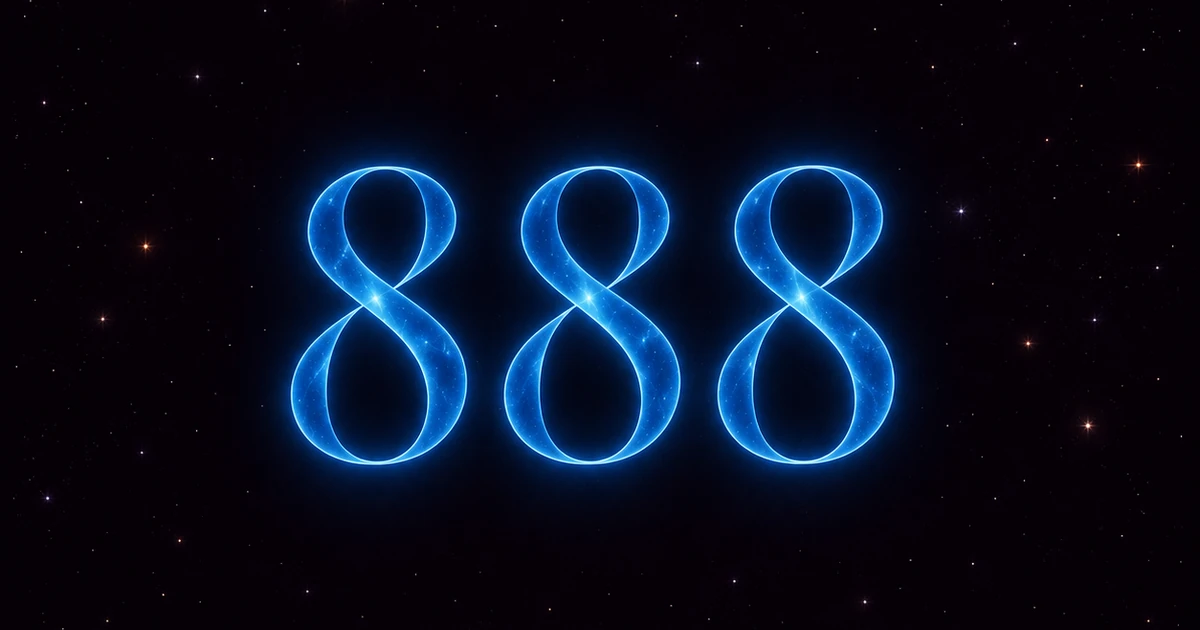
888 Hz is the angel number tone named after 888, and its meaning comes from the number, not the sound. Angel number books read eight as plenty, Chinese tradition counts eight lucky for its sound, and in Greek the letters of the name Jesus add up to 888. As a sound, 888 Hz is an A, three octaves above 111 Hz, and no published study has tested it.
Ready to play Balance And Possibility 888 Hz
Notice what you would like to keep making time for.
Where do angel numbers come from?
From a handful of modern books. The idea that a repeated number is a message from angels was spread by the writer Doreen Virtue: her 1999 book Healing with the Angels has a chapter called Number Sequences from the Angels, with a reading for each run of repeated digits, and her later books Angel Numbers and Angel Numbers 101 gave the practice its name.
Virtue later stepped away from it. After her conversion to Christianity she wrote a post titled Angel Numbers aren't biblical, calling numerology one of the New Age teachings she had "unfortunately passed along to others".
Seeing a number everywhere has a name of its own. The linguist Arnold Zwicky called it the frequency illusion, in a post on Language Log:
once you've noticed a phenomenon, you think it happens a whole lot, even "all the time".
Noticing is still noticing, and a number you keep meeting can be a good moment to pause. What it means is yours to decide.
What does 888 mean as an angel number?
Plenty, by way of the digit eight. Angel Numbers 101 reads 8 as plenty of every kind, its endless loops standing for a flow that never runs out, and 888 is that digit three times over.
The loops have a history of their own. An eight on its side looks like the sign for infinity, ∞, which the mathematician John Wallis first used in 1655, for a curve that could be traced out infinitely many times.
Harmonance offers 888 Hz in a quieter key: as a prompt for balance, continuity and possibility. The symbolism is there to think with, never a promise of anything.
What does eight mean in Chinese tradition?
Good luck, carried by sound. Eight is 八, read bā in Mandarin and baat in Cantonese, close to 發, read fā or faat. Lee Simmons and Robert Schindler set out the link in their study of price endings in Chinese advertising:
The digit 8 in Chinese (ba) is similar in pronunciation to fa, which means "to get rich" or "enrichment," and to fu, which means "lucky."
The belief shows in what people choose. In their sample of advertised prices, 8 was the most common ending, at 39.9 per cent, about four times what chance would give, and they recall that many Chinese entrepreneurs opened new businesses on a date written 8/8/88. In Vancouver, a study of close to 117,000 house sales found that homes with an address ending in 8 sold for 2.5 per cent more than homes with other numbers, and the effect appeared where more Chinese residents lived than average, or in homes sold more than once.
So 888 carries its meaning the way any number does: through the people who hold it.
Why is 888 linked with the name Jesus?
Because in Greek the letters of the name add up to 888. Greek had no separate digits: letters doubled as numbers, and the history of Greek numerals at St Andrews sets out how the first nine letters stood for 1 to 9, the next nine for the tens and the last nine for the hundreds. Spelled in Greek, the name is six letters: iota, eta, sigma, omicron, upsilon, sigma.
| Letter | Name | Roman letter | Number |
|---|---|---|---|
| Ι | iota | i | 10 |
| Η | eta | e | 8 |
| Σ | sigma | s | 200 |
| Ο | omicron | o | 70 |
| Υ | upsilon | u | 400 |
| Σ | sigma | s | 200 |
| Total | 888 | ||
The sum is old. Irenaeus, an early Christian writer, recorded it as the doctrine of a teacher called Marcus, whose number games he wrote to refute in Against Heresies, book one, chapter fifteen:
This is the name of Jesus; for this name, if you reckon up the numerical value of the letters, amounts to eight hundred and eighty-eight.
The same chapter reports a second pattern: the 24 letters of the classical Greek alphabet split into eight units, eight tens and eight hundreds, which Marcus read as 888 once more. The Sibylline Oracles, verse prophecies written in Greek, set the sum as a riddle about the name: "For eight ones, and as many tens on these, / And yet eight hundred will reveal the name".
How does a number become a frequency?
By counting waves. A frequency in hertz is how many times a vibration repeats in one second, and the international system of units defines the hertz as one per second, keeping it for things that repeat. A tone of 888 Hz is air pushed to and fro 888 times a second, each wave lasting a little over a thousandth of a second.
So the 888 belongs to the counting as much as to the sound. The second is a human measure, fixed today by the vibration of a caesium atom: 9,192,631,770 of its cycles make one second. Counted per minute instead, the same tone would be 53,280. An angel number tone takes a number people already care about and reads it as waves per second.
As a note, 888 Hz is an A. ISO 16, the international standard for concert pitch, puts the A in the treble stave at 440 Hz, and doubling that gives the next A up at 880 Hz. 888 Hz sits 8 Hz above it, which the standard cents arithmetic puts at 16 cents, about a sixth of a semitone.
How do 111, 222, 444 and 888 Hz fit together?
They are one note in four octaves. Doubling a frequency raises it by an octave, the step between two notes that share a name, so 111 Hz doubled is 222 Hz, doubled again is 444 Hz and doubled once more is 888 Hz. Each step fits twice as many waves into the same moment.
| Tone | Waves in 27 ms |
|---|---|
| 111 Hz | 3 waves |
| 222 Hz | 6 waves |
| 444 Hz | 12 waves |
| 888 Hz | 24 waves |
The whole angel family is closer than it looks. The nine tones from 111 to 999 Hz are 111 Hz multiplied by one to nine: the first nine harmonics of 111 Hz, the series a string tuned to 111 Hz sounds above its lowest note. 888 Hz is the eighth harmonic, three octaves up. Sounded together, the nine make the overtone chord of a low A: A, C sharp, E, G and B.
| Tone | Above 111 Hz | Nearest note |
|---|---|---|
| 111 Hz | the fundamental | A, 16 cents sharp |
| 222 Hz | one octave | A, 16 cents sharp |
| 333 Hz | an octave and a fifth | E, 18 cents sharp |
| 444 Hz | two octaves | A, 16 cents sharp |
| 555 Hz | two octaves and a major third | C sharp, 2 cents sharp |
| 666 Hz | two octaves and a fifth | E, 18 cents sharp |
| 777 Hz | two octaves and a flat seventh | G, 16 cents flat |
| 888 Hz | three octaves | A, 16 cents sharp |
| 999 Hz | three octaves and a whole tone | B, 20 cents sharp |
Why does 888 Hz sound louder than 111 Hz at the same volume?
Because hearing is more sensitive at 888 Hz than at 111 Hz. ISO 226 maps the levels at which pure tones of different pitch sound equally loud to young listeners with healthy hearing, and on those contours a low tone needs far more sound to match a higher one.
| Tone | Sound level |
|---|---|
| 111 Hz | 61.4 dB |
| 222 Hz | 50.6 dB |
| 444 Hz | 42.5 dB |
| 888 Hz | 38.4 dB |
Twenty-three decibels is about two hundred times the sound power. Played side by side at one level, the four tones would not sound equal. At the level where 888 Hz sounds as loud as a 1,000 Hz tone at 38 dB, 111 Hz sounds only as loud as one at 12 dB: a faint tone.
We checked the arithmetic in sound, not only on paper. Each tone was rendered as a pure sine at the level the contours give and read back through the meter of Harmonance's own sound standard, and all four came back at 38.4 phon. The meter follows the 2003 edition of ISO 226, which has since been revised as the 2023 edition.
What does research say about 888 Hz?
No published study has tested 888 Hz on listeners. Its meaning comes from the number, and nothing in the research singles out this pitch.
Research on listening is about music in general, and much of it is early. The US National Center for Complementary and Integrative Health has looked across that work and puts it plainly:
However, because much of the research on music-based interventions is preliminary, few definite conclusions about their effects have been reached.
Those studies are about music, not a single steady tone, and none of them tells us what 888 Hz does for a person listening at home. What the tone offers is arithmetic anyone can check, a history worth knowing and a sound you can judge for yourself.
How do you listen to 888 Hz?
Press play at a low volume and listen for a few minutes, then stop and notice the quiet afterwards. Keep it low: the same NCCIH page notes that music played too loud can contribute to noise-induced hearing loss. The 888 Hz page plays the full version free, with a strings version beside the pure tone.
To hear the family, play 111 Hz, 222 Hz and 444 Hz one after another, then 888 Hz: the same note climbing three octaves. All nine angel number tones are together in the angel number collection, and Studio lets you layer tones into a longer session of your own.
The guide to angel numbers and their frequencies reads each of the nine numbers in turn. For the wider picture, the science of sound healing sets out what research on sound can and cannot show, and the guide to 432 Hz follows the argument over concert pitch that ISO 16 settled at 440 Hz. If you came with a feeling rather than a number, How do you feel? starts there.
Sources and limits
The meanings of 888 come from books, language and scripture, quoted here as their writers put them. The tone's numbers are arithmetic anyone can redo, and the loudness figures come from the ISO 226 contours as Harmonance's own meter applies them. No study has tested 888 Hz itself, and the research quoted concerns music in general.
- Doreen Virtue, Healing with the Angels: the chapter Number Sequences from the Angels.
- Doreen Virtue, Angel Numbers 101: the reading of the digit 8.
- Doreen Virtue, Angel Numbers aren't biblical: her later view of numerology, as archived.
- Arnold Zwicky, Language Log: the frequency illusion.
- MacTutor, John Wallis: the first use of the infinity sign.
- Unicode Han database, 八 and 發: the Mandarin and Cantonese readings.
- Lee Simmons and Robert Schindler, Cultural Superstitions and the Price Endings Used in Chinese Advertising: why eight is lucky, and the price endings.
- Nicole Fortin, Andrew Hill and Jeff Huang, Superstition in the Housing Market: the Vancouver house sales.
- MacTutor, Greek number systems: letters as numbers.
- Irenaeus, Against Heresies, book one, chapter fifteen: the name Jesus as 888.
- The Sibylline Oracles, translated by Milton Terry: the riddle of the name.
- BIPM, The International System of Units: the hertz and the second.
- ISO 16: the A at 440 Hz.
- UNSW Music Acoustics, note names and frequencies: the cents arithmetic.
- UNSW Music Acoustics, harmonics: the harmonic series.
- ISO 226:2003 and ISO 226:2023: the equal-loudness contours.
- Harmonance, the loudness numbers as a CSV file: each tone's level for equal loudness, its playback level and the measured result.
- NCCIH, Music and health: where the research on listening stands.
Tones to play while you read
Related guides

432 Hz benefits, chakras and the evidence
432 Hz benefits and chakra claims weighed: the tuning history, the chakra framework, and what studies of 432 Hz music have and have not found.
Angel Numbers And Frequencies: Numerology As Listening Prompts
A grounded guide to angel-number symbolism, frequency labels, and reflective listening while keeping spiritual meaning in the realm of personal interpretation.

174 Hz, 417 Hz and 741 Hz played together
174 Hz 417 Hz 741 Hz played together: why the three Solfeggio tones sit smoothly in the ear, where the numbers come from and what has been studied.
Just be curious. This is not a medical device or medical advice. For any health concern, please speak to your doctor.