Guide
Plain-language context
This page restores the useful context from the earlier Harmonance site and rewrites it for the current claim standard. It is offered as listening education, symbolism, and practice background rather than as a promised outcome.
For direct playback, use the related frequency page: 141.27 Hz: Mercury.
141.27 Hz Mercury: communication and listening context
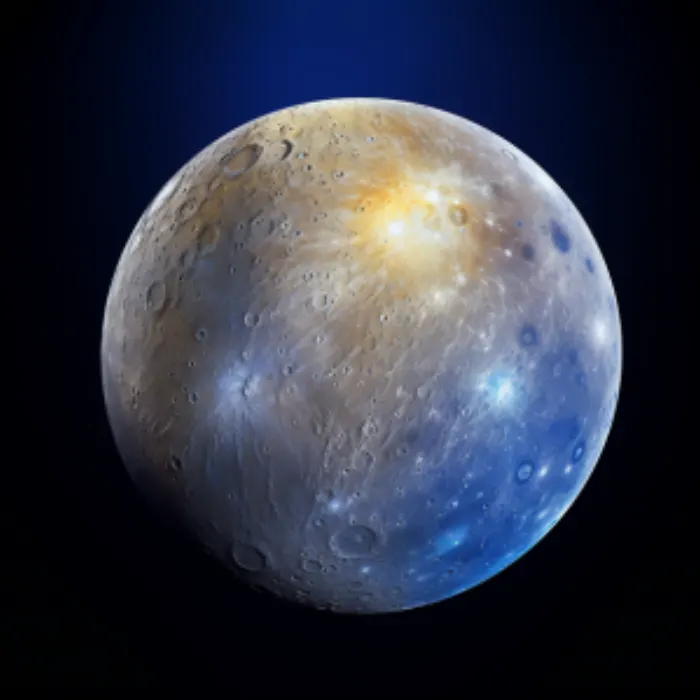
The Mercury tone is part of Hans Cousto's cosmic-octave system, in which a real orbital period is doubled through octaves until it becomes audible. Mercury races around the Sun once every 87.97 days, the fastest orbit in the solar system, and that briskness shows up in the sound: among the planetary tones this one feels nimble and bright rather than weighty.
Where the symbolism comes from
Mercury has carried the same cluster of meanings for a very long time. In Roman myth Mercury was the fleet-footed messenger of the gods, patron of language, trade, and quick wits; in Vedic astrology Budha governs intellect and speech. Western astrology ties the planet to communication and reasoning. The fast little world became, fittingly, the planet of the mind in motion.
As with every cosmic-octave tone, the figure is a translation of orbital motion into something we can hear, not a sound the planet emits, since audible waves cannot cross the near-vacuum of space. The communication symbolism is a frame for attention, not a property of the audio.
How listeners use it
- A clear, slightly forward quality that draws attention to the page or screen.
- A warm-up before drafting a message, a difficult conversation, or a rehearsal.
- A daytime tone rather than a wind-down sound for evening rest.
Many people use it as a small, repeatable cue at the start of focused work. Real fluency still comes from reading widely, writing often, and listening carefully · the tone is one quiet companion to that, not a shortcut. For more on attention and listening, see our overview of binaural beats and brain waves.
How to listen
- Try a short session of five to fifteen minutes before writing or speaking work.
- Keep the volume low and conversational; you should be able to talk over it.
- Pair it with one idea you want to articulate more clearly today.
- Switch it off if the brightness starts to feel buzzy rather than helpful.



%22%2F%3E%3Ccircle%20cx%3D%2296%22%20cy%3D%2296%22%20r%3D%22116.9%22%20fill%3D%22url(%23halo-fa432192)%22%2F%3E%3Ctext%20x%3D%2296%22%20y%3D%2296%22%20font-family%3D%22Fraunces%2C%20'Source%20Serif%20Pro'%2C%20Georgia%2C%20'Times%20New%20Roman'%2C%20serif%22%20font-weight%3D%22600%22%20font-size%3D%2265.28%22%20text-anchor%3D%22middle%22%20dominant-baseline%3D%22central%22%20fill%3D%22url(%23gold-fa432192)%22%20style%3D%22font-variation-settings%3A%26quot%3Bopsz%26quot%3B%20144%22%3E%3Ctspan%3E432%3C%2Ftspan%3E%3Ctspan%20font-size%3D%2220.16%22%20dx%3D%223.84%22%20dy%3D%22-15.36%22%20font-weight%3D%22500%22%20font-style%3D%22italic%22%20fill%3D%22%23FFC842%22%20opacity%3D%220.78%22%3EHz%3C%2Ftspan%3E%3C%2Ftext%3E%3C%2Fsvg%3E)